Tobold's Blog
My Steam 2022 review
Steam sent me a review of my year on that platform. I don't know what the cutoff date for that was, but I did play Against the Storm and Baldur's Gate 3 this month on Steam, and they aren't listed. Also, there seem to be a few mistakes, like Wartales being listed as "First played in 2022", when I already blogged about it in 2021, and got far more hours in it played than the last place in that list suggests.
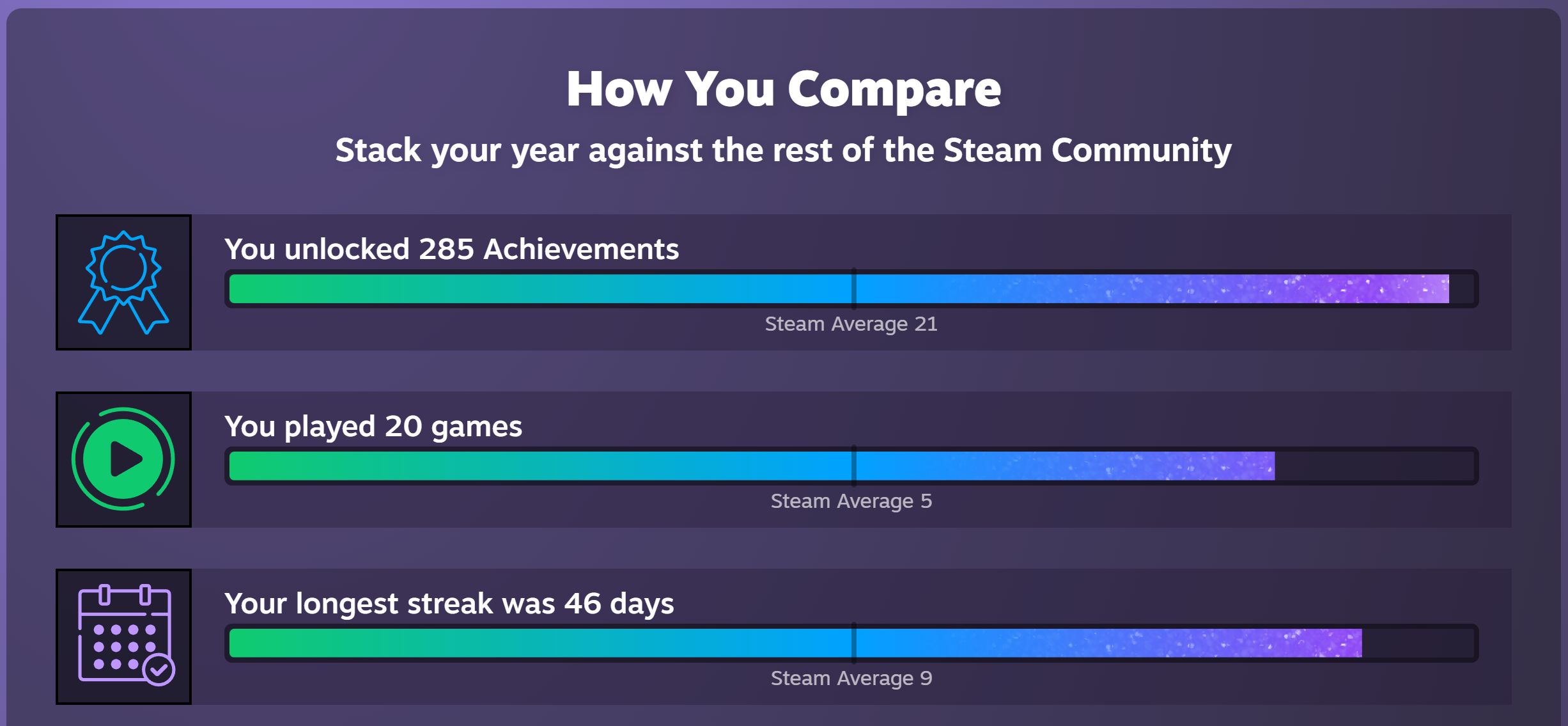
I was also a bit surprised by the comparison between me and the average Steam user:
I unlocked 14 times more achievements than the average player? Wow, I must be a hardcore power gamer! But the biggest shortcoming is that Steam can only count the games I played on Steam. I mentioned in a comment on the previous post that I played 20 hours of Timberborn this year, but that was on Epic. And there were a number more of games either on Epic or on Xbox Game Pass for PC that I played, which Steam couldn't count. Not to mention my Nintendo Switch and my iPad. So the review of a single platform is kinda cute, but very incomplete to paint a full picture of my gaming habits.
Against the Storm
I am normally not the world's biggest fan of roguelike/roguelite games; I find the large loss of progress at the end of each individual run in exchange for a small permanent boost to future runs annoying. However, it turns out that this dislike is mostly about the more typical roguelike games, where you play a character battling monsters. In
Against the Storm each individual run is the construction of a settlement. In that case the reset works a lot better: Settlement builders otherwise have a tendency to get complicated when the settlement becomes very big. And a reset allows for the next settlement to deal with a different environment, with different resources, so there is very good replayability.
Technically, Against the Storm is still in Early Access. But that mostly means that there is an update every two weeks. The game doesn't feel incomplete, and I didn't encounter any bugs. In fact, Against the Storm seems to have fewer bugs than some of the released triple-A games this year. The interaction between the developers and the community is great: Every update comes with a changelog that indicates how many of the changes were suggested by the community, and that is the majority of them. Against the Storm is normally €20 on Steam or Epic, but during the current Winter Sale it is €16. For that money you get a really excellent game, so I didn't even bother to look for key reseller prices.
What I really liked about Against the Storm is that for each run you can choose the difficulty, the biome, and some bonuses. If you are in the mood for a casual, easier game, you can do that. If you want a harder challenge, that is also possible, and it gives you more rewards on the permanent upgrade tech tree. If the highest of 4 difficulty settings isn't hard enough for you, there are 20 prestige difficulty levels beyond that, which unlock by you winning on the previous one. I tend to play city builders more for the casual fun than the challenge, so I am mostly playing on the second difficulty level. The difficulty levels add challenge by accelerating the "impatience" timer, and increasing the "hostility" of the forest. Every run ends if either you collected enough reputation points to win, or the queen's patience run out. You gain reputation points by fulfilling "orders", aka quests, or by increasing the resolve of your population, by fulfilling their needs. There are also events that give reputation points.
In every run, you start on a glade, and you need to chop trees to reach others glades and increase the area on which you can build. Smaller glades you open contain resources. Larger glades can be "dangerous" or "forbidden", which means that you need to deal with an event once you open that glade. Because you don't know what resources you will find on the starting glade and beyond, you can't just build a cookie cutter standard settlement each time. Often some resources aren't available at all, and you need to get them via trading. That keeps successive runs interesting.
Against the Storm has an overwhelmingly positive user review score on Steam, with 96% of reviews being positive. I can only add my recommendation to that. If you like city/settlement/colony builder games in general and want to try something a bit different, this is a fantastic game.
Standardized D&D
According to Wikipedia, there are
over 2,000 variants of chess. If you made a list of all those variants and noted down next to each of them how many people are regularly playing chess that way, the result would probably be not very surprising: A huge number of people will be playing chess by the standard rules, and then each variant is only played by a much smaller number of people. Dungeons & Dragons probably has far more than 2,000 variants, because nearly every table might either have some house rules that differ from the standard rules, or a different focus. I have been a member of a role-playing club for some time and played D&D with many different groups of people, and the result was always somewhat unique.
Computer games tend to have fewer variants. Yes, if the game is more of the "sandbox" variant, people might concentrate on different activities in the game. Somebody doing solo quests in World of Warcraft might have a very different experience of the game than somebody doing raiding. But it would be rather difficult to let's say invent and play a variant of League of Legends, so very few people do that. The computer taking care of all the rules, the user interface, and how the game is played, goes a long way to standardize the game experience. Especially in multi-player games, which tend to have better cheat prevention; a single-player game you can more likely find for example a god mode cheat code that gives you a different experience.
At some point in the not-so-far future, I'd estimate 2025, there will be a game called something like "One D&D Digital". It will be a virtual tabletop version of Dungeons & Dragons, and Hasbro / WotC will push this as the "one" official version of D&D. Presumably there will still be ways to play D&D offline. But if the digital version is any good, it will become the public face of Dungeons & Dragons. If you'll search for a video of people playing D&D on YouTube, you'll see them playing the digital version. Because if you want to have a maximum number of viewers, you'd better play the standard version of the game, not a variant with a lot fewer players. The standardized digital version will be the one with all the sponsorship deals. Plus the digital version will look a lot better than the offline version played with graph paper.
I'm okay with that. I already played a bit of the beta version of Baldur's Gate in multiplayer with my D&D friends, and in a way it *was* a sort of D&D game. I have no problem imagining a future in which such a multiplayer online game is considered the standard version of D&D, and is played by a lot more people than are playing offline around a table. There will be people who will say that playing digitally is not "real D&D", while others will complain about the monetization of digital D&D. But in the end this is the most likely path forward for this game.
Playing grand strategy games as Switzerland
I just finished a game of Victoria 3 as Switzerland. It was an experiment to compare to my previous playthrough of Hearts of Iron 4 as Switzerland. In both games I remained strictly neutral, didn't wage war, and didn't do any territorial expansion. That is not how these games are intended to be played. But it allows me to check the other systems, economic and political, of a game very thoroughly.
The good news is that playing this way in Victoria 3 is considerably more fun than in Hearts of Iron 4. Victoria 3 is mostly an economic game, so concentrating on your economy basically works. However, one can see that nobody playtested the game like that. There are some rather glaring design flaws that become very obvious if you play Switzerland.
The biggest design flaw I encountered as Switzerland in Victoria 3 is how you are limited with what other markets you can trade. Landlocked nations are basically screwed in the game, because without a port you can only trade with your direct neighbors. I couldn't even trade with Bavaria, which is very close to Switzerland, because smaller German states were in the way. And I couldn't trade with Italy either, because Italy for some reason had decided to join a customs union with Russia, and so the game used my distance to Moscow to determine that I couldn't trade with my direct neighbor Italy.
Customs unions in Victoria 3 are extremely powerful and give a huge boost to your economy. But because you can lose a customs union when the other country has political trouble, the reverse is also true: Getting kicked out of a customs union can totally ruin your economy. Which totally messes up the idea of playing the game in a purely economic way.
After having played a both Belgium and Switzerland and ending up bankrupt in both games in the same way, I am now pretty certain that there are bugs or design errors in the way welfare payments are calculated. Basically they are based on your most profitable industries, and set at a far too high level. If unemployed people are getting paid 50% of the highest possible wage even with very conservative social security laws, any downturn quickly turns into a death spiral: You budget is in ruins because of high welfare payments, and you have huge numbers of unemployed people despite also having huge numbers of job openings.
Not a design flaw, but a serious limitation when playing as Switzerland, is that the lack of access to colonies results in you being unable to develop your economy beyond a certain point. The latter stages of the tech tree all require goods like oil and rubber, which are mostly found in the colonies. Also many luxury goods, like coffee, tea, and tobacco are from the colonies.
At least this playthrough I managed my politics much better. Most of my population was loyalist, and I had very few radicals. Which meant that I never had to deal with revolution. But the revolutions of other countries often messed up my trade relations and thus economy. And unlike Hearts of Iron 4, there is no setting where you push the AI to follow historical precedence. In this game the USA became communist, and Germany was formed by Prussia swallowing Austria, but failed to annex a lot of the tiny German states.
I think I'll stop playing Victoria 3 now, until there are a few more patches that fix some of the things that annoy me about the game.
Under-monetized D&D
In a
recent investor call, Wizards of the Coast CEO and president Cynthia Williams said,
“D&D has never been more popular, and we have really great fans and engagement. But the brand is really under monetized.”. Williams mentioned that while dungeon masters comprise roughly 20% of the D&D player base, they make up
“the largest share of our paying players”. An investment in digital, she posits, will allow Wizards of the Coast to
“unlock the type of recurrent spending you see in digital games”.
That didn't go down well with some D&D players, presumably because they consider being under-monetized to be a feature of D&D, not a flaw. I could run a whole D&D campaign for years with a single copy of just the Player's Handbook, with the DM's Guide and Monster Manual being already optional. Hasbro / WotC would rather sell me more books with adventures, more rules, or world settings. But in the current form of the game, even if I bought every single D&D book they release, they still don't sell more than the occasional Player's Handbook to the players, because they don't need all those other books, and some of them would be spoilers for them, so they are discouraged from buying those books. I could even play a campaign of D&D without spending anything at all, just using the free
Systems Reference Document SRD. You can see how this situation is great for players, and a problem for the executives of the company.
So their idea for the future, as told in their
One D&D reveal trailer, is pushing D&D more towards digital. I just received the first "digital/physical bundle" of a D&D campaign book, Dragonlance - Shadow of the Dragon Queen. But the future is "D&D Digital", a full virtual tabletop online service, where WotC can milk players as well as the DM for access fees.
Besides the cost aspect, the other reason D&D players aren't too happy about this is that it will probably lead to a more standardized form of Dungeons & Dragons. If you play on a virtual tabletop, and there is software doing some of the work that a DM usually does, e.g. determining whether your sword attack hits that orc, there will be less room for house rules. I play on a virtual tabletop already, Roll20, and most of the time I just use the already existing material on that platform; it is possible to make orcs different for a campaign of mine, but it involves me manually editing stuff. In the pen & paper form there is a much larger variety of how Dungeons & Dragons is played by different groups. So fans of variants of D&D like
OSR feel somewhat threatened.
Me, I am quite open towards D&D Digital. One thing it should help with is finding other people to play with. Making it easier to run a game for the DM might even solve the
reported DM shortage problem. And if somebody wants to play a heavily house-ruled variant of D&D offline, he can still do so, even if "mainstream" D&D is going digital.
The power of recommendations
I just went on an incognito browser and searched Google for “MMORPG blog”. Yep, I’m still on the first page of search results, although I renamed my blog and stopped blogging about MMORPGs many years ago. And while my site traffic is way down, I still get most of it from search engines, based an a high Google page rank from times past. Now I stopped taking web traffic seriously a long time ago; my blog has always been just a hobby, and never been a serious source of income or influence for me. But in today’s economy, where “influencer” is actually a job many people aspire to, and visibility is extremely important to businesses and politicians, the people who control what content is recommended to us are extremely powerful.
For most cases, whether your content gets recommended and thus promoted on some platform depends on some algorithm. While the algorithms aretop secret, they can to some degree be reverse engineered. Which then leads to the business of SEO, search engine optimization, and its equivalent for video platforms. With some negative consequences for the content itself, e.g. click bait titles. These days a lot of content creators are putting in a lot of effort to get their content ahead in the queue. But the algorithm not only recommends what it thinks people will want to see, it is also optimized to make the most money for the platform. For example the advertising revenue for financial content is orders of magnitude higher than for let’s say games; so if you are showing an equal interest in both, the majority of the recommendations will be about financial content, as the platform makes more money frim you watching that.
The social media platforms are privately owned. And in some cases, somebody within those companies decides to manually override the algorithm. Thus currently a huge discussion about Twitter, because Elon Musk released internal documents, the “Twitter files”, showing how previously Twitter employees interfered with the algorithms to make conservative politicians less visible, or suppress stories deemed hurtful to the progressive causes they believed in. Which then of course begs the question what Twitter will do tomorrow, with a new owner who is a lot more conservative. Should who owns Twitter, or what the political beliefs of the employees are, determine what stories and people you will see on the platform?
In Europe in many countries there are still state TV stations with strict rules on giving equal air time to different political parties. That might seem antiquated, but there are certain advantages: The people of the UK watching BBC News, or Germans all watching Tagesschau, end up all having all heard the same and balanced version of the facts. While people watching politically affiliated news end up getting served different versions of “alternative facts”. Which makes it a lot harder for people from different sides to even talk to each other, because they aren’t even living in the same world with the same truths. The basic idea of social media is to connect people, but we are apparently well in the way where social media goes the same way as US TV, creating only echo chambers. This is all completely legal, as the constitutional provision for “free speech” only applies to the government, not private companies. But I feel that it just hurts everybody in the end, and further propels the culture wars towards political violence.
Victoria 3 - Second Impressions
I have finished my first game of Victoria 3, playing through a whole century from 1836 to 1936 as Belgium. Following the "Learn the game" objectives, I ended up doing colonization, despite not really wanting to. I also annexed Luxemburg and the Netherlands. In the early 20th century I rose to the top prestige rank, but I ended up at rank 8 in the world. The problem was internal strife, leading to revolutions, which then wrecked my economy. As far as I hear that happens to a lot of people. My country also progressed a maximum towards a modern democratic and multicultural state with its laws, resisting both communism and fascism.
Overall, I had a lot of fun, and spent over 40 hours playing Victoria 3 for just one complete game. And I can see myself playing some more. Victoria 3 is principally an economic simulation, and I do like economic simulation. The fact that this involves a lot of micromanagement is okay with me, but is admittedly not for everybody.
Having said that, the economic user interface isn't perfect. Information is sometimes very hard to find, being hidden somewhere, or not available at all. But the domestic political user interface is a lot worse. You'll see some numbers like x% of turmoil in one of your states, but it is very hard to find out what is behind it. And often impossible to fix, getting you into a situation where all options lead to a revolution. That has to do with the fact that you are a "shadow ruler", you don't play the head of government or state. And by introducing progressive laws, you diminish the power that you have to control the country; for example the introduction of Free Speech makes it impossible for you to bolster or suppress certain political groups. Any economic downturn ends up radicalizing your population, which quickly ends up in a death spiral to revolution. And that is not just your country, but pretty much everywhere. You constantly get bombarded with diplomatic events where "revolutionary X" split away from country X and they are now fighting each other. In the process that tends to mess up your trade with country X, which is annoying. And if you have a revolution yourself, weird stuff happens with your economy, where you simultaneously have lots of unemployed people and lots of open jobs, without the two getting together, even if it they are the type of worker that you would need.
I researched everything in all three tech trees. That turned out to be a lot less advantageous than I would have thought. In Victoria 3 it is very hard to be ahead of the technological curve, because you rely on some things getting imported. In my game the world market for oil even in 1936 wasn't big enough for me to enable switching from coal to oil, which made the invention of things like plastics, automobiles, or tanks not very useful. My conquest of the Netherlands was mostly motivated by Friesland having some oil, which I needed very much.
The reason why countries are likely to get into an economic death spiral is that the game simply doesn't have the possibility to reduce certain things that cost a lot of money or tools to reduce political tension. You can't reduce the size of your standing army, for example, which is why conscription is the much better option. And the bigger your economy gets, the more fragile it becomes. The first revolution I had, where either enacting or not enacting a certain law led to a revolution, got me from having maximum financial reserves to being in default. Despite me having a huge investment pool stored up, default meant that I couldn't build anything anymore. So in the last phase of the game I simply didn't have any good plays, neither economically nor politically, and could just watch my downfall.
I think that in an echo of my Hearts of Iron IV game, I will try to play a full game of Victoria 3 as neutral Switzerland next, without colonies or warfare. The colonization and warfare systems aren't much fun anyway, and I would like to see whether I can have a stable economy and politics throughout a whole century.
Victoria 3 - First Impressions
After some deliberation I finally went and bought Victoria 3, despite the mixed user reviews. One thing that really made me want to play this was when I discovered that Belgium is among the 4 nations proposed to play through the "Learn the game" objective. So I am now on my first game, a few years in, and I am having fun. But I can see why there would be a lot of people who won't like this game.
One problem, presumably more relevant for the US market, is the ongoing culture wars, where Victoria 3 manages to make both sides angry. In a game where you start in the year 1836 and can play as the USA or a major European power, slavery and colonialism are represented. Some people consider that it is inacceptable that a game lets you "play" with slavery. Others consider it an affront when the player of the USA can abolish slavery 20 years early without even starting the Civil War. And that is just the start of it, Victoria 3 also has child labor, voting rights for rich white men only, absolute monarchies, capitalist and colonialist exploitation, and everything else that somebody "woke" would be upset about. The game is basically one big trigger warning. Meanwhile the history buffs are upset that in order to placate the progressive people, the game is making progressive politics a bit too easy and understates the opposition. This is a game that is realistic enough to state that the world in the 19th century wasn't a very nice place by 2022 standards, and not realistic enough to play through that century with anything resembling historical accuracy, even if you as a player stick to the historical script.
The other big problem of Victoria 3 is its gameplay focus. It has to be said that different Paradox grand strategy games have a certain overlap of scope, but with different focus points. I just played Hearts of Iron IV a bit, which is mostly focused on warfare, and only covers research, politics, and economics in as far as they serve the war. Crusader Kings 3 focuses on dynasties, does war reasonably well, but totally sucks as an economic simulation. Victoria 3 is mostly an economic simulator, has a reasonable strong domestic politics part, but the warfare aspect is rather bad. You have very little control, armies can "teleport" without bothering with logistics, and strange AI behavior can make the outcome of a war rather unpredictable. Victoria 3 is a grand strategy game with a deficit in military strategy, which is obviously what many people are interested in.
So, what do you actually do when "playing" Victoria 3? Well, mainly it is an economic simulation. You have different population groups, which consume different goods, albeit with a lot of overlap. There are artificial limits, you never "run out" of any good; famine only exists in the game as an "event", not something that happens if you don't produce enough food. Instead, if you don't produce enough grain or clothes or furniture, the price of these goods goes up, with a cap of +75% over base price, and the people who consume these goods get unhappy. But if you produce far too much of something, prices go down too much, and your production building become unprofitable, unable to pay their workers much, and those workers will become unhappy too. Thus Victoria 3 is a constant exercise of trying to keep the price of everything balanced. And there is a huge number of different goods. This requires a lot of micro-management, up to the point where you decide for each of your provinces whether one type of farm concentrates on producing grain, fruit, or wine, and might want to review that decision in response to market changes. Fun for me, but certainly not for everybody.
The downside of you playing the economy more than anything else is that the goods tree and research tree is the same for every nation, so that gameplay can feel a bit sameish, regardless which nation you chose. The Spiffing Brit, a YouTuber who likes to "break" games,
made a video of turning a tiny rock of an island into a global powerhouse in Victoria 3. And if you watch this and then play any other nation, you are still going to go through a lot of the same steps; industrialization just always goes through iron, coal, steel, and tools.
In my game I am not very happy with the research tree. A first technology was already under research when I started the game, so I thought that one would be useful and left it running. But it turned out that the Water-Tube Boiler is actually a useless technology for Belgium (and a lot of other countries at that point in time). The technology allows you to run your factories and mines with fewer workers, but doesn't increase production. But if you have a large population, and a lot of them are peasants working in subsistence farming, you would want them to work as laborers in factories to increase their standard of living. A worker-reducing automation technology is only useful if you have a much larger economy where those fired laborers can go and get better jobs, instead of going back to subsistence farming.
I am still in the "learning the game" phase, because Victoria 3 is a highly complicated game. My version of Belgium will avoid colonizing the Congo; not only because by today's standards that colonization is today considered a mistake, but also because I don't want to play the sucky warfare system. I am not sure how much replay value Victoria 3 has, but I am certain that it will take a good number of hours until I have explored the various economic and political systems of the game. That is okay for me, but I understand why the game has a 4.7 user review score on Metacritic. It is too complicated for the average player, not accurate enough for the hardcore Paradox grand strategy fan, and politically contentious.
Going Grey
If you read any blog post of mine over the last 20 years that was talking about me playing a game, I almost always bought that game. There is only a tiny number of games that I, as an early version of "influencer" :), got a free review copy of; and in all of those cases I disclosed that fact. I played games which I didn't so much individually buy, but got as a part of a Humble Bundle or XBox Game Pass for PC subscription. But I don't think I ever pirated a game. Piracy seems to get a lot less media attention these days, but I guess it is still around. I was never a fan. And fortunately I had a good job, and could afford to buy the games I wanted to play, thus supporting the developers.
Now with retirement my financial situation has changed. For the large majority of people, retirement monthly income is significantly lower than work monthly income. The idea is to build up some retirement savings while you work, and draw them down during retirement. Exact planning of that is absolutely impossible, because you don't even know how long your retirement will last. If you compare the average retirement age with the average life expectancy, you get an average retirement of around 2 decades. But in reality that is plus or minus 100%, you could die just after retiring, or you could live to get 100 years old. You also don't know how you savings investment portfolio will perform over time, nor whether your financial needs will suddenly go up due to increased health care needs. The sensible thing to do after starting retirement is to review your spending habits, and to cut cost where possible, as you don't know how long your money will need to last, even if you have a decent amount of savings.
But as I still dislike piracy, I am going for a compromise: I will reduce my game spending by using sites like
GG, and buy grey market game keys instead of giving my money to Steam directly. I did some research, and it turns out that game key resellers aren't any more dodgy than other reselling services, like Amazon Marketplace, or eBay. Which is to say that you still need to be careful if you see an offer that seems too good to be true, but a large percentage of resales is actually legit. Thus the "grey" in grey market, it isn't a "black" market. There is a risk of buying something that has been bought with a stolen credit card, but that risk exists in various reseller markets.
In many cases, a grey market key comes from the game company itself having tried to optimize sales by
selling the same software to different people at different prices. Thus in a way, me thinking of myself as having a lower income and buying that software at a lower price is working as intended. Even the fact that the origin of grey market keys is often obscure is working as intended, as it minimizes
consumer surplus. Game companies don't want you to know that they are selling their game to other people for less money. I still believe that game developers need to eat and pay rent. Which would probably prompt me to pay full Steam price for a game like Dwarf Fortress, where I think that my money actually goes to a developer, and not to a big company. But indie developers don't usually try complicated pricing to market strategies, so indie games aren't as heavily discounted on key reseller sites.
So, since Planetfall and Disciples: Liberation, if you read me writing about a game on this blog in the future, you can assume that I bought it via a grey market key reseller. Unless I mention that you can get the game as part of a subscription, of course.
Disciples: Liberation
In a comment to a recent post of mine, a reader mentioned Disciples: Liberation as a game that doesn't have the problem that you can't lose units in a battle if you want to be successful in the campaign. So I checked the game out, and found that this is true. If my "level 20 soldier" dies in battle, I can replace him with an identical level 20 soldier at a relatively low cost. So if I win a battle with heavy losses, it is usually worth replacing the lost troops instead of reloading and trying again. Well done!
Having said that, Disciples: Liberation is a bit of a weird game. It tries to do things differently than other, similar games, and not all of those new ideas are actually good. For example the game is currently running in the background while I write this. The reason for that is that you get resources in real time, but only when the game is running. It is a strange design choice somewhere half between a mobile idle game and normal PC games, where you have to do stuff to get resources. There are also a lot of inconsistencies in the UI design, so things rarely work as you think they would. And the text-only soft porn dialogue isn't really my thing. But overall the game is okay.
I wouldn't really recommend Disciples: Liberation at the full $40 price tag on Steam. But if you can get the game for cheaper, it is a decent tactical RPG type of game. The strong point is probably the large number of different troops in the game, which can be both recruited by you, or encountered as enemies. I've had hours of fun, but sadly can't tell you how many hours, because Steam is counting all the hours the game is idling in the background as play time.
Playing unplayable games
There are so many games around that it is impossible to play them all, or even just to research each of them in more depth. So we all need to take some shortcuts, where we see a game and more or less instinctively react with "oh, this looks interesting" or not. And there are games where I instinctively react with "oh, that one is unplayable for me". Unplayable in the sense that I don't feel I would ever do reasonably well when playing the game as intended, and that I wouldn't enjoy the experience.
Of course that also poses a challenge. What is it that makes a certain game for me unplayable? Would there be a way to work around it? Earlier this year
I played Elden Ring, a game that would normally be unplayable for me, by using cheat codes. The reason I wouldn't be able to play this as intended is my reaction speed, and the cheats enabled me to play Elden Ring for 40 hours and have a much better idea what that game is about.
Earlier this week I stumbled over another unplayable game in my Steam library. Hearts of Iron IV, a game I received as part of a Humble Bundle, but would otherwise never have bought. I also have access to it via my Xbox Game Pass for PC subscription. Now this clearly posed a different sort of challenge than Elden Ring, because it isn't my reaction time that keeps me from playing. Hearts of Iron IV is one of those overly complicated Paradox games with extremely bad tutorials, which simply feels overwhelming to the average player. So I tried to find a way around that.
It didn't start well. I played the tutorial, and failed. The tutorial has you playing Italy, with your main task being winning the war against Ethiopia, and following the instructions I just lost. Then I found a video on YouTube with a tutorial to the tutorial, telling me the things that I needed to know to win the tutorial, which the tutorial doesn't tell you. Only Paradox can make games which prompts Youtubers to make videos that explain the tutorial to you.
At least this got me to the point where I understood what part of Hearts of Iron IV was unplayable for me: Combat. Basically the outcome of battles is determined by a bazillion of different factors, and a lot of them are either unknown to the player, or there is so little feedback from the game that you just don't understand why an attack is successful or not. For example in the tutorial you need to make a battleplan and then *not* execute it for some time (despite the tutorial telling you to), which causes your troops to prepare for that plan, and then execute it better. So I decided to try out Hearts of Iron IV without battles.
The game I played was with a neutral, democratic Switzerland. I "won" the most basic victory condition, being still alive at the end of the game, which ended with the German Reich winning WWII in 1957. As I was playing vanilla, with no DLC, Switzerland had the boring default focus tree, which I completed rather early. I also completed the complete research tech tree. It turned out that having nukes doesn't help you at all in Hearts of Iron IV, unless you are actually at war, have air superiority somewhere, and can drop those nukes. And even then they seem to be underwhelming, compared to the historical role they played in ending the war in Japan.
I now understand the focus tree, tech tree, economic and political aspects of Hearts of Iron IV much better. So theoretically I would now have an easier time playing an actual game as intended, getting involved in the war. I just still don't want to. In Elden Ring, trivializing combat meant I could explore the world and the story, and there was something there. In Hearts of Iron IV, there isn't. The whole economic, political, and research part of the game is very thin, and clearly just there to support the combat part. Understanding the non-combat part doesn't actually solve the problem of the game not giving you enough feedback in combat to understand what is actually going on. And without the DLCs there isn't much point in playing anything but a major power, because only those have interesting focus trees. And you are pushed to more or less follow actual historical events, because there are systems in place that would make it very difficult for a player to make the German Reich democratic, or have the USA enter the war much earlier. Yes, if you know the game well enough and have the DLCs, you can make
fascist Switzerland conquer Europe. But what would be the point in that?
Removing the trigger
I have been posting here more than once about how the woke thought-police has attacked Dungeons & Dragons for "racial discrimination" against orcs. I didn't agree that the solution should be to remove negative racial stat modifiers, as I think that makes character creation less interesting. No real orcs are harmed when a game gives them a -1 INT modifier, due to the fact that orcs don't exist.
Finally at WotC somebody had the right idea: Orcs weren't the problem. Nobody cares about orcs. The problem was the word "race", because the snowflakes get triggered whenever they hear the word "race". So they came up with a more brilliant plan, which doesn't diminish the game:
They simply replaced the word "race" in D&D with "species". Nobody gets triggered anymore, and we can keep playing D&D without persecution.
Pyrrhic victories
In 279 BC, after having won the Battle of Asculum against the Romans, King Pyrrhus of Epirus is reported to have said some version of "another victory like this, and we will be ruined!". Thus the term
pyrrhic victory for a victory that comes with great losses. And unfortunately this is a concept that diminishes my fun in a lot of strategy / tactics game that I am playing, most recently Planetfall, but also classics like the Heroes of Might & Magic series.
In many of these games the surviving army of one battle is what you have as an army for the next battle. You get some reinforcements, and the survivors might gain some sort of experience and levels. But with reinforcements coming slowly, and veterans being hard to replace with fresh troops, and major loss of troops can be catastrophic for the rest of the campaign. The extreme case of that is tactical role-playing games, where you will want to never lose a single character. Thus you will want to engage *only* in fights that you are not only certain to win, but certain to win without any significant losses.
The game design problem of that is that roflstomping all enemies isn't as much fun as pitched battles. In D&D it is said that the art of DMing has a lot to do with making battles *seem* dangerous, without them actually being so. An AI you fight against in a computer game is usually less skilled at that sort of deception. So most of the battles I fought in Planetfall had me losing not a single unit, because I wouldn't engage if that was not the case. I only accepted losses for things like the final fight to eliminate a computer opponent, when ending a war was a big enough win to allow for losing some units.
The problem is a design where wins and losses snowball over the length of the campaign. I usually take perks for my Planetfall heroes that give them a better army at the start. Better starting troops means you can eliminate marauders from various resources and landmarks around your cities, which means faster expansion, which ends up with you getting access to more and better troops earlier. If you "won" your first battle while losing lots of units, your expansion would be seriously hampered by you having to replenish those troops.
Having said that, Planetfall is not the worst offender, because you start with tier I and II troops, and over the course of the game you get access to tier III and IV troops, which will be better than even veteran tier I troops. At a certain point in the game you can swarm the enemy with cheap troops and don't mind the losses. But 4X games in general certainly have a good start / bad start problem, where the effect of good or bad luck in the early stages of the game determines a lot of the outcome of the latter game.
Newer› ‹Older