www.Tobold.com
Tobold@GMail.com
A blog with my thoughts regarding games I am playing and other stuff in life. Please read my Terms of Service
RSS Feed
Archives
• PrUn Alternative Start - Metallurgist
• PrUn Log - Stardate 2022-05-30
• PrUn Alternative Start - Fuel Engineer
• Old World
• Timberborn
• PrUn Log - Stardate 2022-05-26
• Prosperous Universe Giveaway
• Shared responsibility
• PrUn Log - Stardate 2022-05-21
• All models are wrong
• PrUn Log - Stardate 2022-05-16
• Board game bloat
• PrUn Log - Stardate 2022-05-13
• PrUn alternative start - Constructor
• So I quit my day job ...
• Blockchain gaming
• PrUn alternative start - The weirder options
• PrUn Log - Stardate 2022-05-07
• PrUn alternative start - Carbon Farmer
• First Day Start in Prosperous Universe
• PrUn Log - Stardate 2022-05-03
• PrUn Log - Stardate 2022-05-02
• The Twitterocalypse

• PrUn Alternative Start - Metallurgist
• PrUn Log - Stardate 2022-05-30
• PrUn Alternative Start - Fuel Engineer
• Old World
• Timberborn
• PrUn Log - Stardate 2022-05-26
• Prosperous Universe Giveaway
• Shared responsibility
• PrUn Log - Stardate 2022-05-21
• All models are wrong
• PrUn Log - Stardate 2022-05-16
• Board game bloat
• PrUn Log - Stardate 2022-05-13
• PrUn alternative start - Constructor
• So I quit my day job ...
• Blockchain gaming
• PrUn alternative start - The weirder options
• PrUn Log - Stardate 2022-05-07
• PrUn alternative start - Carbon Farmer
• First Day Start in Prosperous Universe
• PrUn Log - Stardate 2022-05-03
• PrUn Log - Stardate 2022-05-02
• The Twitterocalypse
Tobold's Blog
Tuesday, May 31, 2022
PrUn Alternative Start - Metallurgist
Thanks to a friendly account reset by the developer, I was able to try and blog about yet another Prosperous Universe starting package: The metallurgist. This profession extracts ores and then smelts them (usually with carbon and oxygen) to make metals. The starting planets either have iron ore or aluminum ore, so there is a decision to make. One good choice, shown as 5 stars (great) in the Company Creation Assistant is Deimos in the Antares system. Decent concentrations of both aluminum ore and oxygen, and not too far away from the Antares commodity exchange. Only that in the "square" of the 4 main commodity exchanges, Antares is the opposite corner from the most populous region of this universe, Moria.
In Moria, another 5-star option is proposed, Vallis. Less oxygen here, but good iron ore concentration, and right next to Moria station. However, the online handbook recommends Montem. Which is a bit weird, as the Company Creation Assistant only gives Montem 4 stars, and the iron ore concentration is much lower. So, which advice do we follow? Now Montem is one of the most popular planets in this universe, and it has a good concentration of limestone. So instead of choosing the more conventional option of Vallis, I decided to go for a variation and chose Montem. Because I messed up my start as a constructor, starting as metallurgist on Montem is actually a opportunity to do both. My previous attempt had taught me that limestone is an important limitation of starting as a constructor, and with the other material needed being iron, that obviously combines well with metallurgist.
So I started on Montem with the recommended set of buildings: 2 pioneer habitations, an extractor, and a smelter. And then I immediately went off script, and started extracting limestone, rather than iron ore. Montem really is bad for extracting iron ore, and it is cheaply available in large quantities at Moria station. I set the smelter to make iron, however there are two possible recipes, and I am missing the flux for the more profitable one. Time to do some shopping.
With the building materials for extractor and smelter, the metallurgist starting package has somewhat fewer prefabs than other packages. That is compensated by a bigger pile of cash, 45k to start with. Which is great news: Even with buying the iron ore instead of extracting it, and buying basic and luxury consumables for a week, and buying the carbon, oxygen, and flux for the smelter, I still have plenty of cash. So I can buy the building materials (76 MCG, 3 BBH, 3 BDE, 4 BSE) for a prefab plant immediately. And my base even has room for the pioneers that prefab plant needs, so it just takes one trip to Moria station and back before I am in both the metallurgist and the constructor business. That is some quite decent profit, even in the Moria system, where there are a lot of other metallurgists and constructors.
Labels: PrUn
- posted by Tobold @ 6:30 AM Permanent Link (3) comments


Monday, May 30, 2022
PrUn Log - Stardate 2022-05-30
The development of my base on Verdant is accelerating. That has to do with the curious economy of Prosperous Universe: While there is a large section of the tech tree that needs higher level workers, there isn't a whole lot of trade in those higher level goods. A lot of that activity is invisible, private deals between members of the same corporation working together. So when I looked into what buildings that needed the next level of worker, settlers, would fit with my current food processing business, and were profitable, I came up empty. Yes, you can construct a hydroponic farm to grow coffee beans and turn those into coffee, there just isn't much money in that. So I just bought a bunch of coffee beans and went for more pioneer level buildings instead.
With every building I add, my daily profit grows. But the next building still costs about the same, so I can expand faster and faster. So I made a plan for a whole set of buildings, which will culminate into me branching into another business: Carbon farming. I am now up to my 5th water rig, and my 6th pioneer habitation. Next I want to build my third farm, followed by my first incinerator. The incinerator will turn a mix of plants from my farm into carbon.
Why carbon? Because I was thinking about my second base, and I might go into the metallurgist business with that. I am already producing oxygen on Verdant, and to make iron you need that, plus carbon, plus iron ore. And there is a planet with a good concentration of iron ore close to Verdant. So those two would integrate with each other really well, as Verdant is also consuming iron to make prefabs.
I also added one more new building to Verdant, a storage facility. The 1,500 tons/m3 of base storage were getting a bit cramped, and one storage facility adds 5,000 more tons/m3 to that. So right now I occupy 280 out of the 500 area on Verdant. I have 500 pioneers working, with living space for a hundred more available, which will be enough for the coming farm and incinerator. At today's prices my net profit per day is 14k. The plan is to grow that some more, until I approach the 500 area on Verdant. And then instead of using a permit to grow Verdant by 250 more area, I'd rather use it for that second base, which will have 500 area. That will need some saving up, I have to consider over 150k for a second base.
Labels: PrUn
- posted by Tobold @ 8:29 AM Permanent Link (1) comments
Sunday, May 29, 2022
PrUn Alternative Start - Fuel Engineer
Since my original First Day Starter Guide for Prosperous Universe, the company creation assistant has changed. While some information about the starting package is now less visible, other elements have improved: The screen to enter your company name and company code is now showing much better whether your chosen name and code are valid and available; and the screen to choose your starting planet now shows a rating how suitable that planet is for the chosen profession:


Luxury consumables isn't the only thing we need to buy. There is in fact a long list. We only have basic consumables for 7 days, which isn't very long. And even worse, we have input materials for our refinery for less than 3 days, if we make both slower-than-light and faster-than-light fuel. The only material we have enough of, because we can produce it with our extractor, is galerite rock. We need more hydrogen, helium-3 isotope, and ammonia. At some point we could build a collector to gather the ammonia ourselves, but the concentration is somewhat low, so that would be not very profitable.
On the plus side, we already have some fuel we could sell, and we have 35k CIS currency. We could also consider selling some of the fuel in the tanks of our two ships. This is a bit of a high-risk strategy for other professions, selling your starting fuel to get more cash early on. But as we are already producing fuel, the risk for us is somewhat lesser. However, my recommendation would be to fly to Benten Station empty, and just spend those 35k of local currency. Because, unsurprisingly with the only fuel starting planet in the system, fuel is rather cheap in Benten, and selling our fuel there isn't very profitable.
Time to work on an alternative strategy: I buy consumables and input materials in Benten for about 2 weeks of production for my 35k, without selling any fuel. And I will use the fact that I can fly around with fuel at the lowest possible cost to increase my profit and make some extra cash. Now this is where I would say that Fuel Engineer is the only starting package where a PRO license for 8 Euro per month, at least paid once, would be of a bigger advantage than for the other starting packages. Because the PRO license, or the BASIC license you get when it expires, allows you to pick up shipping contracts. Using an external site to find the most valuable shipping contracts, we can send our second ship to work for somebody else, while our first ship goes shopping on Benten. The PRO license also allows to use the currency exchange, which might come in handy if we decide to sell our fuel in another commodity exchange than Benten, or get paid in foreign currency for our shipping contracts.
So this will be the strategy for the first week or so: Keep our base supplied with consumables and input materials, produce fuel, and use our ships for shipping contracts when something profitable pops up. Once we have produced a good amount of fuel, we will ship it to a commodity exchange other than Benten. Even with cheap fuel we wouldn't want to make that trip too often, so better to let production accumulate for a while. Once we made about another 35k profit that way, we can build our first additional building, a barracks (HBB) that offers room for 75 pioneers and 75 settlers, and we can buy the consumables our settlers need. That will boost the efficiency of our refinery and make it run at 100%.
Labels: PrUn
- posted by Tobold @ 2:42 PM Permanent Link (0) comments
Saturday, May 28, 2022
Old World
*Disclaimer* I received a Steam key for this from the developer.
There is a theory from the 16th century, based on the works of Aristotle, that a theater play should have three unities: Unity of action, time, and place. In other words, a play gets better if concentrates on fewer different actions, a shorter time span, and fewer locations. I had to think of that when looking at Old World, because that game at least implements this idea for time and place: Old World covers a much shorter time and smaller geographic area than Civilization. Gone are the games where Ghandi with his tanks rolls over American phalanxes. Old World covers history only from the first cultures to Roman times, basically bronze and iron age. And thus the map isn't global, but Mediterranean and Middle east. And honestly, I do think that makes the game better.
Personally, in this kind of games, I tend to like the earlier part more than the end game. The part where you don't have too many units to move every turn, and too many cities to micro-manage. Apparently the devs of Old World felt the same, and changed some important features of the game to prevent that end game bloat Civilization is suffering from. First of all is the order system: You have a limited number of orders to give every turn, which is independent from the number of units you have. If you have 10 military units that you would want to move once and then attack, you need 20 orders. If you have only 20 orders, but 30 military units, you still won't be able to do more. However, if you have few units, you might be able to give them several movement orders, and advance a smaller group of units very far over the map, which has huge implications on warfare.
The second big change is that you can't build cities wherever you like, but only on specific "city sites". That prevents some of the cheesy strategies that pack cities as densely as possible. It also turns barbarians and tribes into something far more important, because they tend to sit on those city sites that you would need to build more cities. Furthermore it solves another eternal Civilization problem, leading to more balanced random starting positions, and thus less need to restart X times until you got a good start.
The big addition to the genre is the character-driven dynastic and political game. A game takes 200 turns, which depending on your settings (1 turn = 1 semester or 1 year) could be either 100 or 200 years. That gives you enough time to necessitate careful succession and dynasty planning, but allows each ruler to remain in office for a decent number of turns. Early in the game you choose 3 out of the 4 possible major families in your empire, and then you need to keep those families happy, as well as possibly religious leaders, tribal leaders, and the leaders of other nations. So there are a bunch of characters in the game, and besides trying to influence or marry them, there are also a number of events that can happen, which will need you to make decisions. I liked this part of the game more in Old World than I liked it in Crusader Kings 3, where having several children could completely ruin your kingdom. In Old World you only ever have one ruler, and you can fiddle with succession laws to get the "right" one, although that might lead to consequences. My Romulus ended up getting killed by his brother Remus, who wasn't happy that I had put my son as heir instead of him.
Old World also has a campaign mode, where you play through the history of Carthage through a series of scenarios with modified rules. There are more scenarios in the base game and the DLC. There is also a number of mods available on the Steam workshop, for example if you would like to play more than 200 turns.
Getting that Steam key sent by the developer got me playing this game. But actually I had already bought Old World on the Epic Games Store two years ago, when it was still "Epic exclusive", and hadn't gotten around to playing it. Now this "Epic exclusive" is an interesting strategy worth talking about. Do you know what the Epic Games Store prominently doesn't have? A player review system! Many games are a bit rough around the edges on release. Old World, two years later and now released on Steam, is 90 updates further developed. The "Epic exclusive" time was basically a variation of an "Early Access" release, but without the danger of some bug on release ruining your Steam review score. Of course I don't know whether that was intentional, but I do think that a smaller release first before coming to Steam did the game good.
I am 20 hours into Old World, and I want to play more, so I can certainly say that I like the game. However, one needs to consider that different people play these games in different ways. If for example you play Civilization like a war game and always go for the military victory, Old World might not be the best alternative for you. But if you are open to innovation and changes to the formula, Old World is certainly something I would recommend.
- posted by Tobold @ 9:25 AM Permanent Link (2) comments
Friday, May 27, 2022
Timberborn
I have been playing Timberborn from Mechanistry. That is a survival village building game in which your population consists of beavers instead of humans. Now that at first looks like a gimmick; you could replace the little people in most survival village building games by any number of cute anthropomorphic animals. But in the case of Timberborn the beavers point to the unique selling point of the game: Water management.
The main environmental threat of Timberborn are the droughts that hit the land in regular intervals, and for longer and longer durations. In droughts the water sources stop producing water, so rivers dry out, and the lands next to the rivers turn from green to barren. Beavers, of course, can build dams. And so a good part of Timberborn is about using dams, floodgates, and later dynamite to create areas that remain green when the water stops flowing. Only on green areas can you grow crops and trees, so water management is essential for the survival of your village. But if you flood an area, only specific underwater crops can still be grown.
With water comes the importance of terrain height. Water always flows downwards, or sideward if all downwards paths are blocked. The steeper the terrain, the faster the flow, and Timberborn has water wheels that power industry like lumbermills. Height also appears to be important for wind, and windmills, although that is a lot less visible than the flow of the water.
Timberborn is still in early access, but is already completely playable, and the list of features is growing. Most importantly there is also a map editor, which provides a lot of additional player-made content, and thus more replayability. A second beaver faction, unlocked by getting to a certain point with the first one, is also providing a variation. Overall at least a solid 20 hours of fun up to now for around $20 (available on GoG, Epic, and Steam, so it depends on who has what sales ongoing).
- posted by Tobold @ 8:46 AM Permanent Link (1) comments
Thursday, May 26, 2022
PrUn Log - Stardate 2022-05-26
I built a third food processor on Verdant, which pushed my need for pioneers up to 420. As I only have 400 housing for them, a fifth pioneer habitation will be next. Not having enough housing gives you a proportional reduction in efficiency, so right now everything I do is only 95% as efficient as it will be when I add more housing. The big advantage I have now is that because I built a prefab plant, I can produce all the prefabs needed for new buildings myself.
Previously I was in the habit of producing goods, flying them to the closest commodity exchange (Moria), selling my goods, buying building materials and prefabs, and flying those back home. The sooner I got my building materials shipped home, the sooner I could expand my production. So obviously I was interested in selling my goods fast, and buying goods fast, because sitting in the commodity exchange with cash or unsold goods means capital that isn't working. My prefab plant has taken away some of that time pressure, and that has advantages too.
In Prosperous Universe the commodity exchanges work like a stock market: People put in buy and sell orders. If somebody who is trying to sell offers his goods at a price equal or lower to the highest bidder, the sale happens immediately. Same if somebody is trying to buy and offers to pay equal or more than the lowest asking price. But you frequently have a "spread", a difference between the lowest ask and the highest bid. For example, currently in Moria, people are willing to pay around 70 for oxygen, while sellers are willing to sell oxygen for around 90.
So if I arrive at Moria with a cargo of my oxygen production, I could sell that oxygen immediately for 70. Or I could post it for a cent lower than the lowest ask, 89.99, and hope that somebody comes and buys it before somebody else underbids me. Or I could post it for 80, hoping that other oxygen sellers are unwilling to lower their prices that low. The more money I ask, the longer it will probably take to sell my oxygen, but up to 20 credits more per unit of oxygen means significantly better profits.
One useful tip in PrUn is to rent a warehouse, because at just 100 credits per week rent that is rather cheap. And with a warehouse, you can sell goods with no ship present. That dead capital held in cash might come in useful after all, because just like I can sell oxygen possible for more if I wait a bit, I can also wait for the things I am buying. For example limestone has been moving a lot lately, going up from 120 to over 150, then falling to 100. I haven't gone as far as trying to speculate, just buying and selling the same goods to and from the warehouse. But I sure am taking a bit more time now, waiting for the goods that I am selling to be relatively high, and the goods that I am buying relatively low.
Labels: PrUn
- posted by Tobold @ 6:30 AM Permanent Link (4) comments
Wednesday, May 25, 2022
Prosperous Universe Giveaway
You know of these YouTube channels that do large giveaway promotions? That isn't me, this blog doesn't have the budget for that. :) Fortunately, because on YouTube there is now a new scam ongoing where scammers contact everybody who commented on such a giveaway video, telling them "you won, please send me $15 in shipping fees", pretending to be the channel owner. Oh, humanity!
But yesterday a reader of my blog contacted me in Prosperous Universe. Which made me very happy, because I wasn't totally sure anybody is actually reading my PrUn posts. I noticed that this reader was on a trial account. I had 3 keys in my possession for 1 free month of PRO account, which I got when I bought one of the supporter packages of Prosperous Universe. So I asked him whether he wanted one of those keys, and he accepted. A PRO account has access to local markets, which can be helpful at the start if you can find some decent shipping contracts that pay more than the cost of fuel. And there are minor quality of life features as well, like the ability to set a production to "recurring". It's not a huge advantage, but it is nice to have.
So I thought it would be a good idea to check with you whether there are other readers playing Prosperous Universe, who would be interested in a free key for 1 month of PRO. If you are, please contact me (USR Tobold) in game. If there are more than 2 people who want a key (which I would consider unlikely), the first 2 readers with a trial account who contact me in game will get the keys.
Labels: PrUn
- posted by Tobold @ 6:30 AM Permanent Link (2) comments
Tuesday, May 24, 2022
Shared responsibility
McDonald's in Belgium is currently running an ad campaign for trash bins. You might find that strange. What interest would a fast food chain have in promoting its trash bins? I imagine what happened was that some people buy a burger, and then throw the wrapper on the street. With the trash being both concentrated around the burger restaurants *and* being marked McDonald's, some people will blame the company for the trash problem. This is an example of shared responsibility: Obviously McDonald's itself is not throwing burger wrappers on the street, so some responsibility has to lie with the individual customers who currently aren't using the trash bins. But as McDonald's provides the wrappers a part of the responsibility lies with them as well.
Society appears to have a problem understanding the concept of shared responsibility. Depending the political leaning of a commenter, he might *either* blame McDonald's *or* "the youth of today" for the wrapper trash on the street. It is rare that somebody acknowledges that both parties somehow share the blame and the responsibility. With one-sided blaming often come one-sided solutions to the problems, which aren't really all that adequate, because they ignore half of the problem.
The biggest example of this is global warming. Many people blame oil companies for global warming. But the simple scientific fact is that a jerry can of petrol by itself emits no carbon dioxide at all, and a comparatively little amount of CO2 was produced making it. Over 90% of the carbon dioxide production happens the moment that somebody takes that petrol, puts it in his tank, and uses it to drive somewhere. In the climate change jargon that is known as "scope 3 emissions", the emissions that not a company itself does, but their customers do with their product.
Oil companies have some responsibility for their scope 3 emissions. But it is easy to see that for example car companies aren't exactly innocent in this either. And it is also obvious that the final customer, the person driving the car and producing the CO2 has some share of the responsibility as well; for example he could be driving a Hummer, or he could be driving a Prius, which makes a huge difference in emissions for the same distance driven.
The inability to admit shared responsibility leads to absolutely idiotic proposals on how to solve the problem: Sure, let's make petrol illegal, confiscate all the money of oil companies, and buy electric cars for everybody with the cash! If you did that, you'd notice that we don't have enough electricity to run all those electric cars. And most of the electricity that we do have is produced by burning fossil fuels. If you bought an electric car in a country that burns coal to make electricity, e.g. Germany, you are possibly emitting more carbon dioxide than a diesel car.
Pointing fingers and blaming somebody else for the problem is always the easiest path, but it doesn't actually lead anywhere. Climate change is a problem that needs a very complex system of many solutions, which includes the necessity of not just companies acting, but also consumers adjusting their behavior. Your holiday trip to Thailand? You really want to blame the travel agency, the airline company, or the oil company providing the jet fuel for the huge emissions that causes? Some decisions are clearly taken by the end consumer, and companies have a tendency to react to market demand. You and me aren't solely responsible for climate change, but we shouldn't forget that we are part of the problem.
- posted by Tobold @ 7:55 AM Permanent Link (7) comments
Saturday, May 21, 2022
PrUn Log - Stardate 2022-05-21
My base on Verdant is still growing. I executed the plan I mentioned in my previous post to add a prefab plant, so now I have that plus 4 pioneer habitations, 1 oxygen collector, 4 water rigs, 1 farm, and 2 food processors. I am using 380 of 400 possible pioneers, but only 193 out of 500 area, so I still have a lot of room to grow. Still my overall net profit is just grown slightly to 11k, because the stuff I am selling got cheaper, while the stuff I was buying got more expensive. On the plus side, I can now make the prefabs that I need to expand further, and had only to import the granulate, which is very cheap right now. Also my shipping traffic to and from Verdant is now a lot more balanced, because I have heavy imports now.
I still have to play the second account as Constructor for another week before I can liquidate the company again and try out a new starting package. With every liquidation the forced delay until the next one increases, which makes my original plan to try out and blog about all starting packages somewhat impractical. Anyway, I played the Constructor long enough to be sure now that I made a mistake: The only good location for a Constructor starting base is Montem, as it has both limestone and iron, and is close to Moria station. While I am happy to have tried out the method to build a starting base on a planet that is *not* a starting planet, by moving before building the base, my choice of planet wasn't great. Having silicon ore instead of limestone and iron ore is suboptimal, and the fuel cost to Moria are greatly cutting into my profits. That base never really took off, I am barely breaking even, and still haven't built a single expansion building yet.
Part of the problem was that the Constructor option looked nice on a spreadsheet, at prices which turned out to be historically high. Once prices had stabilized to a more "normal" level, the profitability wasn't all that great anymore. Would have worked on Montem, but lower prices combined with my suboptimal choice of planet pretty much killed that project. The good news is that any regular player, who isn't already on his third base, can liquidate his company faster if he ever made a mistake like that. Anyway, I'm not going to try Constructor again, I think I learned a good amount of what that career is about, and will rather try something completely different.
On Verdant the big question is how to continue to expand my base. The previous long term vision was to make mostly rigs and food processors to make drinking water, as drinking water was more profitable than making basic rations. That difference is profitability has mostly melted away. In a way, the markets in Prosperous Universe follow standard economic theory are are somewhat self-correcting: If a good is exceptionally profitably, people will make more of it, until supply meets demand and lowers prices. Still my base on Verdant is very good, because it has multiple different streams of revenue: Drinking water, basic rations, oxygen, and now prefabs. I think I will look at a better balance between drinking water and basic rations, so that I am not too dependent on one or the other, and can be more flexible going after one or the other when the opportunity arises.
This week I didn't spend much time playing Prosperous Universe, as I was busy for 3 days with a seminar. The good news is that PrUn is exceptionally well suited to real life situations like that. If you set up consumables in advance to not run out, your base is happily producing in your absence. You just need to ship your product to the next commodity exchange and cash in, which is always fun. Depending on how your base is set up, you could even thrive during much longer absences, being eventually stopped by either inputs running out, or outputs filling all of your storage space.
Labels: PrUn
- posted by Tobold @ 7:22 PM Permanent Link (0) comments
Tuesday, May 17, 2022
All models are wrong
In order to better understand complex realities, people frequently use models. Some models are very complex by themselves, but more frequently people use much simpler modeling tools, for example spreadsheets. A spreadsheet with all the income and expenditures is a simple model for the business venture it represents, and a lot easier to understand. However, that spreadsheet is most certainly wrong. If you had two similar businesses, e.g. two coffee shops in the same area, spreadsheets could tell you that one of them was doing better than the other. But chances are that the spreadsheet can't tell you why, because that might depend on complex factors that aren't in the model, e.g. one of them having friendlier staff because the boss is treating his employees better. The very reason we use models, to simplify things and make them easier to understand, always result in the model stripping away complexities, and thus not being ablet to explain everything.
Prosperous Universe is a game that can be played with a rather small number of clicks and keyboard entries per day, if you consider only the actual game client. But the list of community resources has a lot of tools and spreadsheets which you can use to model your virtual company, with the goal of optimizing it. I'm using the first spreadsheet on that list, called Rain's Master Base Planner. You enter the data of your base, like what buildings you have, what recipes you are producing, and what efficiency bonuses you have from various sources, and the spreadsheet tells you how profitable your base is. So when I have some cash accumulated, I can use the spreadsheet to simulate an expansion: Should I buy another water rig, one more farm, or rather a food processor? Depending on my situation and the market prices, the spreadsheet will tell me the best option. A good part of "playing the game" thus happens on the spreadsheet, not in the game client.
After some hits and misses using the spreadsheet to plan bases, I realized why in game some of the base builds that the spreadsheet said were fine didn't actually work out all that well in the game: The model of the spreadsheet was based on market prices, as if those markets had infinite capacity and frictionless trades. Apparently the previous "universe" actually had commodity exchanges on planets, so people on these few select planets could directly trade between their base warehouse and the market. And if you are a new player, and make a relatively common product in small quantities, your trades aren't going to have a huge impact on the market price. So the spreadsheet "worked" as a model to some extent.
In the current universe, commodity exchanges are now on orbital stations, so even people on planets in those systems have some shipping cost. And the further away you are from the 4 main commodity exchanges, the more important shipping becomes. You can actually design a base full of PP1 prefab plants a few jumps away from the next market, and the spreadsheet would tell you that it is very profitable; only that the amount of iron and limestone you would need to import is actually more than you can handle with your two ships, so the base isn't really working. You can also, on the spreadsheet, design a very profitable base mass producing some rare item; but if you actually did that, you'd find that there isn't all that much demand for that rare item, and your real profit would be much lower, or even non-existent. The spreadsheet also uses prices as they are right now, so unless you start overriding those market prices manually, market risk of changing prices isn't well covered.
Once you understood the limitations of the model, you can still put the spreadsheet to good use. You just need to look out for more things than just net profit: Import and export volumes, an "off sheet" estimation of shipping cost, manually putting in some alternative prices to check sensitivity to price variations, and the like. But the question I am asking myself is how limiting it is to the model that intermediate goods are considered to be at market price. That is not something that a real world company necessarily does: It is often much easier to treat intermediate parts as being worth whatever it did cost to make them, rather than being worth what the market would pay for them.
One example in Prosperous Universe would be the production chain leading to padded work overalls PWO. Now PWO are a so-called luxury consumable, but for the most basic form of workers, pioneers. Thus a very large number of people use PWO to increase the efficiency of the workforce. Only that if you run the numbers in a spreadsheet, the production of PWO from cotton fabric COT is not profitable at all. However, that is because there is no liquid market for cotton fabric. It seems most people who make cotton fabric, a material you need more advanced workers (settlers) to make, also have the less advanced building that turns COT into PWO. One would arrive at a better model for the profitability of the whole chain by treating each intermediate (water -> raw cotton -> cotton fabric -> padded work overall) as costing only whatever labor cost goes into them. By treating the intermediates as "cheap", all the profit of the overall chain appears on the last step, the production of PWO, which is the good you actually sell.
My observation in Prosperous Universe is that when I am trying to find a production that involves settlers using the regular base planner spreadsheet, none of them are really profitable. Which is counterintuitive, because obviously there are a lot of final products around that involve settlers in one of the steps. I just haven't figured out how to make that more clear in the spreadsheet / model that I am using.
Labels: PrUn
- posted by Tobold @ 9:29 AM Permanent Link (5) comments
Monday, May 16, 2022
PrUn Log - Stardate 2022-05-16
My main base on Verdant is looking pretty good: 4 pioneer habitations (which is already 1 more than I actually need), 1 oxygen collector, 4 water rigs, 1 farm, and 2 food processors. The whole thing is balanced so that I use most of the raw water, making drinking water my most valuable export, supported by oxygen and rations. Net profit is 10.6k per day.
For the blog I have special permission to play around with a second account, going through all the various starting packages. The latest is a Constructor base, which is making building materials. On paper, or rather on spreadsheet, the profits are nice for a starting base, 3k net profit per day. In practice, the thing is rather complicated, because the net profits are the result of 10k revenue per day balanced by 7k cost per day. The daily cost of my Verdant base, which is much bigger and more profitable, is just 1.2k, because I am largely self-sufficient. The shipping activity of Verdant is mostly about exporting, with the most valuable export, drinking water, not even being the one taking the most shipping space. On the return trip, I tend to carry very little, just the few consumables I'm not making myself, the beans I don't grow because they are so cheap, and occasionally some building materials for the next expansion project. On the Constructor base I import more weight than I export, and I make exactly those building materials for base expansion.
Hmmm, about merging those ideas?
So my next expansion idea for Verdant is to build a Prefab Plant MK1 there. While those prefab plants are nicely profitable, in practice I probably wouldn't export much, but instead mostly make building materials for myself for a good deal cheaper than the cost of importing them. The addition of the prefab plant to Verdant would perfectly balance my import and export shipping volumes. That is interesting, because everybody else on Verdant has more exports than imports, so that there are a lot of shipping contracts from Verdant to Moria, but none for the return trip.
Labels: PrUn
- posted by Tobold @ 8:25 AM Permanent Link (0) comments
Sunday, May 15, 2022
Board game bloat
Board games on Kickstarter are frequently very different from board games you can pick up at your local toy store. Kickstarter games are often more complex, thus have more parts. And many of them come with a large number of miniatures. Furthermore in a store you probably just buy the base game first, and check that one out before you decide to buy any expansions. Kickstarter board game campaigns work on FOMO (fear of missing out), and try to sell you all-in pledges with several boxes of expansions and deluxified materials. All of that has consequences: If you pick up Settlers of Catan at your local toy store, the box weights just about 1 kg. An all-in pledge of the latest Kickstarter game can be easily over 10 kg, with some getting up to 25 kg. For some games, e.g. Frosthaven, already the base game box is 10 kg.
But there is another big difference between board games in a store, and board games via Kickstarter: Logistics. A store gets many games delivered at once, which is more efficient and cheaper for shipping cost. A Kickstarter backer gets his pledge delivered individually. Which means that he has to pay for shipping individually. That has always been a problem for people living in far out places, but shipping costs used to be reasonable if you lived in the "48 contiguous states" of the USA, or in Europe.
But shipping costs have gone up dramatically during the pandemic, and recently there have been lots of stories in the board game crowdfunding space that show the effect of that. Usually a Kickstarter campaign comes with some shipping cost estimate, and the actual shipping cost is calculated later, when the game is ready to ship, and the game company charges that shipping cost to its customers via the pledge manager. Some companies simply shrugged their shoulders and charged their backers the full new shipping cost, way above the estimate. CMON estimated the shipping cost of Marvel Zombies all-in to the UK to be $110, now it's $272 (including the VAT one needs to pay on the shipping). Needless to say, some of the backers are pretty outraged right now, especially since the communication about it from CMON wasn't very good.
Other companies have done better communication, and some basically agreed to pay part of the increased cost by using all of their profits, but then still needed to go begging to their backers to cover the remaining shipping cost. Some small board game companies delivered their games, and then went out of business, because as nice as it looks if you agree to make a game without profit, the unsustainable it is.
Needless to say, this mostly affected board game companies that made those heavy big box games with lots of miniatures and components. And there are still a lot of crowdfunding campaigns that have already been funded last year, where we don't know the impact of shipping cost yet, because the project isn't at that pledge manager stage yet. But between you having to pay much more, and you having to pay a bit more but then the game company going out of business, there aren't really any good options here. And that has a chilling effect on future board game Kickstarter campaigns, because if companies now make better estimates of shipping costs at current rates, these games look a lot less attractive than before.
Labels: Board Games
- posted by Tobold @ 10:12 AM Permanent Link (1) comments
Friday, May 13, 2022
PrUn Log - Stardate 2022-05-13
You are only allowed to have one account on Prosperous Universe. But for the blog and my series on the different starting packages, I got special permission for a second account. Of course I don't cheat, and the two accounts don't "trade" with each other. But it turns out that from a learning the game perspective, a second account has been an advantage.
The most important lesson from my experiment as a Constructor was that you need not only look at how profitable a certain production is, you also need to check how much import and export it necessitates. The more cargo you need to transport back and forth between your base and the commodity exchange, the more important the distance between the two becomes. So for Constructor a base in the Moria system is a huge advantage. Fortunately for my main account, Victualler on Verdant, being 5 jumps away from Moria is not a big problem. A lot of what I produce, like water and agricultural products, is used directly on my base to make higher-value products. And I don't need to import very little, mostly consumables, and even there I make two of them myself.
But in my previous log, I was hesitating between building another water rig, or building another oxygen collector. With what I learned since, it turned out that making a lot more oxygen would not have been a good idea. While a single collector on Verdant at today's prices makes over 2k profits on its own, it also produces 40 tons per day of oxygen to export. If I scaled my base up to maximum oxygen production (for an area of 500), I could run 19 collectors, but would produce 750 tons of oxygen per day. With a ship holding only 500 tons or 500 cubic meters of cargo, and needing 3 days for a round trip to Moria, I simply wouldn't have the shipping capacity to do that.
On the other extreme, if I built up my base to maximum drinking water production, with 21 rigs and 9 food processors, I would make about the same profit (40 k net profit a day for a full base), but only need to ship 50 tons of product per day. I'm not demolishing my collector, but for the moment I'll rather build more rigs. With the profits I made since the last log, I am now at 1 collector, 3 rigs, 2 food processors, and 1 farm. And while previously my food processors were making drinking water only 17% of the time, that production is now up to 55%. And I am still producing and excess of basic rations, that I can sell as well. So my net profit per day with this setup is 9k, which is already pretty nice for a company that is only 20 days old.
I must admit that joining a corporation helped. With my base only needing one ship for import and export, my second ship is frequently doing shipping contracts for other players in my corporation. And my corp mates pay better than the shipping contracts available on the free market. The additional income from shipping helps me to finance the next building faster, and that sort of growth is self-accelerating. After accumulating production for a few days, I have a ship on the way to Moria with 50k worth of cargo. I'll need to restock on 12k worth of consumables, but I can still afford another rig and a 4th pioneer habitation from that.
Labels: PrUn
- posted by Tobold @ 8:02 AM Permanent Link (1) comments
Thursday, May 12, 2022
PrUn alternative start - Constructor
This is part of my ongoing series of comparing the different starting packages in Prosperous Universe. This time I will talk about my start as a Constructor. Which I might have messed up, but hey, that's the way one learns. The reason why I was interested in the Constructor career is that they make construction materials and prefabs, which are needed to make new buildings. Since the Steam Early Access release of PrUn, a lot of new players have joined the game and played through their first week or two, so they now buy a lot of these construction materials to expand their starting bases. Prices are high, and that makes this an interesting career choice, at least for the moment.
Now the first starting planet recommended for constructors is Montem. And in hindsight that is where I should have started. But instead I was kind of trying to combine testing constructor with testing the option of taking a starting planet that is not on the list by flying there before building a base. I looked at Montem, saw that the concentrations of resources wasn't great there, and decided that I could find a better starting position. I found a planet just 3 jumps away that had a really good concentration of SIO, which is one component of making gravel. A constructor starts with iron, limestone, polyethylene, and silicon ore as starting materials, so I thought that being on a planet rich in SIO would be a great start.
Well, it wasn't. I should have stayed on Montem, for the limestone, which is used more than SIO. But more importantly I should have stayed to be in the same system as the next commodity exchange, and not 3 jumps away. As it turns out, a lot of the stuff you need as a constructor is rather heavy. And as I mentioned in my previous post that means that you can't load very much onto a ship, and thus have to fly back and forth more often. This is an interesting change of pace from the Victualler, who has longer production chains and lighter goods, making shipping less frequent.
I would consider Constructor a more difficult start than Victualler. As a Constructor you only get two buildings, Basic Material Plant BMP and Prefab Plant Mk1 PP1. So you don't extract any resources at the start, but need a lot of materials to make goods. And the starting package doesn't last very long, just a day or so, depending on what you make. So the early game as a Constructor absolutely needs a spreadsheet to calculate what materials you need to buy to just make it over the first week, and then it turns out you don't even have enough money for a week's worth of materials. So you need to sell your production quickly, and fly several times back and forth the commodity exchange just to keep the wheels turning.
Having said that, the initial profitability making MCG and BSE, at least with current prices, is higher than that of the Victualler. And, having two ships and *not* using them to do shipping contracts for other players this time, I decided to not sell my goods at Moria station, but go for Hortus station, where the prices for the prefabs I make are higher, and the cost of food and water is lower. The different factions are designed to have a role in this universe, Moria is about heavy industry and construction, Hortus is the breadbasket. So for optimal profit, I need to buy my consumables in Hortus, and the metals and minerals in Moria.
I didn't have a perfect start as Constructor, but I will still try to play that career for a bit and try to turn it around. The Victualler starts with a building more, and doesn't need much cash at the start to get going, so he can build a 4th building relatively quickly. But as Constructor I can make the construction materials to build a 3rd and 4th building myself, as soon as I have stabilized my economy and accumulated a comfortable buffer of materials and consumables. The start is more difficult, but I might still make it!
Labels: PrUn
- posted by Tobold @ 6:30 AM Permanent Link (4) comments
Wednesday, May 11, 2022
So I quit my day job ...
Yesterday was my last day at work. Technically I am on holiday until end of June. And then a 3-year period begins, in which basically my company pays for my inofficial "early retirement", until I can officially retire and receive a state pension. It's a weird construct of European labor law: After me having worked for over quarter of a century for the same company, I have very strong legal protection against being fired. Thus making a deal with me where I stay a home ("released from work") in exchange for a reduced salary is cheaper than firing me. But putting aside the legal details, I'll just say that I am retired from now on.
Maybe, if you don't know me very well and read that title, you thought that I decided to quit my day job in order to put more time and effort into my influencer career on social media. I have seen a lot of YouTube videos like that over the past year or so. It is part of what has been called "the great resignation", a movement where at least some people were prompted by the COVID pandemic to rethink their lives, and ended up quitting bad jobs in order to do something else. On YouTube that "I quit my day job" announcement is usually directly followed by begging for money, via Patreon or YouTube subscriptions. Don't worry, I'm not asking you for money. I'm fine, financially. I only have a rarely used "buy Tobold a coffee" button on my blog, and am not at all counting on any income from the internet.
Honestly, it scares me if young people decide to go for a full-time influencer career. The general public on social media is the shittiest employer imaginable, providing zero stability, being highly demanding, and often being rude about it. An influencer career today is what a career as sports star or rock star was for earlier generations: The glamour of the few very visible successful cases hides the sad reality of the many people who try and fail. And even if somebody achieves a modicum of success and manages to pay the bills at the end of the month with his YouTube / Twitch revenue, that might change any time, when suddenly the subject he is streaming about becomes not popular anymore.
Having said that, being retired I might have a bit more time for blogging, and especially for playing games, which is what I am mostly blogging about.
- posted by Tobold @ 7:22 AM Permanent Link (12) comments
Tuesday, May 10, 2022
Blockchain gaming
Blockchain games up to now have been a complete failure. The most successful one, Axie Infinity, is basically a pyramid scheme preying on people in less developed countries. Ubisoft's venture into this area has been a PR disaster. And Square Enix has been widely ridiculed for selling of valuable intellectual property to invest in blockchain gaming. I always find it astonishing how quickly people forget about rather recent history, and are unable to learn lessons from it. Because what I learned from years of MMO gaming is that yes, blockchain games *could* be a massive hit, if certain conditions were met.
If you go through the now nearly 20 years of archives on this blog, you will find numerous blog posts about people spending real money on virtual items in MMORPGs. For years this was a kind of a war, where developers would try to prevent players from trading virtual goods, and players would try to do it anyway. The prevention of trade is the reason why your raid epics are "bound" to the character that picked them up. There is strong historical evidence that if players care very much for a game, and there are items in that game that make your character stronger, these players will be willing to pay real money for those items.
With blockchain technology, each item in the game can be a non-fungible token NFT that can be freely and safely traded between players using the crypto currency used on that blockchain. With the devs now in on it, the game can be designed to be real-money trade friendly.
So what about the examples of the failed NFT games? Well, any such game need to answer the question where all that money is coming from. If *everybody* in the game is just in it for the money, because the game itself just sucks, this can't work. You need some players who want to sell virtual goods, because they like money, and some players who want to buy virtual goods, because they want those goods for their characters. And that is where the Ubisoft Digits went wrong: They were just cosmetic items in a game with just a 58 Metacritic rating.
But if you apply the technology to a more popular game, and you make all items in the game NFT, not only the cosmetic ones, there will be demand, and there will be trade. There was demand, and trade, in games that tried to restrict RMT, so if you remove those restrictions, the trade will flourish. Of course, strictly speaking, if you buy the Sword of Uberness from another player instead of getting it from a lootbox, this is still Pay2Win. But I have a sneaking suspicion that the hardcore gamers will be surprisingly quiet about that, because they will be earning good money from that.
Have blockchain games up to now been horribly bad? Yes! Is that an inherent feature? No! As soon as somebody makes an actually good game that allows players to trade virtual items via the blockchain, that could become quite popular and profitable. Maybe Square Enix is onto something. Or it will be somebody else who makes the first actually good blockchain game. But the idea isn't unworkable: There is a lot more intrinsic demand for powerful items in virtual worlds than there is intrinsic demand for pictures of bored apes. Analysts found that only a very small number of people actually trades NFTs, and most of those trades are "wash trades", faked to make an NFT appear more profitable. Virtual items in games will certainly not be worth millions, but there could be actual demand from a much broader base for them.
- posted by Tobold @ 10:34 PM Permanent Link (7) comments
Monday, May 09, 2022
PrUn alternative start - The weirder options
In my First Day Start post I am describing a typical start in Prosperous Universe: You select a starting package and a starting planet, then build a base and set up production. But that is just the recommended and usual start. PrUn is very much a sandbox game, and you aren't actually limited to play like that. You have other options, and that includes not building a base straight away.
What if you don't like any of the starting planets on offer? Well, no problem, as you don't start the game with the starting planet already settled. Everything you own is loaded onto your two ships, and you can fly them elsewhere. Obviously you don't have the materials to settle on planets with harsher conditions, like low/high temperature or pressure. But that leaves over a hundred possible planets you can start on, and only 19 of those are official "starting planets" you can select from the company creation menu.
Of course all those other possible planets aren't next to a commodity exchange, but neither are all of the official starting planets. I would consider up to 6 jumps away from a commodity exchange to be still manageable, you just need to plan your trips a bit more carefully. With my second "test stuff for blogging" account, I am currently trying this strategy to start on a planet with higher silicon oxide concentration than any starting planet, just 3 jumps away from Moria Station. Planets with good resource extraction make for a good start, and the higher the concentration, the bigger the profits.
There is an even more extreme alternative: How about playing Prosperous Universe with no planetary base at all? The building materials for your starting base can be sold instead of building that base. And that would give you a nice chunk of cash to start a career as a space trader. Buy low, ship the goods elsewhere, sell high. You can always build a base later if you change your mind, as long as you haven't lost your money.
It has to be said, however, that as a space trading game, Prosperous Universe is quite risky. If it takes a day or two to fly to the commodity exchange where you want to sell, the high price for your cargo there might have dropped before you arrive. Other players see the same opportunities as you do. And trading goods between commodity exchanges not only costs time, but also fuel, so you need to make a certain minimum profit with your cargo to just break even. Also, each good has a volume and a weight. For example iron oxide weights 5.9 tons per unit, so you can only fit 84 into your hold, which is limited to 500 tons or 500 cubic meters, whichever is smallest. With iron ore also being rather cheap, it is pretty much impossible to make more money than the fuel cost by hauling it from one exchange to another.
Labels: PrUn
- posted by Tobold @ 7:46 AM Permanent Link (0) comments
Saturday, May 07, 2022
PrUn Log - Stardate 2022-05-07
Prosperous Universe is a game in which much of the fun of "playing" comes from planning things. The actual execution of the plan is inherently slow, and thus not so exciting. But at the end you see whether your plan worked. In my previous post I was talking about a series of transactions that enabled me the materials to construct two more buildings on my planet. A second food processor, and, because that one pushed my need for pioneers to 210 and I only had space for 200, a third pioneer habitation. So, now the materials have been delivered to my home planet, Verdant, and the buildings constructed. Great!
The one thing that isn't so great is the unpredictability of the player-run economy. It tends to be self-correcting: If prices for something are high, more players get into that business, which then drives prices lower. So in my previous post I had announced that having identified the most profitable option for me to expand my base, my net profit per day would go up to 7k. But by the time I actually did the expansion, my net profit per day now is a bit lower already, 6.5k, with prices for the goods I am making trending downwards. Anyway, it's still an improvement, I'll just have to fiddle around more with optimization.
My base now has 3 habitations, 1 water rig, 1 farmstead, 1 oxygen collector, and 2 food processors. The food processors can either turn the crops from the farmstead into basic rations, or the water from the rig into drinking water. But the water from the rig is also used to grow those crops. And the production from just 1 rig and 1 farm is more than 1 food processor needs, but less than the consumption of 2 of them.
So the first thing I did was to optimize my farmstead. I make rations out of a mixture of beans, grain, and vegetables. But for some reason unknown to me, beans are a lot cheaper on the market than the other two. So I switched my farm to grow only the more expensive grain and vegetables, and I am buying the beans at the commodity exchange and ship them in.
The more difficult part was optimizing my food processors, determining the best ratio of rations vs. drinking water to produce. I ended up with 83.3% RAT to 16.7% DW, which is a double-recipe of RAT and a single recipe of DW, both set to recurring. At this production, I am using up only slightly more grains and vegetables than I produce, and with the reserves I accumulated from the time I only had 1 food processor, I have grain and vegetable reserves for over 70 days. Going high on rations means I consume less water, but I am still consuming 7 units more than I produce. Again, I have reserves from earlier, so I have 26 days of water left at this rate.
The more obvious pathway of further base improvement would be to build a second water rig, as this is clearly the missing resource I could most easily produce right now. And with a second rig, I could change the RAT:DW ratio to something like 2:1, and produce more of the more profitable drinking water. However, there is currently a huge spread between drinking water ask and bid price, and it isn't obvious at what price I would actually be able to sell by the time I improved my base, produced, and shipped that drinking water.
So another option might be to first invest in a second collector, to gather more oxygen. That production has absolutely nothing to do with my food processing chain. But oxygen is used in various smelting processes, and Verdant is closest to Moria Station, which is a central hub for the metallurgy industry. Basically my oxygen production is me diversifying away from just doing food processing, and up to now has good profitability on its own. I might do the rig first, simply because it is the cheaper investment.
Labels: PrUn
- posted by Tobold @ 10:11 AM Permanent Link (2) comments
Thursday, May 05, 2022
PrUn alternative start - Carbon Farmer
As I said in my previous post, I am planning to look at all the different starting packages of Prosperous Universe, and comparing them to the Victualler that I already discussed in detail. In this episode, we will have a look that the Carbon Farmer.
At first glance, there are a lot of similarities between Victualler and Carbon Farmer. They both rely on agriculture, and thus both prefer the same kind of starting planet: Lots of water and good fertility. So Hortus - Promitor (VH-331a) is again a good option for starting location, and it makes it easy to compare the two starting packages if we remove the influence of the location.
What changes if you take the Carbon Farmer starting package is the set of recommended buildings. You now get the materials to build 2 habitations, 2 farmsteads, and 1 incinerator. As you will have some hydrocarbon plants HCP in your inventory, you might be tempted to have your farmsteads grow more HCP, and burn that in the incinerator. However, if you do it that way, you produce very little carbon, and far too much HCP. So to balance your production you need to produce high-carb maize MAI and high-carb grains GRN, and burn a mixture of HCP, MAI, and GRN in your incinerator, which cuts production time down from 1 day to just under 8 hours. On Promitor, your 2 farms produce enough that you can balance the production of 2 farmsteads making HCP, MAI, and GRN with the consumption of 1 incinerator. It just takes some adjustment, as the different recipes don't have the same speed.
So, is Carbon Farmer a good option? I don't think so. Of course, my analysis is based on prices current at the time of this writing. Most importantly, carbon right now only sells for about 250 credits on Hortus Station. You can get more if you fly further away, but unless you could get 400 per carbon somewhere, the Carbon Farmer is just making less profit than the Victualler. Also, because you use all the output of your farms to burn it, and you have neither rig nor food processor, you are neither producing the water needed for your farms, nor the basic rations and drinking water for your pioneers. Which means that you need to import a lot of stuff. Building a rig as your next building helps a bit.
My recommendation? It might sound strange, but if you want to become a Carbon Farmer, your best option might be to start as a Victualler, and use the profits of that to build additional farmsteads and an incinerator.
Labels: PrUn
- posted by Tobold @ 7:56 AM Permanent Link (0) comments
Tuesday, May 03, 2022
First Day Start in Prosperous Universe
This is a rather detailed step-by-step guide of your first day in Prosperous Universe, getting you from the very start to having a running production. I will use the Victualler (food producer) career path as example, as it is one of the easiest choices. In the future I plan to discuss the start of other career paths, but will refer back to this post for all the steps that are common for each career. Eagle-eyed readers might notice that the screenshots are not from my main account, and normally you can't have more than one account. My thanks to Molp from simulogics for allowing me a second account for the specific purpose of this blog series.
So, you want to play Prosperous Universe, you created an account, and hit the Play Now button. You will be greeted by the Apex Company Creation Assistant, on the starting package tab. As I said above, for the purpose of this guide, we will choose the Victualler starting package. If you find the screenshot below too small, you can click on it for a larger version.

On the next tab, starting location, we choose Hortus - Promitor (VH-331a). Why that one? There are 3 criteria here: One is the table in the lower right corner, showing that the closest commodity exchange, Hortus Station, is "in system", and thus can be reached relatively quickly with just slower-than-light flight. The second is the concentration of water on the planet, which is very important for farming. The third is soil fertility, which is obviously also important, but the exact value here is less important than the fact that there is soil fertility at all. You can't farm on planets without any soil fertility. Now you can go to the company details tab, and enter a name for your company, and a 3- or 4-letter code. If you try to be clever and use something like FOOD for your 4-letter code, you'll find that somebody else already thought of that. Finally there is the last tab, Early Access Disclaimer. On this tab you need to click on "Click here to confirm that you have read and understood this disclaimer.". Then you can hit the Create button. If at this point in time nothing happens, you need to go back to the company details tab and choose a different name and code. This section is still being worked on as I write this, so you might not get a proper error message telling you what exactly went wrong, but it usually means you tried a company name or code that is already in use. Once you found an original name and code and hit Create, the following screen appears:
 The box with the header "Welcome licensee!" is a short tutorial on the APEX user interface. I would very much recommend you actually read what it says in those 12 boxes and follow the instructions. We are going to use that information later in the guide to create some new screens. After that, we are going to create our first base.
 As it says in the Hints box, you need to press the START BASE button at the bottom of your starting planet's info tile. That would be the mostly blue tile in the middle. And the button is lower down than what you can see on this screenshot. So you need to scroll that tile lower, until you find that button:
 After clicking on START BASE, another window opens, on which you click BUILD BASE. Congratulations, you are now an inhabitant of this planet. Before we go any further in expanding our base, we are going to make a new screen that will help us manage our inventory. For that you need to press the ADD button on top of your screen, next to the SCRNS button. You type in a name, description is optional, and press CREATE, and you will land on a large, empty window. Hover your mouse over the gear symbol in the upper right corner of that tile, and click the vertical bar to split the large tile vertically into two smaller ones. Than do the same with the horizontal bar on both new tiles, to create a total of 4 smaller tiles. Now press the INV button in the sidebar to the left. A new buffer window opens up. Buffer windows aren't permanent, so you now drag the inventory by the blue bar on top to the upper right of your 4 tiles. Close the now empty buffer, and click on one of the three OPEN buttons of the list of inventories. That opens one of your inventories, which you can now again drag and drop into another one of your 4 tiles. At the end you will have created a useful screen with information about all of your inventories:
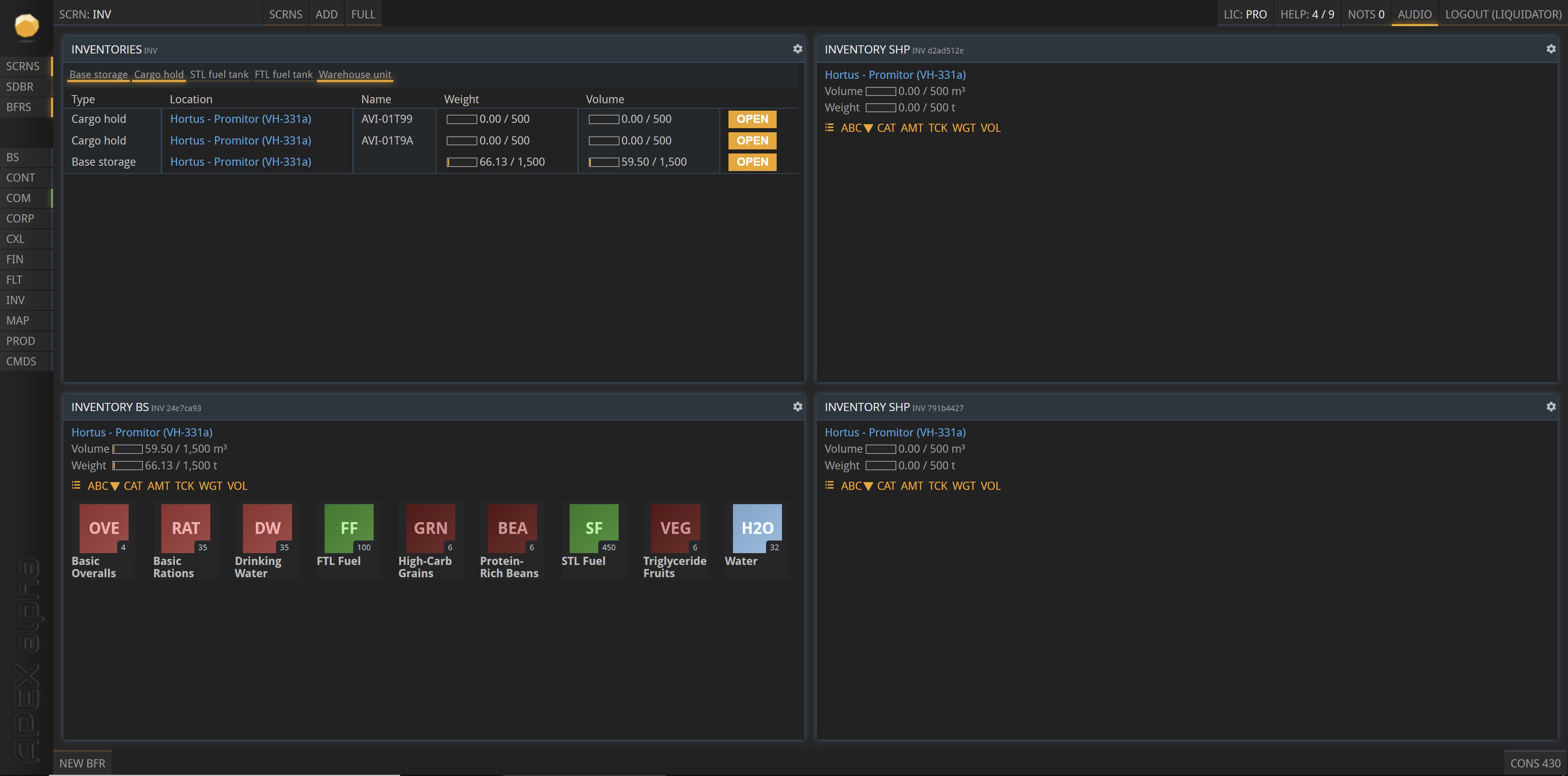
 As you can see, everything you own is in the cargo spaces of your two ships, and your base inventory is open. So now you drag and drop each one of the colored squares onto the square marked ALL in your base inventory, that only appears while you are dragging. The final result should look something like this:
 While doing this, the Construct Building Hints window will pop up. The important part here is that it reminds you that you have choses the Victualler starting profile, and that the buildings recommend to build are 2 HB1 pioneer habitations, 1 RIG to produce water, 1 FRM farmstead to grow crops, and 1 FP Food Processor to turn those crops into basic rations RAT. In this case I would recommend minimizing that buffer window, because before we construct these buildings, we will first prepare one more new screen in the APEX user interface. Like before, ADD screen, call it something like Planet (because Base is already taken), and split it into 4 tiles again. Press BS on the bar to the left. Press View Base and drag the resulting base overview holding the blue bar on top onto the first empty tile.


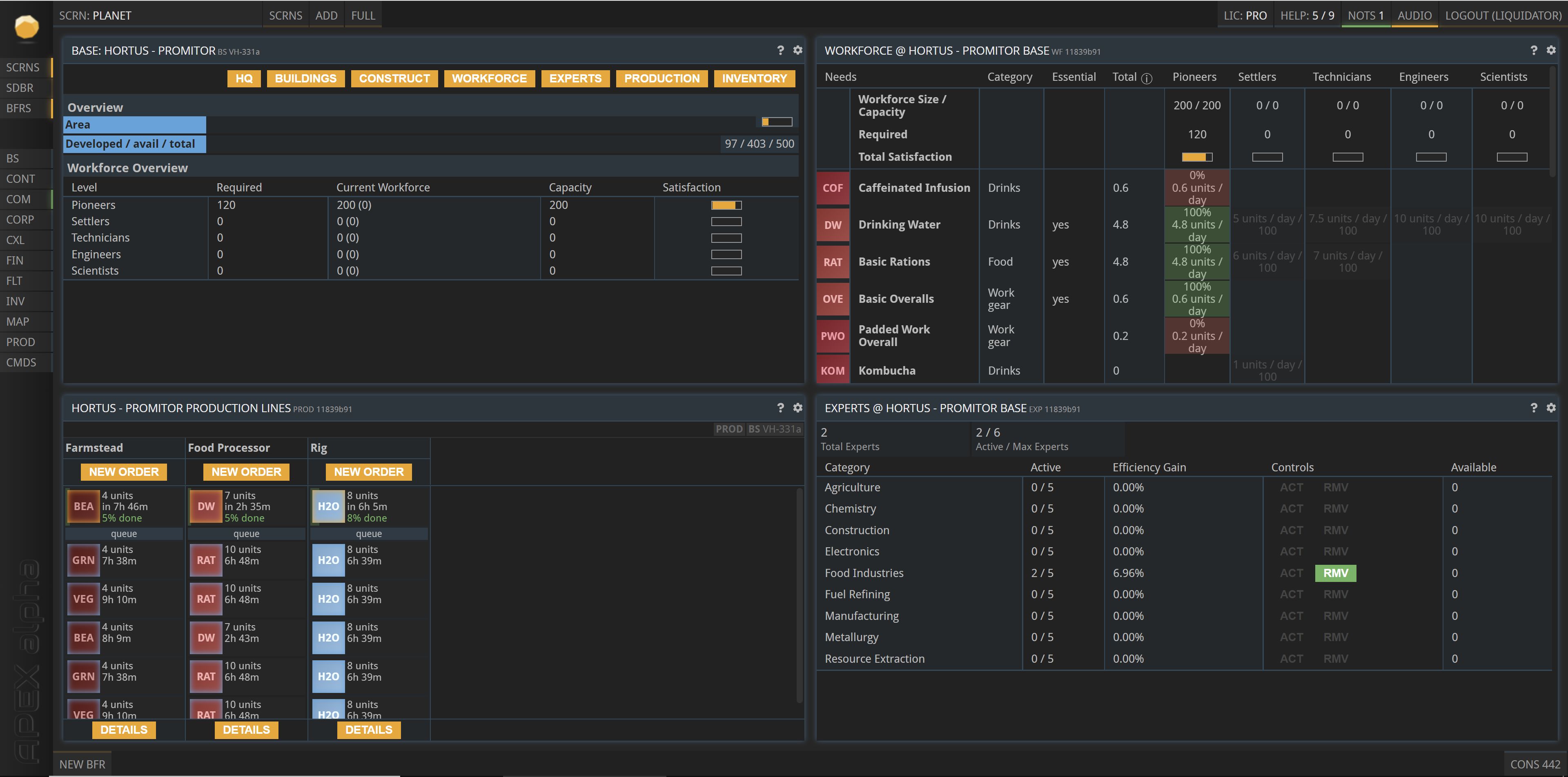
Now we have a construct button, with which we can construct our base. Press it and build a pioneer habitation, twice (not more!), on the Infrastructure tab of the construct window. Switch to the Resources tab and build a rig. The hint to start producing pops up, but you can minimize that. Then switch to the Pioneers tab and build both a farmstead and a food processor. Your base screen should now show 120 pioneers working. Press the buttons Workforce, Experts, and Production, and drag the new tiles that open by their blue bar into the empty tiles on your screen. Your screen should now look something like this: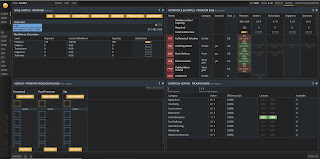

You can click on the ACT for activate button for the 1 expert that isn't assigned yet, but otherwise you won't need the expert section for now. We can now go back to the Hints window on starting production. If you minimized that, it will be at the bottom of your screen, showing as some number next to NEW BFR. If you closed it, don't worry, you can type HINT in a new buffer to get the full list of hints back. Let's first have a look at your inventories, by hovering the mouse pointer over SCRNS at the top of the screen and opening the inventories screen we created earlier. You will notice the blue building materials from the inventory are all gone, you used them all up to construct those buildings. In green there remain icons for the two types of fuel for your ships, for faster than light FTL travel and slower than light STL travel. In light red you will see basic overalls, basic rations, and drinking water, the essential goods that your pioneers consume. In darker red and light blue you will see high-carb grains GRN, protein-rich beans BEA, and triglyceride fruits VEG, as well as some water H2O. We will now make more of these goods, but the ones you have allow you to start production queues in all three of your production buildings. For that we will go back to the Planet screen we created and look at the tile with production. We will now start a NEW ORDER for each of the three production buildings. Let's start with the rig. Press NEW ORDER under Rig.
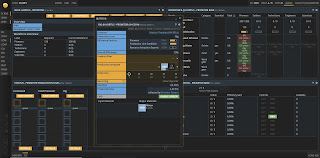 As the rig can only make one possible recipe here, you can simply click QUEUE ORDER. A hint about trading commodities will open (you can minimize that for now), and one production of water will appear on your rig.


Yes, that is 6 and a half hours of production in real time. It's a slow game. Feel free to hit QUEUE ORDER 5 more times to fill up the production queue. Note that you could set order size in the production window, but for the moment I would advise against it. Yes, you could put up to 20 orders in a single slot, giving you 160 water instead of 8. But it would take over 5 days, and you only get the water at the very end of this. As we need the water you produce earlier for the farm, stick with single productions for now.
If you click on NEW ORDER under farmstead, a very similar window opens, with a pre-selected production template turning 1 water into 2 beans. Don't do that. Instead press the downward pointing triangle next to that recipe and select the recipe that turns 6 water into 4 beans. While that looks like a much worse deal, this produces beans a bit faster. Only QUEUE ORDER once, then change to a different recipe. This time we turn 4 water into 4 grain, again just queueing one single order. Finally we select the recipe to turn 3 water into 4 vegetables. You will have to scroll down, potentially moving the buffer window up to reach that recipe.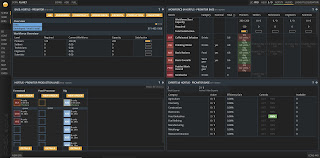

You now have a day's worth of production scheduled for your farm. You still have 3 free slots in your queue, so if you want, you can repeat the same sequence BEA/GRN/VEG.
Finally we set up the production of our food processor. For the time being we use 2 different recipes: One to turn 10 water into 7 drinking water. The other to turn 1 BEA plus 1 GRN plus 1 VEG into 10 rations. In order to balance your production of water with your consumption, for the start on Promitor I would suggest queueing up 1 drinking water DW order followed by 2 orders for basic rations RAT. You can do that twice: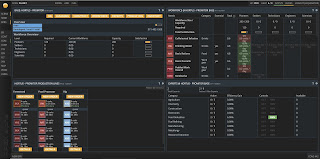 Congratulations, you now have a running food and drinking water production. On Promitor, this will produce a small excess of BEA, GRN, and VEG, but I would advise against selling that excess, you might need it later for a second food producer. You will also produce about 5 more DW and 24 more RAT than your pioneers consume, per day. The only thing your pioneers consume that you are not producing yourself, is basic overalls. Your workforce window shows that you consume 0.6 per day, and your inventory starts out with 4, so you have enough for 6 days. You will probably want to fly a ship from Promitor to Hortus Station to buy more overalls. But you could wait a day or two before you do that, and take your excess rations with you for selling. But that is a story for another day.
If you have further questions, feel free to write them in the comments section below, or open a new buffer in game, type USR Tobold, click CONTACT USER and chat with me in game.
Labels: PrUn
- posted by Tobold @ 4:41 PM Permanent Link (6) comments
PrUn Log - Stardate 2022-05-03
On the previous post, Maazels commented: "Maybe it's just me that this game is confusing to learn, I'm struggling to work out how to do things, even after going through the Youtube tutorials.". Good news, Maazels, it isn't just you. Prosperous Universe *is* confusing to learn. Actually, I hang out in the help chat of PrUn from time to time, just to answer questions of confused new players like you. The help chat is usually very helpful and willing to answer all new player questions. The community in PrUn is great!
Besides the tutorial videos, which could definitively be better, there are a number of videos from other people on YouTube or Twitch that cover the start of the game, or go through all steps. But the biggest newbie-friendly feature of PrUn is the COLIQ command, which allows you to liquidate your company and start over. Which means that you don't need to worry about getting your choice of career or starting planet wrong, or messing up you first base. If that happens, you can easily try again, applying everything you learned from the first run and doing better the second time around.
The other good news is that the UI is confusing because it is so extremely powerful. The best thing to do is to add lots of screens (the ADD button is at the top of each screen). And then you can split the one big "tile" you get into as many tiles as you want, change sizes as you want, and fill them with whatever command you want. For example I have a COM screen that has all of my chat windows. Or a screen with various information about my local commodity exchange, Moria.
Okay, back to the adventures of Kappa Alpha Industries. I had a flurry of exciting activity in the day since the last post. Basically "my ship came in", my first larger delivery of goods produced at my base arrived at the commodity exchange, ready for sale. I had 100 rations, 40 drinking water, and 188 oxygen, for a total value of over 20k. Actually, only 88 of those oxygen were my first batch of production with a collector. The other 100 I had bought on the Verdant local market, where somebody had sold them for just 60 credits each during a dip in the market, and I was pretty sure that I could sell them for 75.
So I had just started selling my goods, and only had 129 oxygen left, when I was chatting on the corporation Discord about me selling my oxygen and wanting to buy building materials for a second food processor for the money. One of my guild mates asked me if I could sell him the oxygen instead on the nearby planet where our guild headquarters is, and offered me 100 credits each. So I did that, plus a couple of side deals with him. Meanwhile another friendly guild mate offered to sell me the construction prefabs I needed at a discount. So with getting extra money for my wares, and a discount on the prefabs, I was actually able to get the materials for both a second food processor and a third pioneer habitation module. It'll take a few more days to get everything transported to where it should. But by the end of the week, the net profit of my base should have gone up from currently 5.2k per day to 7k per day. And then I should write another blog entry about balancing the production between my water rig, the farm, and the two food processors.
Labels: PrUn
- posted by Tobold @ 8:28 AM Permanent Link (0) comments
Monday, May 02, 2022
PrUn Log - Stardate 2022-05-02
This is the log of the adventures of Kappa Alpha Industries in Prosperous Universe. It is the first entry in this format, although some of what I did previously can be found in my previous blog posts on this game. Today is day 9 of my adventures, and because it is Monday, something significant happened: I got a company rating of "A", allowing me to accept all local market contracts, not just the ones that were okay with a "P" for pending rating.
Now, only companies that either pay a subscription, or at least paid a subscription for a single month, have a company rating. Trial accounts have a "U" for unrated, and can't accept local markets at all. Some people in negative Steam reviews call that "Pay2Win". However, the reason to hide local markets is much more complicated than just the devs wanting to make money. Local market contracts can be set to any price at all. And every new account starts out with a starting package of building materials and cash. So if trial accounts could access local markets, cheating players could easily create a string of trial accounts, sell their starting packages for 1 credit to their main account, and buy overpriced goods from that main account. Trial accounts with access to local markets could also be used to troll other players, accepting shipping contracts, picking up cargo, and never delivering it. So, yeah, I understand the need for a paywall here.
Once you pay for a subscription, which are relatively cheap, your company rating goes up to "pending". You also get a "pending" for the three sub-ratings: Activity, reliability, and stability. Activity measures how timely you are with fulfilling contractual obligations; it usually takes just a few days of doing contracts for that to get rated. Reliability measures whether you did or did not fulfill your contractual obligations; it takes 10 contracts to be rated. Stability is the financial stability of your company; an accounting "period" in the game goes from Sunday at midnight (UTC) to next Sunday at midnight. As stability needs 2 accounting periods to measure, it takes "2 Mondays" after starting the subscription to be rated. As I decided early on to subscribe, today is that second Monday, and I now have a stability rating of "C", presumably because my economy is still very small. But thanks to "A"s in activity and reliability, I have an overall rating of "A".
I called one of my ships "Planet Service" and use it to bring my produced goods to market, and bring back consumables or building materials I need from the market. Although that takes a day-and-a-half each way from planet to commodity exchange and back, one ship is sufficient for that task now, as production and consumption are slow processes. But players start out with 2 ships, and as a third ship costs millions, most players just have those 2 ships for a very long time. So I have one ship that I don't need for my own economy, so I can use it to make a bit of money on the side with shipping contracts.
As I mentioned in one of my previous posts, the main problem of shipping is fuel cost. It can easily cost 2k or more to fly from one system to another. A lot of shipping contracts don't even pay that much. They could still be worth picking up, for example if I was bringing goods from the planet that I am on, Verdant, to the next commodity exchange, Moria Station, and had some empty space in my cargo hold. If there is a shipping contract that still fits in and is for that same way, the shipping fee for a flight that I would have done anyway is just free money. But if I fly my second ship just to earn money, I need shipping contracts that pay more than the fuel cost of both ways, and those are hard to find. I did join a corporation, which is the guild mechanic in Prosperous Universe, and some friendly guildmates occasionally give me shipping contracts with decent pay. The current universe in PrUn is over a year old, and some people already have large economies, where it needs more than 2 ships to fly everything to where it needs to be.
Currently my second ship just picked up a shipment in a different faction's corner of the universe, near Benten. I was lucky to find a good contract paying 12k, which more than covers fuel cost for the whole round trip. But that got me into contact with another element of the game which I hadn't seen yet: Different factions have different currencies, so I got paid in "funny money" that I can't use directly at home. There is a currency exchange market, but it is very complicated. So I decided to do something else: After I delivered the cargo to the Benten system, I will fly to the Benten commodity exchange. Different commodity exchanges have different prices. In the case of Benten, the best planets to gather the raw materials to make slower-than-light fuel are in the Benten system. As a result, STL fuel prices in Benten station are cheaper than elsewhere. Instead of trying to convert the foreign currency into the one I use, I simply bought 300 FTL and 1000 STL fuel with it. At a price difference of 3 credits per unit of STL fuel compared to my home market, that's another 3k profit for the trip. And I can very much use that fuel myself.
So, this is it for today. I certainly won't post daily, Prosperous Universe is a slow game and there won't be something to report every day.
Labels: PrUn
- posted by Tobold @ 7:45 AM Permanent Link (2) comments
Sunday, May 01, 2022
The Twitterocalypse
Not having talked to the man himself, to the best of my knowledge and based on public information, Elon Musk is a man with colorful views which are all over the place politically. For example he supports universal basic income, which is an extreme left position, but he also opposes cancel culture, which is a more right wing position. However, if you look at what other people say currently about Elon Musk, he is Hitler incarnate and will single-handedly destroy the internet. Because he has bought Twitter, and expressed the opinion that banning certain right-wing politicians and news outlets from Twitter is wrong. There is a not insignificant probability that Donald Trump will get his Twitter account back.
What is interesting about this is that it shatters a previous polite illusion that Twitter is a politically neutral platform, which only bans hate speech. The same people who claimed that since Twitter banned Trump are now expressing their fear that Twitter will ban *their* opinions and candidates. Which means that suddenly left and right are united in the opinion that whoever has control over Twitter, could wield immense political power by banning certain outlets or even more insidiously tweak algorithms that push certain political opinions more than others.
While it will still take some time before Elon Musk is actually in control, some things can already be observed now, just in the few days since the takeover was agreed upon: Right-wing personalities on Twitter have a huge influx of tens to hundreds of thousands of followers. Left-wing personalities are losing followers. That is indicative of two things: People flock towards echo chambers, and away from platforms where they are likely to even come in contact with opposing views; and in the public perception a purchase of Twitter by Elon Musk means a move towards the right.
On January 6, 2021, a mob of 2,000–2,500 supporters of U.S. President Donald Trump attacked the Capitol Building in Washington, D.C. They sought to overturn his defeat in the 2020 presidential election by disrupting the joint session of Congress assembled to count electoral votes that would formalize President-elect Joe Biden's victory. Source Wikipedia. A lot of people think that Donald Trump is at least partially to blame for that attack, and I would agree with that. But what was the worst negative consequence of political importance to Donald Trump in the 16 months since? He lost his Twitter account. That, and the panic about the possibility of him getting that Twitter account back, tells you something. It means that the CEO of Twitter in some instances wields more political power than congress or the president. And that because Twitter is (or should I say "was") a publicly traded company, that political power is for sale.
While the problem is pretty clear, the solution is far from clear. In a perfect world, lawmakers would agree to some reasonable limitations to the political power of companies. In the real world, lawmakers ban math books that they consider too woke. Whoever is in power at whatever level of politics only tries to limit the political power of companies that disagree with him. If a month ago there would have been any attempt of Republicans to limit the power of Twitter, Democrats would have tried to block these attempts. Today it might just be the other way around. The two sides fundamentally agree that certain companies have too much power, but will never agree on measures against that, because each side wants measures that only harms their political opponents.
I don't think Elon Musk is the worst possible owner of Twitter, and he might well make that platform more centrist than it is now. But you never know with that guy. At some point later in his life he might announce his candidacy to become president of the United States. Does anybody think that owning Twitter wouldn't be an unfair advantage for such a candidate? And isn't it weird that there is no regulation about this sort of unfair advantage?
- posted by Tobold @ 6:30 AM Permanent Link (6) comments

