www.Tobold.com
Tobold@GMail.com
A blog with my thoughts regarding games I am playing and other stuff in life. Please read my Terms of Service
RSS Feed
Archives
• We're all the good guys
• Panda-crafting
• Integrals
• Not quite super-heroic
• Another MoP start complaint
• Half-time score
• The Favorites of Selune campaign - Level 3 - Session 2
• Blizzard repeating old mistakes
• Once again into the fray
• Thoughts on Theramore
• Sandbox vs. Guided
• Horizontal content
• Scenario loot
• Playing without a tank
• Jagged Alliance Online
• Attention deficit disorder
• Good storytelling in Dungeons & Dragons
• An honest announcement
• The 47 percent
• Is Facebook killing MMORPGs?
• The Guild Wars 2 economy
• I liked the game so little, I sold the company
• Paying with fake currency
• Innovation is necessary, but not sufficient
• Chuck Norris as a panda
• Efficient market theory
• The hype cycle
• Game trailers
• The Favorites of Selune campaign - Level 3 - Session 1
• Are stat caps a good idea?
• Making money in Guild Wars 2
• Confirmation bias
• Democracy Despite Itself
• The real value of virtual currencies
• Kickstopper
• It's the economy, stupid
• Crafting regrets
• WAR done right
• Guild Wars 2 crafting and auction house
• Playing an engineer in Guild Wars 2
• On the difficulty of difficulty
• City of Profitability
• Guild Wars 2 PvP and monthly achievements

• We're all the good guys
• Panda-crafting
• Integrals
• Not quite super-heroic
• Another MoP start complaint
• Half-time score
• The Favorites of Selune campaign - Level 3 - Session 2
• Blizzard repeating old mistakes
• Once again into the fray
• Thoughts on Theramore
• Sandbox vs. Guided
• Horizontal content
• Scenario loot
• Playing without a tank
• Jagged Alliance Online
• Attention deficit disorder
• Good storytelling in Dungeons & Dragons
• An honest announcement
• The 47 percent
• Is Facebook killing MMORPGs?
• The Guild Wars 2 economy
• I liked the game so little, I sold the company
• Paying with fake currency
• Innovation is necessary, but not sufficient
• Chuck Norris as a panda
• Efficient market theory
• The hype cycle
• Game trailers
• The Favorites of Selune campaign - Level 3 - Session 1
• Are stat caps a good idea?
• Making money in Guild Wars 2
• Confirmation bias
• Democracy Despite Itself
• The real value of virtual currencies
• Kickstopper
• It's the economy, stupid
• Crafting regrets
• WAR done right
• Guild Wars 2 crafting and auction house
• Playing an engineer in Guild Wars 2
• On the difficulty of difficulty
• City of Profitability
• Guild Wars 2 PvP and monthly achievements
Tobold's Blog
Sunday, September 30, 2012
We're all the good guys
Imagine in a pen & paper roleplaying game you come across the following character: He is undead. He is a priest of some dark deity. He uses dark magic and fear to kill his enemies. He works with orcs, trolls, and some sort of minotaurs. What would you think about that character? You'd probably think he's the villain of the adventure. But no, he is my shadow priest in World of Warcraft! And he just finished the first zone of Pandaria being the overall hero and good guy.
Of course if you'd play through that zone with your Alliance character, you'd be the good guy too! Because we're all the good guys. Whether we want it or not. EVE Online has clearly shown that in a low-consequence virtual world environment the default player behavior is evil. If I can shoot and rob you without consequence in a game, why wouldn't I? But as victims in virtual world can react by leaving the game, most game companies have decided to not allow evil behavior towards other players, or at least make being the victim free of consequences as well. Thus in the war between Horde and Alliance, there are no bad guys. And no losers. Whatever side you are currently on, you're in the winning team of the knights in shining armor.
That isn't just a World of Warcraft problem. In the oh-so-dynamic Guild Wars 2 your options are either helping the good guys or not helping them. You can't help the bad guys, even if you wanted to. In Star Wars: The Old Republic you could always choose the most dark side option there is, and play an "evil" Sith, but at the end of the day you're still spending your days helping people with their problems.
There has been some discussion lately in the blogosphere about story in MMORPGs. I don't think the problem is that there is no story. The problem is that the story is so incredibly bad, flat, and predictable. You, the hero, have no personal conflicts, no emotions, no difficult decisions to take. You just walk around, and ask random strangers what there problem is and how you could help them with it. All day. Every day. In many games the most evil thing you are allowed to do is to click "decline" when somebody asks you for help. In a more guided game like WoW that continual series of being helpful is sometimes rewarded with a cutscene, in a less guided game like Guild Wars 2 you get a reward for completing every random stranger's help request in a zone. Not helping them isn't really an option.
In the end you are playing a character who has less character than most NPCs. These games are still miles away from even the interactive storytelling of a pen & paper game, which isn't always great literature to begin with. If there is no other option than being the hero, if everybody is the hero, then ultimately that isn't any better than an office job.
Of course if you'd play through that zone with your Alliance character, you'd be the good guy too! Because we're all the good guys. Whether we want it or not. EVE Online has clearly shown that in a low-consequence virtual world environment the default player behavior is evil. If I can shoot and rob you without consequence in a game, why wouldn't I? But as victims in virtual world can react by leaving the game, most game companies have decided to not allow evil behavior towards other players, or at least make being the victim free of consequences as well. Thus in the war between Horde and Alliance, there are no bad guys. And no losers. Whatever side you are currently on, you're in the winning team of the knights in shining armor.
That isn't just a World of Warcraft problem. In the oh-so-dynamic Guild Wars 2 your options are either helping the good guys or not helping them. You can't help the bad guys, even if you wanted to. In Star Wars: The Old Republic you could always choose the most dark side option there is, and play an "evil" Sith, but at the end of the day you're still spending your days helping people with their problems.
There has been some discussion lately in the blogosphere about story in MMORPGs. I don't think the problem is that there is no story. The problem is that the story is so incredibly bad, flat, and predictable. You, the hero, have no personal conflicts, no emotions, no difficult decisions to take. You just walk around, and ask random strangers what there problem is and how you could help them with it. All day. Every day. In many games the most evil thing you are allowed to do is to click "decline" when somebody asks you for help. In a more guided game like WoW that continual series of being helpful is sometimes rewarded with a cutscene, in a less guided game like Guild Wars 2 you get a reward for completing every random stranger's help request in a zone. Not helping them isn't really an option.
In the end you are playing a character who has less character than most NPCs. These games are still miles away from even the interactive storytelling of a pen & paper game, which isn't always great literature to begin with. If there is no other option than being the hero, if everybody is the hero, then ultimately that isn't any better than an office job.
- posted by Tobold @ 10:41 PM Permanent Link (23) comments


Saturday, September 29, 2012
Panda-crafting
Some short remarks on crafting in Mists of Pandaria: One really positive thing is that this time Blizzard was extremely generous with harvesting nodes in the new zones. They are so plentiful, especially for the basic stuff you need a lot of, that it doesn't even matter that they aren't shared like in GW2. If you have problems finding Ghost Iron Ore or Green Tea Leaves, you are doing something wrong, they are literally all over the place.
On the downside Mists of Pandaria has two features that makes life harder for crafting alts. One is the Spirits of Harmony, which replace the elemental crafting components from previous expansions. Motes of Harmony to create Spirits of Harmony drop from every mob, but they are bind on pickup, and thus can't be traded. Thus if you want to craft something that needs those, you need to farm lots of mobs. With an estimated drop rate of around 10%, and 10 motes needed per spirit, you only get a Spirit of Harmony for every 100 mobs you kill, and it's not clear whether all mobs even drop them.
The other problem is specific to some crafts, for example tailoring: The better recipes are in a level 90 area which isn't accessible unless you are level 87 to do a quest, or level 90 to fly there. My tailor / inscriber mage isn't making much progress in crafting, because he is stuck in tailoring, and can get only one new inscription recipe per day via Scrolls of Wisdom. My alchemist warrior is doing a lot better, being already at 600 skill. Transmutation mastery rocks early in an expansion! Unfortunately Blizzard really miscalculated with the gem transmutation recipes: They need Golden Lotus, which is far more expensive than the rare gems you can make with them. :(
On the downside Mists of Pandaria has two features that makes life harder for crafting alts. One is the Spirits of Harmony, which replace the elemental crafting components from previous expansions. Motes of Harmony to create Spirits of Harmony drop from every mob, but they are bind on pickup, and thus can't be traded. Thus if you want to craft something that needs those, you need to farm lots of mobs. With an estimated drop rate of around 10%, and 10 motes needed per spirit, you only get a Spirit of Harmony for every 100 mobs you kill, and it's not clear whether all mobs even drop them.
The other problem is specific to some crafts, for example tailoring: The better recipes are in a level 90 area which isn't accessible unless you are level 87 to do a quest, or level 90 to fly there. My tailor / inscriber mage isn't making much progress in crafting, because he is stuck in tailoring, and can get only one new inscription recipe per day via Scrolls of Wisdom. My alchemist warrior is doing a lot better, being already at 600 skill. Transmutation mastery rocks early in an expansion! Unfortunately Blizzard really miscalculated with the gem transmutation recipes: They need Golden Lotus, which is far more expensive than the rare gems you can make with them. :(
- posted by Tobold @ 12:28 PM Permanent Link (8) comments
Friday, September 28, 2012
Integrals
In mathematics an integral is basically the area under a curve. If the curve represents something real, like time on the x-axis and something with an economic impact on the y-axix, the integral also represents something real, like real money. Now Wired just posted a really nice curve which is starting to catch the attention of bloggers. It shows the subscription numbers of World of Warcraft over the years. But somehow people are missing the integral. If you count the squares covered by the curve, you'll see there are over 66 of them. And each of them represents 1 million "subscriber years".
Of course this is all subscribers combined, and people in different regions pay different amounts of money for one year of subscription, up to $200 per year. The average is probably closer to $100, given that half of the subscribers are Chinese who pay a lot less. But whatever your estimate is for the revenue from one "subscriber year", if you multiply it by 66+ million you end up with a huge number, most probably over $6 billion.
Wired has chosen a moment to end that curve which corresponds to it pointing downwards. Which is somewhat misleading, because whatever you might heard or think about Mists of Pandaria sales, it is absolutely certain that for the coming months the subscription numbers of World of Warcraft will go up again. Maybe by not as much as the subscriber peak after previous expansions, and maybe not for long, but there *will* be a peak. Nobody can possibly pretend that WoW will have less subscribers in the first quarter of the new expansion than in the last quarter of the previous one.
But even if you did the scientifically worst possible extrapolation and projected a linear decline on the slope of the end of Cataclysm, you'd still end up with another 4 years and more than $1 billion more in revenue for Blizzard. A far more likely exponential decline with occasional peaks from expansions every 2 years will see World of Warcraft "dead" not before 2020, and Blizzard making at least $2 billion more money from it.
And in the end it is those billions of dollars that count. Take any other MMORPG and plot the money it made over the years, and all those curves will look rather puny compared to World of Warcraft. For a lot of games it took not 7 years to peak. Hell, many of the newer ones didn't even reach 7 weeks before declining. And no other games peaked at making a billion dollars a year: Either they had far less subscribers, or they had a different business model in which millions of players each paid a lot less on average for playing their game.
World of Warcraft is a game that dominates at least a decade of the MMORPG market. It has a huge impact on the state of that market, on how we think about what a MMORPG is, and on how future MMORPGs will be designed. It would take an extreme amount of hate and narrow-mindedness to just point at the last part of the curve and pointing a finger at the decline in Schadenfreude. Unfortunately the internet isn't short on hate and narrow-mindedness. But if you are wishing a game with 9 million subscribers to die, you shouldn't be surprised if some other game can't be saved by 20,000 petitions.
Of course this is all subscribers combined, and people in different regions pay different amounts of money for one year of subscription, up to $200 per year. The average is probably closer to $100, given that half of the subscribers are Chinese who pay a lot less. But whatever your estimate is for the revenue from one "subscriber year", if you multiply it by 66+ million you end up with a huge number, most probably over $6 billion.
Wired has chosen a moment to end that curve which corresponds to it pointing downwards. Which is somewhat misleading, because whatever you might heard or think about Mists of Pandaria sales, it is absolutely certain that for the coming months the subscription numbers of World of Warcraft will go up again. Maybe by not as much as the subscriber peak after previous expansions, and maybe not for long, but there *will* be a peak. Nobody can possibly pretend that WoW will have less subscribers in the first quarter of the new expansion than in the last quarter of the previous one.
But even if you did the scientifically worst possible extrapolation and projected a linear decline on the slope of the end of Cataclysm, you'd still end up with another 4 years and more than $1 billion more in revenue for Blizzard. A far more likely exponential decline with occasional peaks from expansions every 2 years will see World of Warcraft "dead" not before 2020, and Blizzard making at least $2 billion more money from it.
And in the end it is those billions of dollars that count. Take any other MMORPG and plot the money it made over the years, and all those curves will look rather puny compared to World of Warcraft. For a lot of games it took not 7 years to peak. Hell, many of the newer ones didn't even reach 7 weeks before declining. And no other games peaked at making a billion dollars a year: Either they had far less subscribers, or they had a different business model in which millions of players each paid a lot less on average for playing their game.
World of Warcraft is a game that dominates at least a decade of the MMORPG market. It has a huge impact on the state of that market, on how we think about what a MMORPG is, and on how future MMORPGs will be designed. It would take an extreme amount of hate and narrow-mindedness to just point at the last part of the curve and pointing a finger at the decline in Schadenfreude. Unfortunately the internet isn't short on hate and narrow-mindedness. But if you are wishing a game with 9 million subscribers to die, you shouldn't be surprised if some other game can't be saved by 20,000 petitions.
- posted by Tobold @ 9:55 AM Permanent Link (25) comments
Thursday, September 27, 2012
Not quite super-heroic
I consider myself to be a moderate and realist. But by being that, if one is faced with a huge load of unjustified optimism, idealism, and illusions of grandeur, one always ends up looking like a terrible cynic. I don't dislike City of Heroes. But if I read that the huge "Save City of Heroes" campaign managed to get a whopping 19,000 online signature on their petition, I can't help but snortle. In a market where a game with 200,000 actual *subscribers* is regarded as a failure, how is any company going to be impressed by 20,000 non-committal online signatures? If each of these 20,000 people would have sent $100 to NCSoft, that wouldn't have been enough to save City of Heroes.
- posted by Tobold @ 3:14 PM Permanent Link (29) comments
Another MoP start complaint
I mentioned previously that I didn't like how linear the start of Mists of Pandaria is for characters level 85 coming to the new continent. Now I played around with alts some more, and I have to add another complaint: The start of the game is copy & paste identical for Horde and Alliance!
I am really disappointed about that. Playing through the start of Pandaria from the Horde side it appeared as if the Alliance got there first, and Horde stumbled with their airship right into an Alliance base, ultimately conquering it. I would have liked to see the other half of that story told from the Alliance point of view. But no: The Alliance airship comes to Pandaria, finds the Horde has gotten there first, stumbled into their base and then conquers it. There is the same sequence of quests with minor variations (shooting from airship vs. shooting from gyrocopter for example). The same pandaren NPC saves the leader of both sides from identical situations, where their emotions manifest into dark sorcery. Afterwards you have to fight through the same monsters to get to the pandaren village, where the same quest to collect barrels of alcohol awaits you.
I had hoped that somebody playing alts of both sides would at least have two different experiences of the start of Pandaria, but that was not the case. I find that a bit cheap.
I am really disappointed about that. Playing through the start of Pandaria from the Horde side it appeared as if the Alliance got there first, and Horde stumbled with their airship right into an Alliance base, ultimately conquering it. I would have liked to see the other half of that story told from the Alliance point of view. But no: The Alliance airship comes to Pandaria, finds the Horde has gotten there first, stumbled into their base and then conquers it. There is the same sequence of quests with minor variations (shooting from airship vs. shooting from gyrocopter for example). The same pandaren NPC saves the leader of both sides from identical situations, where their emotions manifest into dark sorcery. Afterwards you have to fight through the same monsters to get to the pandaren village, where the same quest to collect barrels of alcohol awaits you.
I had hoped that somebody playing alts of both sides would at least have two different experiences of the start of Pandaria, but that was not the case. I find that a bit cheap.
- posted by Tobold @ 2:13 PM Permanent Link (9) comments
Half-time score
There is an ongoing bet on this blog, based on the Nosy Gamer's rankings of top twelve MMORPGs every week. That ranking was used by some people to declare WoW dead when Guild Wars 2 hit the top and pushed WoW back to rank 2 in XFire hours played on a Sunday. I was betting that this was a function of the hype cycle, and that after the release of Mists of Pandaria, WoW would go back to the first spot. Well, MoP is out, but as the rankings are done from Sunday data, we need to wait for the first Sunday after MoP release for the result. The only thing available now is a half-time score: Data for the Sunday *before* Mists of Pandaria release:
Guild Wars 2 is still on top with 51,481 hours played, compared to WoW's 33,794. But the hype cycle is already very apparent: Guild Wars 2 hours played are already down 25.4% compared to the week before, while World of Warcraft is already up 31.7%. It doesn't take a huge stretch of imagination to think that I might win my bet.
Note that my opinion is solely based on the observed behavior of MMORPG players, aka Lemmings. I do believe that *in the long term* subscription numbers correlate with a game's quality. Or in this time and age profits instead of subscription numbers: If you can earn a billion bucks with your game, it can't be all bad. But in the short term, and especially on release, these numbers have little significance. Especially since only a tiny percentage of MMORPG players has XFire installed, and those aren't necessarily a representative sample.
I do think WoW will be beaten again in XFire numbers by future MMORPG releases. But to be beaten by Guild Wars 2 again, GW2 would have to release an expansion. There is this strange need of MMORPG players to be there on release, which beats any consideration of game quality.
Guild Wars 2 is still on top with 51,481 hours played, compared to WoW's 33,794. But the hype cycle is already very apparent: Guild Wars 2 hours played are already down 25.4% compared to the week before, while World of Warcraft is already up 31.7%. It doesn't take a huge stretch of imagination to think that I might win my bet.
Note that my opinion is solely based on the observed behavior of MMORPG players, aka Lemmings. I do believe that *in the long term* subscription numbers correlate with a game's quality. Or in this time and age profits instead of subscription numbers: If you can earn a billion bucks with your game, it can't be all bad. But in the short term, and especially on release, these numbers have little significance. Especially since only a tiny percentage of MMORPG players has XFire installed, and those aren't necessarily a representative sample.
I do think WoW will be beaten again in XFire numbers by future MMORPG releases. But to be beaten by Guild Wars 2 again, GW2 would have to release an expansion. There is this strange need of MMORPG players to be there on release, which beats any consideration of game quality.
- posted by Tobold @ 6:30 AM Permanent Link (34) comments
Wednesday, September 26, 2012
The Favorites of Selune campaign - Level 3 - Session 2
My previous session ended with a cliffhanger, after the plans of the players for the Battle of Albridge had been betrayed, and the enemy had circumvented their carefully laid trap. So this session started with an enemy army 1 hour march away, and the players having to come up with a plan B on how to organize the villagers and their elven allies. Fortunately they had a good idea: They moved their troops out of the village towards the enemy, and hid behind low hills in bowshot range of the road, forming a battle line parallel to the road. When the enemy came down marching the road, the elves stepped up the hill and started firing their bows at the enemy troops. The villagers then stepped in front of the elves to protect them from the counterattack.
That plan worked quite well, as there were 150 enemies, all just regular mercenary troops. The players had 60 elven archers, 150 villagers (equipped with decent weapons and armor from a raid on a supply caravan), and the element of surprise.
But now we go from telling a story to a meta-gaming subject: Dungeons & Dragons doesn't have good rules to simulate a battle between 150 mercenaries and 210 rebels. You *can* make up such rules, for example grouping X soldiers together and handling them as 1 unit. But the result is never really satisfying: It will always be just a battle between NPCs, with rules problems if you let the players fight in the same battle. And with D&D combat rounds being just 6 seconds long, you can't have a battle raging on for an hour, and 1-minute large battles feel weird. Thus the adventure module went for a very different solution, moving the large battle into the background, and having the player play a series of skirmishes to focus on their contribution to the battle. I liked the idea, and just modified the skirmishes to be more "battle-like".
The players knew to expect about 200 enemies, and the large battle had only 150 of them. So at the start of the battle they received a message from a scout that a smaller troop of around 20 enemies was coming from the north. They sent 20 villagers to protect the village, but soon after received a second message that there was a devil with the other enemy troops, and they were burning the village. Thus they left the larger battle to focus on the threat to the village.
The enemy in the village was 20 regular troops (minions with 1 hitpoint), a mage, and a tar devil. I had originally foreseen this battle on a free battlefield, but now I used a map of a village I fortunately had brought with me. The enemy soldiers had an ability which increased their defenses if they were adjacent to each other, so they basically formed a Roman turtle to attack the players, 4x5 soldiers large. The players at first cleverly delayed their turns to give the cleric and warlord opportunity to cast their buffs (+2 on everybody's armor class, +8 temporary hitpoints). After that the first player having initiative was the dwarven fighter, who did what every dwarf would do when seeing 20 soldiers advancing towards him: He charged them! :)
Unsurprisingly the most effective player in this situation was the wizard, with his fire specialization and area effect spells. His first 3x3 column of flames took out 8 soldiers, well above average. The enemy mage on the other hand, who also had an area effect spell, could never catch more than one player with it, as the players had dispersed to avoid just that. The tar devil posed some danger, catching the ranger in a net and attacking her while immobilized. But ultimately the good tactics of the players made the combat an easy win.
A short rest later the players heard combat noises from the south of the village, where they had initially built a barricade close to the bridge and where the 20 villager troops had fled to from the devil. When the players arrived those villager were dead, with another enemy detachment consisting of 10 crossbowmen, with a leader and a spitting drake, now removing the barricades. A battle around the bridge ensued. The crossbowmen also were minions, but they didn't stand conveniently together and were a bigger threat due to their ranged attacks. Nevertheless the players did very well, for example with the ranger using an action point to dispatch 4 crossbowmen with 2 twin strikes. The enemy leader had a lot of hitpoints, but low defenses, and wasn't very lucky with his attacks. When the mercenaries were dead and only the spitting drake was left, the warlord used his intimidation skill to make him flee.
Again the players had time for a short rest (if the DM doesn't allow those, the fights get boring with only at-will powers used), before seeing smoke from burning farms further south down the road. Moving there the players encountered more enemy troops, led by the mercenary general. But as it was getting late, we kept that battle for the next session.
That plan worked quite well, as there were 150 enemies, all just regular mercenary troops. The players had 60 elven archers, 150 villagers (equipped with decent weapons and armor from a raid on a supply caravan), and the element of surprise.
But now we go from telling a story to a meta-gaming subject: Dungeons & Dragons doesn't have good rules to simulate a battle between 150 mercenaries and 210 rebels. You *can* make up such rules, for example grouping X soldiers together and handling them as 1 unit. But the result is never really satisfying: It will always be just a battle between NPCs, with rules problems if you let the players fight in the same battle. And with D&D combat rounds being just 6 seconds long, you can't have a battle raging on for an hour, and 1-minute large battles feel weird. Thus the adventure module went for a very different solution, moving the large battle into the background, and having the player play a series of skirmishes to focus on their contribution to the battle. I liked the idea, and just modified the skirmishes to be more "battle-like".
The players knew to expect about 200 enemies, and the large battle had only 150 of them. So at the start of the battle they received a message from a scout that a smaller troop of around 20 enemies was coming from the north. They sent 20 villagers to protect the village, but soon after received a second message that there was a devil with the other enemy troops, and they were burning the village. Thus they left the larger battle to focus on the threat to the village.
The enemy in the village was 20 regular troops (minions with 1 hitpoint), a mage, and a tar devil. I had originally foreseen this battle on a free battlefield, but now I used a map of a village I fortunately had brought with me. The enemy soldiers had an ability which increased their defenses if they were adjacent to each other, so they basically formed a Roman turtle to attack the players, 4x5 soldiers large. The players at first cleverly delayed their turns to give the cleric and warlord opportunity to cast their buffs (+2 on everybody's armor class, +8 temporary hitpoints). After that the first player having initiative was the dwarven fighter, who did what every dwarf would do when seeing 20 soldiers advancing towards him: He charged them! :)
Unsurprisingly the most effective player in this situation was the wizard, with his fire specialization and area effect spells. His first 3x3 column of flames took out 8 soldiers, well above average. The enemy mage on the other hand, who also had an area effect spell, could never catch more than one player with it, as the players had dispersed to avoid just that. The tar devil posed some danger, catching the ranger in a net and attacking her while immobilized. But ultimately the good tactics of the players made the combat an easy win.
A short rest later the players heard combat noises from the south of the village, where they had initially built a barricade close to the bridge and where the 20 villager troops had fled to from the devil. When the players arrived those villager were dead, with another enemy detachment consisting of 10 crossbowmen, with a leader and a spitting drake, now removing the barricades. A battle around the bridge ensued. The crossbowmen also were minions, but they didn't stand conveniently together and were a bigger threat due to their ranged attacks. Nevertheless the players did very well, for example with the ranger using an action point to dispatch 4 crossbowmen with 2 twin strikes. The enemy leader had a lot of hitpoints, but low defenses, and wasn't very lucky with his attacks. When the mercenaries were dead and only the spitting drake was left, the warlord used his intimidation skill to make him flee.
Again the players had time for a short rest (if the DM doesn't allow those, the fights get boring with only at-will powers used), before seeing smoke from burning farms further south down the road. Moving there the players encountered more enemy troops, led by the mercenary general. But as it was getting late, we kept that battle for the next session.
- posted by Tobold @ 10:29 AM Permanent Link (5) comments
Blizzard repeating old mistakes
To get some sanity instead of the hype cycle, I tend to not read too much about all the empty promises developers make before a game is released, but rather play it when it is out and see for myself. So now I am discovering a lot about Mists of Pandaria, where others have already learned everything there is to learn before the game was even out. I read the first player hit level 90 only four-and-a-half hours after release. My exploration of Pandaria will be considerably slower.
So I've been playing with my priest through the new zones, or rather through the start of The Jade Forest. As that character also does mining and jewelcrafting I first ran around to collect ore nodes before doing quests. Thus I met NPCs with no quests or empty places, only to find later when doing the quests that these had turned through phasing into quest hubs. In short Mists of Pandaria is repeating the mistake of Cataclysm of having strictly linear quest progression through zones, where every character is forced to go down exactly the same path, and quests can't be skipped.
I believe that people who read forums and blogs have a very wrong idea how Blizzard is making money with World of Warcraft. The bread and butter of Blizzard is not the people who rush through content, the high-end raiding guilds, the elitist jerk theorycrafters, or the bloggers and forum posters. Blizzard is making most of their money from people like my wife, who was subscribed to WoW all the way through Cataclysm, and was busy leveling alts.
Mists of Pandaria might well turn out to be the worst expansion ever to level alts in. It has the linearity of Cataclysm zones, but where Catalysm had two possible zones to start in, Mists of Pandaria only has one. The Jade Forest might end up being more hated than Hellfire Peninsula, because in Hellfire at least you could skip the quests you didn't like. All the talk you heard about Blizzard making MoP more casual-friendly is going to come to nothing if those casuals become bored of leveling alts due to linear questing.
I predict an even worse rollercoaster ride of subscription numbers for this expansion than Cataclysm. In the coming days and weeks you will read about millions of sales, and lots of returning subscribers. But early in 2013 the stories will be of a mass exodus again. World of Warcraft is still very far from dying, but the developers missed a huge opportunity to increase the longevity of the casual subscriptions.
So I've been playing with my priest through the new zones, or rather through the start of The Jade Forest. As that character also does mining and jewelcrafting I first ran around to collect ore nodes before doing quests. Thus I met NPCs with no quests or empty places, only to find later when doing the quests that these had turned through phasing into quest hubs. In short Mists of Pandaria is repeating the mistake of Cataclysm of having strictly linear quest progression through zones, where every character is forced to go down exactly the same path, and quests can't be skipped.
I believe that people who read forums and blogs have a very wrong idea how Blizzard is making money with World of Warcraft. The bread and butter of Blizzard is not the people who rush through content, the high-end raiding guilds, the elitist jerk theorycrafters, or the bloggers and forum posters. Blizzard is making most of their money from people like my wife, who was subscribed to WoW all the way through Cataclysm, and was busy leveling alts.
Mists of Pandaria might well turn out to be the worst expansion ever to level alts in. It has the linearity of Cataclysm zones, but where Catalysm had two possible zones to start in, Mists of Pandaria only has one. The Jade Forest might end up being more hated than Hellfire Peninsula, because in Hellfire at least you could skip the quests you didn't like. All the talk you heard about Blizzard making MoP more casual-friendly is going to come to nothing if those casuals become bored of leveling alts due to linear questing.
I predict an even worse rollercoaster ride of subscription numbers for this expansion than Cataclysm. In the coming days and weeks you will read about millions of sales, and lots of returning subscribers. But early in 2013 the stories will be of a mass exodus again. World of Warcraft is still very far from dying, but the developers missed a huge opportunity to increase the longevity of the casual subscriptions.
- posted by Tobold @ 9:13 AM Permanent Link (39) comments
Tuesday, September 25, 2012
Once again into the fray
I made a pandaren monk this morning and called him "Fungku" (as World of Warcraft doesn't allow "Fung Ku" nor "FungKu". My plans for Mists of Pandaria are:
- Play that monk to at least level 20
- Play my priest from level 85 to 90
- Do the accessible dungeons and scenarios
- Check out pet battles, farming, and other new features
- posted by Tobold @ 9:02 AM Permanent Link (16) comments
Monday, September 24, 2012
Thoughts on Theramore
The Fall of Theramore in its level 85 version was only playable for one week, ending today. From tomorrow on the scenario will be level 90. So some people missed it, because they got discouraged by the minimum iLevel needed. Unnecessarily, I might add, because it was easy enough to get to that iLevel by buying cheap blue "vicious" crafted PvP gear. The Fall of Theramore scenario is easy enough that three pure dps with just that blue PvP gear can easily win the scenario, which gives me some hope that the level 90 scenarios will remain equally accessible. And that PvP gear is a good set to start Mists of Pandaria with, although I expect it will be replaced by greens soon enough.
Having said that, by running the scenario multiple times with different alts, I met some people whose damage output was up to 5 times mine. In one run a death knight wearing what I think from a quick inspection was best-in-slot Cataclysm gear basically soloed the scenario, with me and another guy running behind. I had recount running, and the death knight did 75% of all damage dealt. Impressive!
Apart from some runs having extremely powerful players, the main difference I observed in these scenario runs was that some groups cleverly avoided most of the trash, while others pulled every single patrol and group of mobs, making the run a lot slower. That was especially an issue in the Horde version, which has more trash that can potentially be avoided, while the Alliance version is somewhat more straightforward. Please, Horde players, after killing the war machine you can go up the stairs to the wall, jump with your mount to the gate tower, and get to the castle without having to fight any of the mob groups. And you can get *to* the war machine from the gryphons without a fight as well, by hugging the wall and timing the run through the smith. The scenario gets much faster that way.
After having collected a sufficient number of data points, it appears that every player has a one-in-three chance to find an epic in his loot bag, and that this epic is one his class can "use". So sometimes nobody gets an epic, often there is one epic, and sometimes two or even three players get an epic. And some people will complain, because while a hunter can technically "use" a polearm, or a warlock can "use" gear with spirit on it, chances are they don't want to.
I got a staff for my cleric, a hat for my mage, a two-handed axe for my fighter, and head piece for my paladin, all with the "right" stats. I also got a few pieces I'm not going to use, like 1H weapons for my fighter and paladin and a "healer" helmet for the pally. I would have liked a second 2H axe for my fighter, and one of them for my pally too, but ultimately gave up after having run the scenario too often for my taste.
And then I used transmogrification for the first time. I don't know if it was for some deliberate reason or just rushed, but the epics in the Theramore scenario all look extremely basic and not "epic" at all. Fortunately my priest still had his level 60 class staff, Benediction, and could transmogrify the ugly Theramore staff into something looking somewhat decent. My fighter actually had to buy an axe from the AH to change the basic axe look into something more fitting his style.
Overall the Fall of Theramore wasn't all bad, although it still is the weakest of the pre-expansion events up to date. Especially the story makes no sense at all if you only experience it in-game. You need to read the book or the new lore blog from Blizzard to even get an idea what the Fall of Theramore is about. Far from ideal!
Having said that, by running the scenario multiple times with different alts, I met some people whose damage output was up to 5 times mine. In one run a death knight wearing what I think from a quick inspection was best-in-slot Cataclysm gear basically soloed the scenario, with me and another guy running behind. I had recount running, and the death knight did 75% of all damage dealt. Impressive!
Apart from some runs having extremely powerful players, the main difference I observed in these scenario runs was that some groups cleverly avoided most of the trash, while others pulled every single patrol and group of mobs, making the run a lot slower. That was especially an issue in the Horde version, which has more trash that can potentially be avoided, while the Alliance version is somewhat more straightforward. Please, Horde players, after killing the war machine you can go up the stairs to the wall, jump with your mount to the gate tower, and get to the castle without having to fight any of the mob groups. And you can get *to* the war machine from the gryphons without a fight as well, by hugging the wall and timing the run through the smith. The scenario gets much faster that way.
After having collected a sufficient number of data points, it appears that every player has a one-in-three chance to find an epic in his loot bag, and that this epic is one his class can "use". So sometimes nobody gets an epic, often there is one epic, and sometimes two or even three players get an epic. And some people will complain, because while a hunter can technically "use" a polearm, or a warlock can "use" gear with spirit on it, chances are they don't want to.
I got a staff for my cleric, a hat for my mage, a two-handed axe for my fighter, and head piece for my paladin, all with the "right" stats. I also got a few pieces I'm not going to use, like 1H weapons for my fighter and paladin and a "healer" helmet for the pally. I would have liked a second 2H axe for my fighter, and one of them for my pally too, but ultimately gave up after having run the scenario too often for my taste.
And then I used transmogrification for the first time. I don't know if it was for some deliberate reason or just rushed, but the epics in the Theramore scenario all look extremely basic and not "epic" at all. Fortunately my priest still had his level 60 class staff, Benediction, and could transmogrify the ugly Theramore staff into something looking somewhat decent. My fighter actually had to buy an axe from the AH to change the basic axe look into something more fitting his style.
Overall the Fall of Theramore wasn't all bad, although it still is the weakest of the pre-expansion events up to date. Especially the story makes no sense at all if you only experience it in-game. You need to read the book or the new lore blog from Blizzard to even get an idea what the Fall of Theramore is about. Far from ideal!
- posted by Tobold @ 11:24 AM Permanent Link (14) comments
Sandbox vs. Guided
A roleplaying game can run linearly on rails, following a scripted story, or it can be a completely open world where the players can do whatever they like. I don't like the term "themepark" for the former, as that describes only a subset of it reasonably well, so I'm rather calling it "guided gameplay". As opposed to the unguided or "sandbox" form.
Neither of the extremes is ideal. And as so often it is one of subjects where what people say they like and what they do like are very different things. Blogs and game forums tend to come out overwhelmingly in favor of sandbox games, but the games people actually buy are overwhelmingly guided. And then of course there are a lot of games somewhere in the middle, like Guild Wars 2 for example, which allows for a more sandbox-like experience due to the downleveling feature, but still has the guided elements of the personal story and optimal rewards by following a certain sequence of zones.
It is for that middle I am aiming with my pen & paper Dungeons & Dragons roleplaying game as well. On the one side I want my players to have complete freedom to do whatever they want (and then live with the consequences) in my campaign. On the other hand I've observed that such complete freedom often either leads to the players not having a clue what to do next, or to them doing something and then being unhappy with the consequences.
By definition guided gameplay in a pen & paper game is better prepared than sandbox gameplay. If the players follow the proposed story, they'll run into the planned encounters, and those encounters can be very well prepared and thus be run fast, without having to look up monsters or rules on the spot. Even roleplaying encounters can be well prepared, with me as the DM having thought about what the motivation and goals of the NPCs involved are, and how they would react to the most typical behavior of the players. As soon as the players leave that guided series of events, I have to fly by the seat of my pants. I can make the NPCs react in a way I personally consider logical, in view of what I know about the world and the NPCs in question. But if I didn't expect a situation to arise, I'm unable to give the players pointers in advance on how NPCs are likely to react. And as the players can't possibly have all the information, the response and consequence of their actions might come as a surprise, and not always a welcome one.
So as a DM I can find myself between the Scylla of being too prepared (and thus the story feeling scripted) and the Charybdis of not being prepared enough, and the players running into their doom because they couldn't foresee all the possible consequences of their action. With resurrection being significantly less common in most pen & paper roleplaying systems than in MMORPGs, death has a much more painful sting. Even if players might enjoy the freedom of a pure sandbox for a while, they will be a lot less happy if that leads to their characters dying frequently. And even if the sandbox experience ends well, it might have a weaker (because unprepared) story, gaps in the logic, or unbalanced encounters hobbled together on the fly.
So the very least I have to offer as a DM to my players is that there is a prepared adventure with a prepared story, and pointers on how to get from the beginning to the middle and to the end. But these are really just pointers, not rails. Some NPC asks the players to go somewhere and do something, but the option is there to say no. And that option is more viable than the option to click "decline" on a quest in World of Warcraft, where declining one quest might lead to you being unable to get any more quests in that zone. In a pen & paper game there will always be some adventure, regardless where the players decide to go. But a lot of players instinctively prefer going down the guided path. Full sandbox isn't necessarily the pinnacle of fun, and the players know that just as well as the DM.
Neither of the extremes is ideal. And as so often it is one of subjects where what people say they like and what they do like are very different things. Blogs and game forums tend to come out overwhelmingly in favor of sandbox games, but the games people actually buy are overwhelmingly guided. And then of course there are a lot of games somewhere in the middle, like Guild Wars 2 for example, which allows for a more sandbox-like experience due to the downleveling feature, but still has the guided elements of the personal story and optimal rewards by following a certain sequence of zones.
It is for that middle I am aiming with my pen & paper Dungeons & Dragons roleplaying game as well. On the one side I want my players to have complete freedom to do whatever they want (and then live with the consequences) in my campaign. On the other hand I've observed that such complete freedom often either leads to the players not having a clue what to do next, or to them doing something and then being unhappy with the consequences.
By definition guided gameplay in a pen & paper game is better prepared than sandbox gameplay. If the players follow the proposed story, they'll run into the planned encounters, and those encounters can be very well prepared and thus be run fast, without having to look up monsters or rules on the spot. Even roleplaying encounters can be well prepared, with me as the DM having thought about what the motivation and goals of the NPCs involved are, and how they would react to the most typical behavior of the players. As soon as the players leave that guided series of events, I have to fly by the seat of my pants. I can make the NPCs react in a way I personally consider logical, in view of what I know about the world and the NPCs in question. But if I didn't expect a situation to arise, I'm unable to give the players pointers in advance on how NPCs are likely to react. And as the players can't possibly have all the information, the response and consequence of their actions might come as a surprise, and not always a welcome one.
So as a DM I can find myself between the Scylla of being too prepared (and thus the story feeling scripted) and the Charybdis of not being prepared enough, and the players running into their doom because they couldn't foresee all the possible consequences of their action. With resurrection being significantly less common in most pen & paper roleplaying systems than in MMORPGs, death has a much more painful sting. Even if players might enjoy the freedom of a pure sandbox for a while, they will be a lot less happy if that leads to their characters dying frequently. And even if the sandbox experience ends well, it might have a weaker (because unprepared) story, gaps in the logic, or unbalanced encounters hobbled together on the fly.
So the very least I have to offer as a DM to my players is that there is a prepared adventure with a prepared story, and pointers on how to get from the beginning to the middle and to the end. But these are really just pointers, not rails. Some NPC asks the players to go somewhere and do something, but the option is there to say no. And that option is more viable than the option to click "decline" on a quest in World of Warcraft, where declining one quest might lead to you being unable to get any more quests in that zone. In a pen & paper game there will always be some adventure, regardless where the players decide to go. But a lot of players instinctively prefer going down the guided path. Full sandbox isn't necessarily the pinnacle of fun, and the players know that just as well as the DM.
- posted by Tobold @ 10:17 AM Permanent Link (11) comments
Sunday, September 23, 2012
Horizontal content
Mists of Pandaria next week will add some new content level 1-20, and other new content level 85-90. Anyone wanting to do both on the same character will have to get from 20 to 85 using "old" content. Which isn't so bad until 60, due to the zones up to 60 having been renovated in Cataclysm. But Outland, Northrend, and the Cataclysm zones can easily get boring if you have already done them with several alts.
I don't know how Guild Wars 2 expansion will look like, but I don't see them having the same problem. As you can level in any zone up to your level, any expansion will feel more horizontal, compared to WoW's vertical expansions. Unless you already played everything repeatedly, you can always go to some new corner, or at least your favorite one if you've seen everything already. That makes leveling up yet another character less of a bore than in World of Warcraft.
I do hope the automatic downleveling, which effectively gives you a much wider choice on which zones to play in, will become the standard for future MMORPGs.
I don't know how Guild Wars 2 expansion will look like, but I don't see them having the same problem. As you can level in any zone up to your level, any expansion will feel more horizontal, compared to WoW's vertical expansions. Unless you already played everything repeatedly, you can always go to some new corner, or at least your favorite one if you've seen everything already. That makes leveling up yet another character less of a bore than in World of Warcraft.
I do hope the automatic downleveling, which effectively gives you a much wider choice on which zones to play in, will become the standard for future MMORPGs.
- posted by Tobold @ 3:08 PM Permanent Link (16) comments
Friday, September 21, 2012
Scenario loot
Can anyone confirm or disprove my impression that in the loot bags the 3 players get at the end of the Fall of Theramore scenario there is always only exactly 1 containing an epic? Not a 33% chance, leading to results from nobody getting something to everybody getting something, but always exactly 1 epic, just hidden via the loot bag mechanism. Secondly, although I haven't found an epic myself yet, I was told that they aren't necessarily class-specific, a mage told me a polearm dropped for him.
Now on the macroscopic scale I do understand Blizzard not wanting to hand out 3 useful epics for the relatively little effort of a scenario, because then we'd quickly be swamped with them. But on the microscopic scale my retribution paladin doesn't need all that many items from the loot table, and mainly the 2H-weapon. So if his chance to find one of them is just something like 2%, so on average he'd need to run the scenario 50 times to get one, that isn't terribly attractive to me.
On the positive side one does get justice points for scenarios. Somehow I find justice points for everybody a more appropriate reward for a 3-man pickup group than one random epic for one of the players which might or might not be actually usable for his class. What do you think?
Now on the macroscopic scale I do understand Blizzard not wanting to hand out 3 useful epics for the relatively little effort of a scenario, because then we'd quickly be swamped with them. But on the microscopic scale my retribution paladin doesn't need all that many items from the loot table, and mainly the 2H-weapon. So if his chance to find one of them is just something like 2%, so on average he'd need to run the scenario 50 times to get one, that isn't terribly attractive to me.
On the positive side one does get justice points for scenarios. Somehow I find justice points for everybody a more appropriate reward for a 3-man pickup group than one random epic for one of the players which might or might not be actually usable for his class. What do you think?
- posted by Tobold @ 11:12 AM Permanent Link (15) comments
Playing without a tank
Guild Wars 2 dungeons, World of Warcraft scenarios, there is a trend towards group PvE without the holy trinity of tank, healer, dps. So how does that work in practice? I've been running the Fall of Theramore scenario a couple of times, and unlike everybody else I wasn't concentrating on the horrible story, but on the gameplay. The first question of course is: "Does it work?". The answer is yes, for small values of "work".
Stated simply, playing without a tank and healer works as long as the challenge isn't too difficult. Three pure dps characters with zero healing nor tanking capabilities can only be in battle for so long. They are able to kill a group of enemies faster than a tank - healer - dps trio, but the holy trinity can keep up their act for considerably longer, and thus ultimately beat harder challenges.
Where it gets interesting is when you look at hybrids. Imagine a perfect 5-man group with a tank that always holds all the aggro, and a healer who always keeps everybody alive. In such a group a dps class with ranged dps and no means to mitigate damage or heal himself works perfectly. In fact it works so well that over the years developers attitude towards hybrids has changed: It used to be that if you had hybrid abilities that allowed you to do other things than just pure dps, developers believed that had to be "balanced" by you having less damage output. But as those hybrid abilities don't count for anything in a holy trinity group, and only the damage output counts, hybrids now deal exactly as much damage as pure dps classes.
And there is the rub: Take away the tank and the healer, and suddenly a hybrid class becomes a lot better. As Keen said, a GW2 dungeon is like a WoW dungeon after the tank dies: "Have you ever been doing a dungeon (probably in a pug), had your tank die, and suddenly the mobs are all over your healer or DPS and people just start running around trying to “dodge” the mobs but instead constantly die? Yeah, that’s Guild Wars 2 dungeons, but all the time." Dodging and kiting are instinctive tactics which simply don't work without a tank pulling off the mob from you. (And I'm an expert on kiting, having done it since quad-kiting with a druid in EQ). What you need in a group without a tank or healer are ways to deflect aggro, to self-heal, or to mitigate damage.
As a consequence my retribution paladin was a lot more comfortable to play in the Fall of Theramore than my mage. While in a 5-man dungeon the mage is easier, because he doesn't have to be so close to the mobs he wants to damage, in a 3-man scenario the armor and self-healing of the paladin are just brilliant. I ended up pseudo-tanking (that is being always the one that pulls and takes the first brunt of attacks from the mobs, but not holding aggro very well afterwards) in a group with two pure dps, and still did rather well on damage output.
I'm not certain what that means for class balance in World of Warcraft. That class balance is already screwed by having to take into account very different activities, like soloing, PvE groups, and PvP. And now we get yet another combat mode, where yet a different set of abilities is optimal. The risk is that in the long run certain classes will become prevalent in certain activities, because they are consider to "suck" in other activities. I don't think that can be what the Blizzard developers had in mind.
Stated simply, playing without a tank and healer works as long as the challenge isn't too difficult. Three pure dps characters with zero healing nor tanking capabilities can only be in battle for so long. They are able to kill a group of enemies faster than a tank - healer - dps trio, but the holy trinity can keep up their act for considerably longer, and thus ultimately beat harder challenges.
Where it gets interesting is when you look at hybrids. Imagine a perfect 5-man group with a tank that always holds all the aggro, and a healer who always keeps everybody alive. In such a group a dps class with ranged dps and no means to mitigate damage or heal himself works perfectly. In fact it works so well that over the years developers attitude towards hybrids has changed: It used to be that if you had hybrid abilities that allowed you to do other things than just pure dps, developers believed that had to be "balanced" by you having less damage output. But as those hybrid abilities don't count for anything in a holy trinity group, and only the damage output counts, hybrids now deal exactly as much damage as pure dps classes.
And there is the rub: Take away the tank and the healer, and suddenly a hybrid class becomes a lot better. As Keen said, a GW2 dungeon is like a WoW dungeon after the tank dies: "Have you ever been doing a dungeon (probably in a pug), had your tank die, and suddenly the mobs are all over your healer or DPS and people just start running around trying to “dodge” the mobs but instead constantly die? Yeah, that’s Guild Wars 2 dungeons, but all the time." Dodging and kiting are instinctive tactics which simply don't work without a tank pulling off the mob from you. (And I'm an expert on kiting, having done it since quad-kiting with a druid in EQ). What you need in a group without a tank or healer are ways to deflect aggro, to self-heal, or to mitigate damage.
As a consequence my retribution paladin was a lot more comfortable to play in the Fall of Theramore than my mage. While in a 5-man dungeon the mage is easier, because he doesn't have to be so close to the mobs he wants to damage, in a 3-man scenario the armor and self-healing of the paladin are just brilliant. I ended up pseudo-tanking (that is being always the one that pulls and takes the first brunt of attacks from the mobs, but not holding aggro very well afterwards) in a group with two pure dps, and still did rather well on damage output.
I'm not certain what that means for class balance in World of Warcraft. That class balance is already screwed by having to take into account very different activities, like soloing, PvE groups, and PvP. And now we get yet another combat mode, where yet a different set of abilities is optimal. The risk is that in the long run certain classes will become prevalent in certain activities, because they are consider to "suck" in other activities. I don't think that can be what the Blizzard developers had in mind.
- posted by Tobold @ 8:40 AM Permanent Link (18) comments
Thursday, September 20, 2012
Jagged Alliance Online
I've been playing a bit of Jagged Alliance Online, as JA was I game I played a lot in the 90's, and JA: Back in Action was somewhat flawed. Now the good news is that JAO is very playable, in some respects better than JA:BIA. The bad news is that the business model is fundamentally flawed, which makes the game ultimately unplayable.
In JAO you start out with only one character, your avatar. Annoyingly you choose his class before you've seen anything of the game, and then are unable to change it later or restart, unless you make a new account. After the first tutorial you will need more than one character in your group. So you need to hire mercenaries. Now there are two possibilities: You pay for a mercenary with in-game currency, for 24 hours of real time. Or you buy him permanently for gold bars, which cost real money. And that is where the game quickly breaks down: Paying with in-game currency is getting more and more expensive with levels, faster than your income grows. So you need to do more and more missions in those 24 hours real time to make this work. Somebody who is playing this game all day will have no problems, but somebody who just wants to play for 1 hour every evening is screwed.
So the time-poor should buy mercenaries for real money instead? They probably would if they were reasonably priced. But even a low-level mercenary costs $10. By the time you have a team full of high-level mercenaries bought with real money, you spent considerably more on JAO than a full-price game would cost you. And then you still haven't paid for all the other stuff you're expected to shell out real money for, like inventory space, special items, upgrades for your buildings and such.
In short, a decent online game is just totally killed by an extremely bad business model. Why can't game companies look at games like World of Tanks or League of Legends to learn how to do Free2Play right, which is both attractive for the players and profitable for the company?
In JAO you start out with only one character, your avatar. Annoyingly you choose his class before you've seen anything of the game, and then are unable to change it later or restart, unless you make a new account. After the first tutorial you will need more than one character in your group. So you need to hire mercenaries. Now there are two possibilities: You pay for a mercenary with in-game currency, for 24 hours of real time. Or you buy him permanently for gold bars, which cost real money. And that is where the game quickly breaks down: Paying with in-game currency is getting more and more expensive with levels, faster than your income grows. So you need to do more and more missions in those 24 hours real time to make this work. Somebody who is playing this game all day will have no problems, but somebody who just wants to play for 1 hour every evening is screwed.
So the time-poor should buy mercenaries for real money instead? They probably would if they were reasonably priced. But even a low-level mercenary costs $10. By the time you have a team full of high-level mercenaries bought with real money, you spent considerably more on JAO than a full-price game would cost you. And then you still haven't paid for all the other stuff you're expected to shell out real money for, like inventory space, special items, upgrades for your buildings and such.
In short, a decent online game is just totally killed by an extremely bad business model. Why can't game companies look at games like World of Tanks or League of Legends to learn how to do Free2Play right, which is both attractive for the players and profitable for the company?
- posted by Tobold @ 11:02 AM Permanent Link (15) comments
Attention deficit disorder
Keen is noticing that people are slowly already leaving Guild Wars 2 and sneaking back into World of Warcraft. The Noisy Gamer collects data on hours played in MMORPGs, and sees Guild Wars 2 still in rank 1, but down 13 percent, with WoW on rank 2 going up by 1%. I made a bet with a reader from Brazil that in two weeks his data on the first weekend after Mists of Pandaria release will show WoW back on rank 1.
I think the key to all this lies in a remark Keen made, although he didn't mean it the way I'm interpreting it: "Why? What is Blizzard putting in the punch to get people to leave a game that just launched 3 weeks ago — a game way more unique than any themepark launched in the last 7 years." The thing is, Blizzard didn't put anything in the punch. In fact I am pretty certain that any other major MMORPG launch would have had exactly the same effect on Guild Wars 2. People aren't so much "drawn like moths to a flame", as Keen suggests, but rather a month is about the time it takes them these days to get bored of a new MMORPG.
If you look at "a game way more unique than any themepark launched in the last 7 years", you could agree (or disagree, and I know some people would claim TSW was more unique), but still say: Well, if this is the most unique major MMORPG launched in the last 7 years, it still looks surprisingly a lot like the games from 7 years ago! At the end of the day, after a few hours of Guild Wars 2, what have you actually done that is so fundamentally different from what you are doing in World of Warcraft? The presentation is different, and I sure like location-based quests more than quest hubs. But ultimately I'm still killing 10 foozles for a quest reward and some loot. I still target a mob and combine some auto-attack with some abilities with cooldown on my hotkeys. I still solo quests, group for dungeons, and do some PvP. Guild Wars 2 isn't different from World of Warcraft to the same degree that A Tale in the Desert, or EVE Online, or Puzzle Pirates are different from World of Warcraft.
Yes, everything works slightly differently in GW2 than in WoW, and we could discuss for hours how the changes that Guild Wars 2 made to the genre are innovative improvements. But fact is that you don't need to learn any new skills to play Guild Wars 2. Your character is controlled in the same way, the basic combat tactics for the various abilities are the same. It isn't as if you were playing a completely different game. As Raph Koster would say, you "grok" Guild Wars 2 in a month, and then it isn't much of a learning experience any more, not so much fun any more. Unless there is a game which is radically different, this will be the future of MMORPGs, holding out attention for just a few months. And that includes Mists of Pandaria.
I think the key to all this lies in a remark Keen made, although he didn't mean it the way I'm interpreting it: "Why? What is Blizzard putting in the punch to get people to leave a game that just launched 3 weeks ago — a game way more unique than any themepark launched in the last 7 years." The thing is, Blizzard didn't put anything in the punch. In fact I am pretty certain that any other major MMORPG launch would have had exactly the same effect on Guild Wars 2. People aren't so much "drawn like moths to a flame", as Keen suggests, but rather a month is about the time it takes them these days to get bored of a new MMORPG.
If you look at "a game way more unique than any themepark launched in the last 7 years", you could agree (or disagree, and I know some people would claim TSW was more unique), but still say: Well, if this is the most unique major MMORPG launched in the last 7 years, it still looks surprisingly a lot like the games from 7 years ago! At the end of the day, after a few hours of Guild Wars 2, what have you actually done that is so fundamentally different from what you are doing in World of Warcraft? The presentation is different, and I sure like location-based quests more than quest hubs. But ultimately I'm still killing 10 foozles for a quest reward and some loot. I still target a mob and combine some auto-attack with some abilities with cooldown on my hotkeys. I still solo quests, group for dungeons, and do some PvP. Guild Wars 2 isn't different from World of Warcraft to the same degree that A Tale in the Desert, or EVE Online, or Puzzle Pirates are different from World of Warcraft.
Yes, everything works slightly differently in GW2 than in WoW, and we could discuss for hours how the changes that Guild Wars 2 made to the genre are innovative improvements. But fact is that you don't need to learn any new skills to play Guild Wars 2. Your character is controlled in the same way, the basic combat tactics for the various abilities are the same. It isn't as if you were playing a completely different game. As Raph Koster would say, you "grok" Guild Wars 2 in a month, and then it isn't much of a learning experience any more, not so much fun any more. Unless there is a game which is radically different, this will be the future of MMORPGs, holding out attention for just a few months. And that includes Mists of Pandaria.
- posted by Tobold @ 6:30 AM Permanent Link (20) comments
Wednesday, September 19, 2012
Good storytelling in Dungeons & Dragons
Pen & paper roleplaying games can have extremely good storytelling, much better than any computer RPG. It can also have extremely bad storytelling, with the DM just reading the box text in a flat voice. In this post I would like to give an example from my current campaign to explain some of the principles I use for storytelling in Dungeons & Dragons, and discuss with you how they can improve the stories we play. The example is a recent one (if you are following my journal of the adventures of my campaign), the traitor who ended up revealing the battle plans of the party to the enemy before they could find and kill him. If you were to read the adventure module on which the current adventure is based, you wouldn't find that character in there. So how did this story come to happen?
Principle 1: Actions should have consequences
The story began a few sessions before that, when the players had returned from a mission to help the rebels capture supplies. For their success the rebels were throwing a big celebration in honor of the heroes. The leader of the rebellion suggested to celebrate now, and to discuss the next step the next morning in private. But the players were eager to continue, and started discussing their plans with the leader of the rebellion right there, in the tavern, during the celebration in their honor. Now the adventure module described the innkeeper as somewhat unreliable, and not able to keep a secret. So as a reminder that "lose lips sink ships", I put in a sequence in the next fight (which was scheduled anyway) where the attackers obviously knew the name of the adventuring group and where they were heading. At this point I hadn't completely worked out how they got that information, the idea was just to show the players the consequences of their actions.
Principle 2: Storytelling is interactive
Not all the elements of a story have to come from the adventure module or the DM. The players are also a source of new story elements. If your group's rogue is persuaded that the chest they found is trapped and does a great roll on find / remove traps, it is better to add a trap right there and then and tell the rogue of his success in disabling it than to tell him "no trap there". In this case the players came back from their search for allies with 60 elven archers, and suddenly remembered that their previous plans had been revealed. So they hid the elves in a forest before entering the village. It was at that very moment where the traitor was really born. I was expecting the players to look for the traitor, so I had to make sure there was one. I decided to promote the innkeeper from unreliable to downright traitorous, and to equip him with carrier pigeons as an explanation on how previously the message had come to the enemy so fast.
Principle 3: The players are always central to the story
I had created the traitor for the purpose to be caught, for example during the skill challenge with a short investigation and an insight check. But after first having been worried so much about the traitor, the players then just blocked the road south and told the NPC war council of their suspicions. They later told me they had expected the council to deal with the traitor. But that is something that is unlikely to happen in my campaigns: Major story elements don't get resolved backstage between NPCs. Even if that makes some of the NPCs appear incompetent, it is important that the players are always the heroes of the story, and not bystanders to something happening between NPCs.
Principle 4: Stories shouldn't be too smooth
Stories in computer games frequently either are a constant string of successes for the player, or have setbacks which occur whatever the player does. Setbacks are a good story element, because they make success sweeter. If there is no possibility to fail, success isn't much fun. The first principle of actions having consequences, and this principle, that setbacks in a story are okay, led me to decide that if the players didn't search for the traitor, the traitor would act "in role" to continue to reveal their plans. Having already mentioned the carrier pigeons to the players in a different context, I now let them see one flying south towards the enemy.
Principle 5: Leave room for extraordinary luck
On seeing the carrier pigeon flying south, the dwarf warlord threw his hammer after the pigeon. Although in reality that probably could never work, I would have allowed that to succeed on a critical hit. Dice are central to pen & paper roleplaying, and sometimes one must allow for the story to be changed by the roll of the dice. In this case he missed.
Principle 6: Don't completely derail the story
The setback with the traitor will have serious consequences. They players already know their initial battle plan, which depended on the enemy attacking from the south, has failed. On the other hand that doesn't mean the battle is lost. That would completely change the story. The setback with the traitor will change the story, but not completely destroy it. Unless of course the players react in a way that results in them losing the battle.
So how do you handle storytelling as a DM in your campaigns? Are my principles something you would agree with? What else do you do to make stories in pen & paper games come alive?
Principle 1: Actions should have consequences
The story began a few sessions before that, when the players had returned from a mission to help the rebels capture supplies. For their success the rebels were throwing a big celebration in honor of the heroes. The leader of the rebellion suggested to celebrate now, and to discuss the next step the next morning in private. But the players were eager to continue, and started discussing their plans with the leader of the rebellion right there, in the tavern, during the celebration in their honor. Now the adventure module described the innkeeper as somewhat unreliable, and not able to keep a secret. So as a reminder that "lose lips sink ships", I put in a sequence in the next fight (which was scheduled anyway) where the attackers obviously knew the name of the adventuring group and where they were heading. At this point I hadn't completely worked out how they got that information, the idea was just to show the players the consequences of their actions.
Principle 2: Storytelling is interactive
Not all the elements of a story have to come from the adventure module or the DM. The players are also a source of new story elements. If your group's rogue is persuaded that the chest they found is trapped and does a great roll on find / remove traps, it is better to add a trap right there and then and tell the rogue of his success in disabling it than to tell him "no trap there". In this case the players came back from their search for allies with 60 elven archers, and suddenly remembered that their previous plans had been revealed. So they hid the elves in a forest before entering the village. It was at that very moment where the traitor was really born. I was expecting the players to look for the traitor, so I had to make sure there was one. I decided to promote the innkeeper from unreliable to downright traitorous, and to equip him with carrier pigeons as an explanation on how previously the message had come to the enemy so fast.
Principle 3: The players are always central to the story
I had created the traitor for the purpose to be caught, for example during the skill challenge with a short investigation and an insight check. But after first having been worried so much about the traitor, the players then just blocked the road south and told the NPC war council of their suspicions. They later told me they had expected the council to deal with the traitor. But that is something that is unlikely to happen in my campaigns: Major story elements don't get resolved backstage between NPCs. Even if that makes some of the NPCs appear incompetent, it is important that the players are always the heroes of the story, and not bystanders to something happening between NPCs.
Principle 4: Stories shouldn't be too smooth
Stories in computer games frequently either are a constant string of successes for the player, or have setbacks which occur whatever the player does. Setbacks are a good story element, because they make success sweeter. If there is no possibility to fail, success isn't much fun. The first principle of actions having consequences, and this principle, that setbacks in a story are okay, led me to decide that if the players didn't search for the traitor, the traitor would act "in role" to continue to reveal their plans. Having already mentioned the carrier pigeons to the players in a different context, I now let them see one flying south towards the enemy.
Principle 5: Leave room for extraordinary luck
On seeing the carrier pigeon flying south, the dwarf warlord threw his hammer after the pigeon. Although in reality that probably could never work, I would have allowed that to succeed on a critical hit. Dice are central to pen & paper roleplaying, and sometimes one must allow for the story to be changed by the roll of the dice. In this case he missed.
Principle 6: Don't completely derail the story
The setback with the traitor will have serious consequences. They players already know their initial battle plan, which depended on the enemy attacking from the south, has failed. On the other hand that doesn't mean the battle is lost. That would completely change the story. The setback with the traitor will change the story, but not completely destroy it. Unless of course the players react in a way that results in them losing the battle.
So how do you handle storytelling as a DM in your campaigns? Are my principles something you would agree with? What else do you do to make stories in pen & paper games come alive?
- posted by Tobold @ 10:02 AM Permanent Link (9) comments
Tuesday, September 18, 2012
An honest announcement
You can learn a lot about the production quality of Darkfall by simply extrapolating from the production quality of their announcement video of Darkfall Unholy Wars. If you then still want to sign up for it, please do it via syncaine's blog, he needs the money desperately!
- posted by Tobold @ 7:17 PM Permanent Link (7) comments
The 47 percent
I fully agree with Mitt Romney that it is a problem that 47 percent of Americans don't pay any federal income tax. We just disagree on the nature of the problem. The "median income" is the income somebody has when 50% of his fellow citizens earn more than him, and 50% earn less. If 47 percent of Americans earn so little that they fall under the limit of federal income tax (including legal deductions), it means that the median American income is not far away from the point where the government considers you to be so poor that you don't even need to pay taxes.
For me the solution to that problem would be to create policies that achieve greater income equality. Higher minimum wages, for starters, and limits on the excessive bonuses for people working in finance. I believe that the 47 percent would be extremely happy if they earned enough money to qualify for paying federal income tax.
For me the solution to that problem would be to create policies that achieve greater income equality. Higher minimum wages, for starters, and limits on the excessive bonuses for people working in finance. I believe that the 47 percent would be extremely happy if they earned enough money to qualify for paying federal income tax.
- posted by Tobold @ 1:21 PM Permanent Link (37) comments
Is Facebook killing MMORPGs?
I read a very interesting remark about City of Heroes on Welcome to Spinksville. Spinks wrote: "One of the reasons the news about CoH inspires such emotion around many of the blogs I read is that it is an older MMO, from an era where social networking was not as widespread as it is now. Back then, if you played an MMO, it may well have represented a much more important part of your online social life and online support network, at a time when these things didn’t greatly exist anywhere else." That is a rather interesting concept, the older MMORPGs being both game and social network. Are pure social networks like Facebook stealing that function from MMORPGs, leading to less longevity?
I don't think that this is the whole story. Somewhere in the equation the huge increase in the number of available games has to figure as well. With some people moving quickly from game to game, while others stick to some game for longer, MMORPGs don't make for a very stable social network. There are workarounds, for example I am in a multi-game guild, but even those rely on most people playing whatever game is in vogue at the moment. So if people prefer something like Facebook for a stable social network, it could well weaken the social coherence of the community in any game.
Another factor is that MMORPGs aren't actually very good as social network platforms, because they don't work very well in asynchronous mode. People need to be online at the same time to chat or do things together. There is a good reason why most guilds have a website with a forum somewhere outside the game, because everything they type in chat is only heard by the part of their social network that is currently online, and then not archived. A forum, blog, Facebook, or Google+, are much better at letting people contribute to a discussion at different times.
But Spinks is certainly correct in that an Everquest player a decade ago probably had the majority of his online social life happening in Everquest, and that made the emotional connection to the game much stronger. And that was certainly the reason why Everquest had a much better longevity, growing over years instead of falling off a cliff after a few months like modern MMORPGs do. I'm just not sure how we could get that back, now the genie is out of the bottle, and there are social networks everywhere.
I don't think that this is the whole story. Somewhere in the equation the huge increase in the number of available games has to figure as well. With some people moving quickly from game to game, while others stick to some game for longer, MMORPGs don't make for a very stable social network. There are workarounds, for example I am in a multi-game guild, but even those rely on most people playing whatever game is in vogue at the moment. So if people prefer something like Facebook for a stable social network, it could well weaken the social coherence of the community in any game.
Another factor is that MMORPGs aren't actually very good as social network platforms, because they don't work very well in asynchronous mode. People need to be online at the same time to chat or do things together. There is a good reason why most guilds have a website with a forum somewhere outside the game, because everything they type in chat is only heard by the part of their social network that is currently online, and then not archived. A forum, blog, Facebook, or Google+, are much better at letting people contribute to a discussion at different times.
But Spinks is certainly correct in that an Everquest player a decade ago probably had the majority of his online social life happening in Everquest, and that made the emotional connection to the game much stronger. And that was certainly the reason why Everquest had a much better longevity, growing over years instead of falling off a cliff after a few months like modern MMORPGs do. I'm just not sure how we could get that back, now the genie is out of the bottle, and there are social networks everywhere.
- posted by Tobold @ 9:12 AM Permanent Link (4) comments
Monday, September 17, 2012
The Guild Wars 2 economy
I wanted to write something about ArenaNet's post on the Guild Wars 2 economy. But then I read my newsreader first, and found Azuriel had already written that post. I very much agree with Azuriel's analysis on the sources of oversupply, and the doubts that all that can be fixed with the Mystic Forge. Not to mention the practical difficulties of trying to forge 500 sticks of butter. :) Maybe John Smith should change his first name to Adam and try again.
- posted by Tobold @ 3:15 PM Permanent Link (7) comments
I liked the game so little, I sold the company
Showing my age here, most of you probably don't remember the "I liked the shaver so much, I bought the company" ads from the early 80's. So today we get the reverse story: Former Funcom CEO Trond Arne Aas is under investigation for insider trading. He not only left Funcom shortly before The Secret World was released, but also sold the 600,000 shares he held in the company. Which was a good deal for him, because after launch the share price fell from $17 to around $2.
My guess is that he'll get away with it. He says he didn't have access to sales data after he left the company, and that might well be correct. And for insider trading you need hard data, not just a gut feeling that the company is heading downwards. It is probably not illegal to have seen the TSW sales projections and thought "no way is this game outselling Age of Conan", it only proves the man has some common sense. I mean what else other than leaving the company and selling its shares was he supposed to do when he didn't believe in his company's latest product?
My guess is that he'll get away with it. He says he didn't have access to sales data after he left the company, and that might well be correct. And for insider trading you need hard data, not just a gut feeling that the company is heading downwards. It is probably not illegal to have seen the TSW sales projections and thought "no way is this game outselling Age of Conan", it only proves the man has some common sense. I mean what else other than leaving the company and selling its shares was he supposed to do when he didn't believe in his company's latest product?
- posted by Tobold @ 10:18 AM Permanent Link (10) comments
Paying with fake currency
Have you ever tried to pay for a game with fake currency? I hope not, because that would not only be illegal, but also rather difficult to pull off for a very minor financial gain. But what if I told you of a game that accepts fake currency as part of their business model? You'd probably conclude that they can't be doing very well. And you'd be right: Zynga shares are down 70% this year, and the analysts are starting to write if off. And I think accepting fake currency is a major part of their problem.
Many veteran gamers have problems understanding the somewhat weird game / business model of Zynga games. For example Pete of Dragonchasers started a nice review of Farmville 2, before he floundered at the business model. He says: "It turns out milk bottles can be obtained in two ways: by spamming your Facebook friends for gifts, or by purchasing them with real money. If you want to play Farmville 2 without bugging friends, you’ll have to pay cash for milk bottles. In other words, pay to win. I learned this only after I’d scraped and saved a few thousand gold to buy a baby goat. Suddenly I had this kid and no way to grow it up without opening my wallet (I have exactly 1 friend playing the game and I’ve already spammed her to the point where I sent her a message apologizing for it). And that’s when I quit playing Farmville 2."
This is pretty much the description of the game / business model at the core of most Zynga games: "spam your Facebook friends for gifts, or purchase the same virtual items with real money". For most gamers that is a game stopper. The virtual items Zynga sells are surprisingly expensive, thus paying for them would not just be "pay to win", but actually cost you more than a full-price game, and certainly not be worth it. Zynga is *counting* on most people rather spamming their Facebook friends. They allow you to pay the game with "social capital" instead of real money. Their business plan behind that is that this way they'll quickly gain millions of players for each of their games, and access to a network of people who trust each other, and are thus a juicy target for advertising.
Only that while real money is hard to fake, social capital is extremely easy to falsify. All you need is a Facebook account you don't actually use for staying in contact with real friends. Then you'll find tons of fake friends on the games' forums. There are even a lot of tools on Zynga.com to hook up with complete strangers to add as "friends" and neighbors for your game. And as you only added those 50 fake friends to play Farmville 2 or whatever, you don't mind spamming them with requests for milk bottles or whatever else you need. Once you solved that problems, the better Zynga games aren't actually that bad, if you are into that style of "5 minutes twice a day" management games. I still play Castleville, for example, although nothing else.
Millions of people use Facebook *only* for playing games. For them paying Zynga with "fake social capital", by spamming not your real friends but only people who were already playing makes perfect sense. You are not just beating the game, you are beating the business model behind the game. And as a reward you can play a game for absolutely free, because once you have enough fake friends there is no incentive whatsoever to pay any real money for playing. That is great for the players, but bad for Zynga. And Facebook, whose business model is also based on people trusting their real friends. To me as a player it is perfectly clear why Zynga is failing to make money. They would need to structure their games very differently, and sell stuff for much cheaper, but without the possibility to get the same items from "friends". Their current business model is just too easy to "game".
Many veteran gamers have problems understanding the somewhat weird game / business model of Zynga games. For example Pete of Dragonchasers started a nice review of Farmville 2, before he floundered at the business model. He says: "It turns out milk bottles can be obtained in two ways: by spamming your Facebook friends for gifts, or by purchasing them with real money. If you want to play Farmville 2 without bugging friends, you’ll have to pay cash for milk bottles. In other words, pay to win. I learned this only after I’d scraped and saved a few thousand gold to buy a baby goat. Suddenly I had this kid and no way to grow it up without opening my wallet (I have exactly 1 friend playing the game and I’ve already spammed her to the point where I sent her a message apologizing for it). And that’s when I quit playing Farmville 2."
This is pretty much the description of the game / business model at the core of most Zynga games: "spam your Facebook friends for gifts, or purchase the same virtual items with real money". For most gamers that is a game stopper. The virtual items Zynga sells are surprisingly expensive, thus paying for them would not just be "pay to win", but actually cost you more than a full-price game, and certainly not be worth it. Zynga is *counting* on most people rather spamming their Facebook friends. They allow you to pay the game with "social capital" instead of real money. Their business plan behind that is that this way they'll quickly gain millions of players for each of their games, and access to a network of people who trust each other, and are thus a juicy target for advertising.
Only that while real money is hard to fake, social capital is extremely easy to falsify. All you need is a Facebook account you don't actually use for staying in contact with real friends. Then you'll find tons of fake friends on the games' forums. There are even a lot of tools on Zynga.com to hook up with complete strangers to add as "friends" and neighbors for your game. And as you only added those 50 fake friends to play Farmville 2 or whatever, you don't mind spamming them with requests for milk bottles or whatever else you need. Once you solved that problems, the better Zynga games aren't actually that bad, if you are into that style of "5 minutes twice a day" management games. I still play Castleville, for example, although nothing else.
Millions of people use Facebook *only* for playing games. For them paying Zynga with "fake social capital", by spamming not your real friends but only people who were already playing makes perfect sense. You are not just beating the game, you are beating the business model behind the game. And as a reward you can play a game for absolutely free, because once you have enough fake friends there is no incentive whatsoever to pay any real money for playing. That is great for the players, but bad for Zynga. And Facebook, whose business model is also based on people trusting their real friends. To me as a player it is perfectly clear why Zynga is failing to make money. They would need to structure their games very differently, and sell stuff for much cheaper, but without the possibility to get the same items from "friends". Their current business model is just too easy to "game".
- posted by Tobold @ 9:51 AM Permanent Link (3) comments
Friday, September 14, 2012
Innovation is necessary, but not sufficient
Ionomonkey is worried that by not buying The Secret World we, the players, are sending a bad message: "We’re saying: Guys! Don’t bother innovating too much or giving us anything other than swords, elves and dragons. Don’t change too much the formula either. We want our ability bars, our kill ten rats quests and our raids. We’re going to scream we want different so just switch the furniture around enough so we think we’re getting something new."
I think he got the message wrong. Players are not clamoring for more elves and dragons. They are clamoring for games that are fun, polished, bug-free, and have flow. The Secret World didn't fail because it had innovation, it failed because it relied on innovation to make up for its various shortcoming. If Funcom had made the same game, just with elves and dragons instead of zombies and Cthulhu, it would have flopped even worse.
Innovation is a good thing, but it isn't sufficient. What people appreciate about Guild Wars 2 is not just the innovation (which in part isn't actually that original), but the excellence of execution, how well everything works together. If you can make a game that just works, you can think about doing it in a different setting. But just having an innovative setting and some half-baked new game elements that don't fit together well won't create a smash hit.
I think he got the message wrong. Players are not clamoring for more elves and dragons. They are clamoring for games that are fun, polished, bug-free, and have flow. The Secret World didn't fail because it had innovation, it failed because it relied on innovation to make up for its various shortcoming. If Funcom had made the same game, just with elves and dragons instead of zombies and Cthulhu, it would have flopped even worse.
Innovation is a good thing, but it isn't sufficient. What people appreciate about Guild Wars 2 is not just the innovation (which in part isn't actually that original), but the excellence of execution, how well everything works together. If you can make a game that just works, you can think about doing it in a different setting. But just having an innovative setting and some half-baked new game elements that don't fit together well won't create a smash hit.
- posted by Tobold @ 8:39 AM Permanent Link (35) comments
Chuck Norris as a panda
The famous Chuck Norris World of Warcraft commercial turns out to have a flaw: It shows Chuck playing a hunter (with a white tiger pet). Which was nice enough at the time, but now that the game actually gets a monk class, the hunter is obviously the wrong class to be shown doing all these martial arts manoeuvres. So Blizzard decided to work on a new version, using the original "real" film combined with new in-game footage: It will show Chuck Norris as a pandaren monk kicking down enemies and scenery from the new pandaren starting zones. They hope to release that shortly after Mists of Pandaria.
- posted by Tobold @ 7:16 AM Permanent Link (6) comments
Wednesday, September 12, 2012
Efficient market theory
Spinks is discussing Guild Wars 2 economics, quoting Eric on how large auction houses sink prices. Economic theory tells us that this isn't true. The larger you make a market, the more efficient it becomes, and the faster prices reach the correct level. The correct level being the determined by supply and demand. The problem in Guild Wars 2 and Diablo 3 is not that they have large auction houses connecting all servers. The problem is that they have large supply of items compared to much less demand.
Imagine that after every fight some of your gear would break and would have to be replaced. Given the exact same large auction house, Guild Wars 2 prices for items would be a lot higher. Prices would also be higher if crafting an item would be a mini-game that took half an hour for every item crafted.
Making auction houses smaller is not a solution, if we want good prices for crafted items we need to change the supply and demand for these items. If it wasn't so trivial to craft hundreds of items, their price wouldn't be so low.
Imagine that after every fight some of your gear would break and would have to be replaced. Given the exact same large auction house, Guild Wars 2 prices for items would be a lot higher. Prices would also be higher if crafting an item would be a mini-game that took half an hour for every item crafted.
Making auction houses smaller is not a solution, if we want good prices for crafted items we need to change the supply and demand for these items. If it wasn't so trivial to craft hundreds of items, their price wouldn't be so low.
- posted by Tobold @ 3:52 PM Permanent Link (12) comments
The hype cycle
How well will the book Fifty Shades of Grey sell next year? Chances are, not very well. Today's latest boy band or pop starlet is likely to be forgotten too. Very few people will still be playing Mass Effect 3 or Darksiders II next year. So why would we make a drama about Star Wars: The Old Republic, or The Secret World, or Guild Wars 2 having lost most of their audience as well next year?
By some (not very representative) metrics, Guild Wars 2 has seen more hours played in the week after release than World of Warcraft, and the usual crowd for the hundredth time cheered the "death of WoW". I am betting that the same people will we be very quiet when exactly the same metrics see WoW beating GW2 by a large margin after the release of Mists of Pandaria. The only thing that is measured here is the hype cycle. People just flock to the latest release. Last months game is already old news.
And in a way that represents just an end of exceptionalism, a return to normalcy. MMORPGs are starting to behave like any other entertainment medium, with lots of publicity around release, and a rapid decrease of interest afterwards. Games that grew over years, like Everquest or World of Warcraft, were only possible in an age where not everybody knew what these games are, and they would spread by word of mouth. Since we have Chuck Norris making ads for WoW on TV, the word of mouth channels have become obsolete. Games reach their maximum audience almost instantly after release. And because there is always another new game just around the corner, people just don't stick to any title any more.
I do not think that we will ever return to a situation where player numbers of a MMORPG will grow over the years. They have become like other video games, books, films, and so on, just short-lived blips in an age of attention deficit disorder.
By some (not very representative) metrics, Guild Wars 2 has seen more hours played in the week after release than World of Warcraft, and the usual crowd for the hundredth time cheered the "death of WoW". I am betting that the same people will we be very quiet when exactly the same metrics see WoW beating GW2 by a large margin after the release of Mists of Pandaria. The only thing that is measured here is the hype cycle. People just flock to the latest release. Last months game is already old news.
And in a way that represents just an end of exceptionalism, a return to normalcy. MMORPGs are starting to behave like any other entertainment medium, with lots of publicity around release, and a rapid decrease of interest afterwards. Games that grew over years, like Everquest or World of Warcraft, were only possible in an age where not everybody knew what these games are, and they would spread by word of mouth. Since we have Chuck Norris making ads for WoW on TV, the word of mouth channels have become obsolete. Games reach their maximum audience almost instantly after release. And because there is always another new game just around the corner, people just don't stick to any title any more.
I do not think that we will ever return to a situation where player numbers of a MMORPG will grow over the years. They have become like other video games, books, films, and so on, just short-lived blips in an age of attention deficit disorder.
- posted by Tobold @ 8:45 AM Permanent Link (35) comments
Tuesday, September 11, 2012
Game trailers
There was a lot of negative commentary about the Mists of Pandaria trailer. I wasn't too much of a fan either, because the trailer had so little to do with actual World of Warcraft gameplay. If you think that in this expansion you can play a neutral faction that actively prevents Horde and Alliance bashing their heads in, you have been misled. On the positive side the trailer did show a fantasy game in a part of the virtual world that has heavy Asian influences in architecture and style. It showed the new race the expansion will bring, and the new monk class. So it wasn't completely off the bat. For that you would need to watch the Guild Wars 2 trailer, which manages to have absolutely nothing to do with Guild Wars 2. Nor make any sense. Nor encourage people to buy the game.
Shouldn't there be some "truth in advertising" rules for game trailers?
Shouldn't there be some "truth in advertising" rules for game trailers?
- posted by Tobold @ 1:49 PM Permanent Link (23) comments
The Favorites of Selune campaign - Level 3 - Session 1
In the last session our heroes defeated a skeletal mage in his lair, thus sealing an alliance with the woodsinger elves to help them in the rebellion of the Barony of Harkenwold against the evil Iron Circle mercenaries. This session was a change of pace, as it was a pure roleplaying session with no fight at all, in preparation of the Battle of Albridge.
Having received news that the Iron Circle was preparing to march on Albridge, the group and their new-found elven allies went there too. Last time the heroes left Albridge they were ambushed by very well-informed Iron Circle mercenaries, suggesting that there was a spy or traitor somewhere in the village. So at first the players hid the elves in forest and only took the elven leader to the village.
A war council of all the leaders of the rebellion was going on in Albridge, and the council named the warlord of the group as general for the battle. Most of the village of Albridge is just north of a bridge, with the enemy stronghold in Harken being to the south. Thus battle plans were drawn to use the bridge to the fullest advantage of the rebellion. The rebels want to soundly beat the Iron Circle, to then be able to drive them from the Barony, thus inflicting maximum casualties was as important as protecting the village proper. The players planned a deliberately weak defense south of the bridge, with orders to retreat early, hoping to draw the enemy over the bridge and then cutting them off.
After the players had agreed on the general plan, I ran the battle preparations as a skill challenge. That is I asked the players individually what they would do to contribute to the battle preparations, role-playing each action, and then doing an appropriate (and generally easy) skill-check to determine success. The preparations included getting the elves out from hiding and into the village, and erecting barricades on both sides of the bridge. Nobody thought of looking further for the traitor, thinking that the barricades on the bridge would prevent anyone from slipping out. Although carrier pigeons being kept by the innkeeper were mentioned when discussing how scouts could send messages to the players, the significance of those pigeons wasn't realized until one player saw one of them flying south and was unable to stop it due to lack of appropriate ranged weapons or spells.
So finally the players got concerned about their battle plans having been revealed to the enemy, but disputed what they should do about it. All evidence they collected pointed towards the innkeeper being the traitor, which immediately caused them to suspect that this wasn't true. That's what you get when you play with experienced roleplayers, they never believe in the obvious solution. :) So the rogue went to the inn and started to interrogate the innkeeper, but failing critically in his intimidation roll. The innkeeper appeared to be a regular pigeon fancier, talking excitedly about his hobby, and offering to show his pigeons to the rogue. Once on the roof with the pigeons, the innkeeper opened all cages and sounded a bell which made them all fly away. The rogue, realizing that the innkeeper *was* the traitor and had just duped him, reacted by killing the traitor. So the battle plans were in the hands of the enemy, the pigeons that could have been used to send false messages were gone, and the only person who could have told them about how the messaging worked was dead. Not exactly the optimal outcome.
At first the players stuck to their plan, but waiting all day on the next day they didn't see an army marching up from the south. So they started to get worried about the other bridges over the river, and started placing scouts. On the day after, just after noon, one of those scouts came running back: The enemy had crossed the river at the bridge to the west, and was just one hour away from Albridge now. The Battle of Albridge was soon to begin, and not like the players had planned it. Perfect cliffhanger moment to stop playing, the Battle of Albridge will be the next session.
Having received news that the Iron Circle was preparing to march on Albridge, the group and their new-found elven allies went there too. Last time the heroes left Albridge they were ambushed by very well-informed Iron Circle mercenaries, suggesting that there was a spy or traitor somewhere in the village. So at first the players hid the elves in forest and only took the elven leader to the village.
A war council of all the leaders of the rebellion was going on in Albridge, and the council named the warlord of the group as general for the battle. Most of the village of Albridge is just north of a bridge, with the enemy stronghold in Harken being to the south. Thus battle plans were drawn to use the bridge to the fullest advantage of the rebellion. The rebels want to soundly beat the Iron Circle, to then be able to drive them from the Barony, thus inflicting maximum casualties was as important as protecting the village proper. The players planned a deliberately weak defense south of the bridge, with orders to retreat early, hoping to draw the enemy over the bridge and then cutting them off.
After the players had agreed on the general plan, I ran the battle preparations as a skill challenge. That is I asked the players individually what they would do to contribute to the battle preparations, role-playing each action, and then doing an appropriate (and generally easy) skill-check to determine success. The preparations included getting the elves out from hiding and into the village, and erecting barricades on both sides of the bridge. Nobody thought of looking further for the traitor, thinking that the barricades on the bridge would prevent anyone from slipping out. Although carrier pigeons being kept by the innkeeper were mentioned when discussing how scouts could send messages to the players, the significance of those pigeons wasn't realized until one player saw one of them flying south and was unable to stop it due to lack of appropriate ranged weapons or spells.
So finally the players got concerned about their battle plans having been revealed to the enemy, but disputed what they should do about it. All evidence they collected pointed towards the innkeeper being the traitor, which immediately caused them to suspect that this wasn't true. That's what you get when you play with experienced roleplayers, they never believe in the obvious solution. :) So the rogue went to the inn and started to interrogate the innkeeper, but failing critically in his intimidation roll. The innkeeper appeared to be a regular pigeon fancier, talking excitedly about his hobby, and offering to show his pigeons to the rogue. Once on the roof with the pigeons, the innkeeper opened all cages and sounded a bell which made them all fly away. The rogue, realizing that the innkeeper *was* the traitor and had just duped him, reacted by killing the traitor. So the battle plans were in the hands of the enemy, the pigeons that could have been used to send false messages were gone, and the only person who could have told them about how the messaging worked was dead. Not exactly the optimal outcome.
At first the players stuck to their plan, but waiting all day on the next day they didn't see an army marching up from the south. So they started to get worried about the other bridges over the river, and started placing scouts. On the day after, just after noon, one of those scouts came running back: The enemy had crossed the river at the bridge to the west, and was just one hour away from Albridge now. The Battle of Albridge was soon to begin, and not like the players had planned it. Perfect cliffhanger moment to stop playing, the Battle of Albridge will be the next session.
- posted by Tobold @ 8:55 AM Permanent Link (4) comments
Monday, September 10, 2012
Are stat caps a good idea?
I wasn't only playing Guild Wars 2 this weekend, but also a bit of World of Warcraft. The project to still level up my retribution paladin to 85 before the expansion found a premature end, as after the patch he found himself just 1 xp away from level 85. It appears Blizzard already lowered the xp needed for the last two levels. So I killed 1 mob, hit level 85, and bought some cheap iLevel 377 PvP gear which will be good enough for the expansion. Doing so I noticed that my mana was fixed at 20,000, and didn't budge when I changed between items with different INT. So I checked my holy priest, and other than that his mana was stuck at 100,000, the effect was the same: Changing gear or using other means to increase INT didn't change mana. Mana is capped now, at a rather low value.
Now theoretically I could see the interest of such a cap: If one stat is much better than all others, like INT for most casters, capping it allows people to make more meaningful choices. Like putting more spirit instead of maxing INT. In practice right now the concept is somewhat flawed: INT still is a very good stat, as it not only affects mana, but also spellpower. And it isn't as if you had the choice between gear with INT or spirit. All caster gear has INT as a baseline, and you get the choice between spirit, mastery, critical, haste, and the like. Only the gems and enchants can now reasonably be switched to spirit. You can't even reforge INT into something else.
It appears to me that the problem is one of there being too much spread between basic and best-in-slot gear at the level cap. Casters who got the best available gear had so much INT, their mana pool was simply getting too huge. Why bother with mana conservation and the like if you have more than enough? The cap forces people to not spam their most mana intensive spells all the time any more.
That leads to the question whether we should have more caps on stats like that. Should there be a limit on how much stronger a character with the best-in-slot equipment should be over a freshly levelcapped character? And are stat caps the best way to achieve such a limit? You tell me!
Now theoretically I could see the interest of such a cap: If one stat is much better than all others, like INT for most casters, capping it allows people to make more meaningful choices. Like putting more spirit instead of maxing INT. In practice right now the concept is somewhat flawed: INT still is a very good stat, as it not only affects mana, but also spellpower. And it isn't as if you had the choice between gear with INT or spirit. All caster gear has INT as a baseline, and you get the choice between spirit, mastery, critical, haste, and the like. Only the gems and enchants can now reasonably be switched to spirit. You can't even reforge INT into something else.
It appears to me that the problem is one of there being too much spread between basic and best-in-slot gear at the level cap. Casters who got the best available gear had so much INT, their mana pool was simply getting too huge. Why bother with mana conservation and the like if you have more than enough? The cap forces people to not spam their most mana intensive spells all the time any more.
That leads to the question whether we should have more caps on stats like that. Should there be a limit on how much stronger a character with the best-in-slot equipment should be over a freshly levelcapped character? And are stat caps the best way to achieve such a limit? You tell me!
- posted by Tobold @ 11:00 AM Permanent Link (19) comments
Making money in Guild Wars 2
As Bhagpuss remarks, money in Guild Wars 2 is tight if you play it "normally". Fortunately I am not very much interested in playing games normally. So the alt I made for crafting (and who ended up crafting not very much), is up to 6 gold at level 10, with just 1% of map completion due to not having adventured much beyond the tutorial. So how does one make money in Guild Wars 2?
As Heartless remarked in a comment here, you *can* make money buying items on the auction house and salvaging them, as the materials are worth more than the item. This is due to crafting being mostly a way to make experience points and skill points, and not a way to make money. Nevertheless I do not recommend the salvaging route, because it is somewhat tedious: You first need to find out into how many materials the various items salvage into, and then find the best spread between item price and raw material price. And even then the spread is just a few copper pieces, so you need to salvage hundreds of items before you make even 1 gold. It works, especially with buy orders, but it isn't exactly a get rich quick scheme, and there is a lot of competition.
I found the far better way to make money is exploiting the unthinking undercutters. As Klepsacovic said, the intelligent thing to do is to undercut everybody else by 1 copper, as this guarantees you a quick sale in exchange for an utterly trivial price cut. As Gevlon would say, most people on the auction house are morons & slackers, or to state it in a more politically correct form, they don't care much about virtual currencies and don't treat it as carefully as real money. Thus you can often find somebody undercutting not by 1 copper, but by several silver. So if you see the lowest cost item being 5 silver, and then second-lowest being 10 silver, you can buy the 5 silver item and put it back up at 9.99. Even after AH fees that's an instant 4 silver profit.
Finally I actually made a bit of money by crafting. There are a few masterwork items that sell sufficiently well that they keep a price a few silvers more than their components. But that requires a good knowledge and observation of a specific corner of the market. You need to know which stats are most in demand, and for which slots. Sometimes items for specific slots are needed to skill up, e.g. shoulders, and that automatically floods the market with cheap goods, while the same item for another slot sells for 20 silver and can be crafted for 10.
With everybody on the same auction house, there aren't many opportunities for quick money without much effort or thinking. But with a careful study there is money to be made, even in the deflationary market of Guild Wars 2.
As Heartless remarked in a comment here, you *can* make money buying items on the auction house and salvaging them, as the materials are worth more than the item. This is due to crafting being mostly a way to make experience points and skill points, and not a way to make money. Nevertheless I do not recommend the salvaging route, because it is somewhat tedious: You first need to find out into how many materials the various items salvage into, and then find the best spread between item price and raw material price. And even then the spread is just a few copper pieces, so you need to salvage hundreds of items before you make even 1 gold. It works, especially with buy orders, but it isn't exactly a get rich quick scheme, and there is a lot of competition.
I found the far better way to make money is exploiting the unthinking undercutters. As Klepsacovic said, the intelligent thing to do is to undercut everybody else by 1 copper, as this guarantees you a quick sale in exchange for an utterly trivial price cut. As Gevlon would say, most people on the auction house are morons & slackers, or to state it in a more politically correct form, they don't care much about virtual currencies and don't treat it as carefully as real money. Thus you can often find somebody undercutting not by 1 copper, but by several silver. So if you see the lowest cost item being 5 silver, and then second-lowest being 10 silver, you can buy the 5 silver item and put it back up at 9.99. Even after AH fees that's an instant 4 silver profit.
Finally I actually made a bit of money by crafting. There are a few masterwork items that sell sufficiently well that they keep a price a few silvers more than their components. But that requires a good knowledge and observation of a specific corner of the market. You need to know which stats are most in demand, and for which slots. Sometimes items for specific slots are needed to skill up, e.g. shoulders, and that automatically floods the market with cheap goods, while the same item for another slot sells for 20 silver and can be crafted for 10.
With everybody on the same auction house, there aren't many opportunities for quick money without much effort or thinking. But with a careful study there is money to be made, even in the deflationary market of Guild Wars 2.
- posted by Tobold @ 8:59 AM Permanent Link (12) comments
Sunday, September 09, 2012
Confirmation bias
The book I mentioned yesterday, Democray Despite Itself, also has a discussion about journalism, how people interpret news, and thus the discussion is also relevant for blogging. One very interesting section is talking about confirmation bias, the tendency of people of interpret news as confirming what they already believed before. Thus the same piece of news can be interpreted by different sides as supporting their argument. I see that in blogging all the time.
One example and prediction: The number of subscribers of World of Warcraft will most certainly go up with the release of the expansion (it always does). But it is possibly that with the game getting old this time no new absolute peak will be reached. So I consider it very possible that at some point in the future Blizzard will report their subscription numbers, and it will be something like "11 million" or "12 million". How will people react to that?
Well, the people who believe World of Warcraft is the greates game ever will take this news and interpret it to confirm their bias towards WoW. They will point out how many millions of players Mists of Pandaria added to the game, thus interpreting MoP as a success. They will point out how many million more subscribers WoW has than any other game, or how many more million dollars of profit it makes.
But the same news will also be read by the World of Warcraft haters. And they will interpret it to confirm *their* bias: World of Warcraft is obviously dying if the Mists of Pandaria doesn't succeed in beating the all time high of subscribers. The expansion is a failure, because it added less millions of subscribers than previous expansions. Over half of the subscribers are in China and thus for some reason don't count, etc., etc., etc.
I do try to write in a balanced way on my blog. But confirmation bias also means that anything I say about a game will be interpreted by those who hate that game as overly positive, because they interpreted the same facts in a far more negative way. And by those who love the game, any opinion I have will be interpreted as overly negative, because they read the same news in a far more positive way. I had some crazy people in the comment section recently who interpreted a blog entry from me about playing WoW during the Guild Wars 2 prerelease as an attack against Guild Wars 2, when in fact I had just not preordered the game. They projected their pre-formed belief that Guild Wars 2 was the greatest game ever and not yet sufficiently hyped on my blog post about something completely different, and found that me posting about another game was "proof" for their belief that GW2 wasn't sufficiently praised.
Sometime the tendency of readers to not listen to any arguments I make, but to take every fact or opinion only as a confirmation of what they already believe, makes me despair of blogging. Why argue when even facts will not sway opinions?
One example and prediction: The number of subscribers of World of Warcraft will most certainly go up with the release of the expansion (it always does). But it is possibly that with the game getting old this time no new absolute peak will be reached. So I consider it very possible that at some point in the future Blizzard will report their subscription numbers, and it will be something like "11 million" or "12 million". How will people react to that?
Well, the people who believe World of Warcraft is the greates game ever will take this news and interpret it to confirm their bias towards WoW. They will point out how many millions of players Mists of Pandaria added to the game, thus interpreting MoP as a success. They will point out how many million more subscribers WoW has than any other game, or how many more million dollars of profit it makes.
But the same news will also be read by the World of Warcraft haters. And they will interpret it to confirm *their* bias: World of Warcraft is obviously dying if the Mists of Pandaria doesn't succeed in beating the all time high of subscribers. The expansion is a failure, because it added less millions of subscribers than previous expansions. Over half of the subscribers are in China and thus for some reason don't count, etc., etc., etc.
I do try to write in a balanced way on my blog. But confirmation bias also means that anything I say about a game will be interpreted by those who hate that game as overly positive, because they interpreted the same facts in a far more negative way. And by those who love the game, any opinion I have will be interpreted as overly negative, because they read the same news in a far more positive way. I had some crazy people in the comment section recently who interpreted a blog entry from me about playing WoW during the Guild Wars 2 prerelease as an attack against Guild Wars 2, when in fact I had just not preordered the game. They projected their pre-formed belief that Guild Wars 2 was the greatest game ever and not yet sufficiently hyped on my blog post about something completely different, and found that me posting about another game was "proof" for their belief that GW2 wasn't sufficiently praised.
Sometime the tendency of readers to not listen to any arguments I make, but to take every fact or opinion only as a confirmation of what they already believe, makes me despair of blogging. Why argue when even facts will not sway opinions?
- posted by Tobold @ 12:31 PM Permanent Link (20) comments
Saturday, September 08, 2012
Democracy Despite Itself
I would like to thank one of my readers for a donation. Normally I have the "buy Tobold a coffee" button in the top right corner of the page for that. But as I was recently citing Churchill on democracy, he offered to buy me the book Democracy Despite Itself. Fortunately I have a Kindle, and Amazon has a service where you can buy Kindle books as gifts for other people, so I got the book the same day he offered to give it to me. I'm still in the middle of chapter 1, but I'm already very much enjoying the book. It gives an interesting perspective of how democracy can work in spite of voters obviously being mostly unaware of what politicians are actually doing, be it from lack of interest or just because they've been told mostly lies.
- posted by Tobold @ 11:16 AM Permanent Link (2) comments
Friday, September 07, 2012
The real value of virtual currencies
Professor Edward Castronova made a name for himself at the start of this century by calculating the GDP of Everquest as being the 77th richest country on earth. He calculated the value of the EQ platinum piece by looking at EBay auctions, calculated how much plat was made by all players in a year, and calculated the GDP from that. I never believed his numbers. To me it always appeared evident that he had seriously overvalued the EQ platinum piece. The prices he looked at were black market prices, seriously distorted by the high transaction cost of a trade that was both rare and illegal. If all the EQ plat had been up for sale, the value would have been much lower.
Fast forward a decade, and we have games in which players can legally purchase in-game currency. Via EVE PLEX, on the SOE Station Exchange, on the Diablo III real-money auction house, or in Guild Wars 2 via gems. So how much are those virtual currencies going for? As I expected, not very much. An example:
Imagine you start a new Diablo III character. You want to buy enough virtual currency so that while playing through the game the first time you will always buy your gear from the auction house, at every level, with a less than 1% chance per day of finding some ultra-rare upgrade as loot drop. How much real money would that cost you? Less than a cup of coffee! That cup of coffee buys you a million gold or more, enough to equip you well through normal and beyond in Diablo III.
Guild Wars 2 is quickly heading in the same direction. With even masterwork gear approaching vendor price + 1 copper on the auction house, it effectively costs you only coppers to always wear the best fine or masterwork armor in all slots. Buy the smallest amount possible of gems once, exchange them for silver, and you will be equipped all the way up to the level cap.
Edward Castronova's calculation came out at $3.42 per hour as the "income" of an Everquest player. Looking at games like Diablo III or Guild Wars that appears to be wrong by at least a factor of 10. "Gold farming" is only paying cents on the hour. What makes headlines is like in the real world winning the lottery, getting some extremely rare and thus valuable loot drop that sells for serious money. But if you're planning on quitting your day job and making money farming virtual goods in games, you're in for a disappointment. Virtual currencies are actually not worth all that much once they are freely traded.
Fast forward a decade, and we have games in which players can legally purchase in-game currency. Via EVE PLEX, on the SOE Station Exchange, on the Diablo III real-money auction house, or in Guild Wars 2 via gems. So how much are those virtual currencies going for? As I expected, not very much. An example:
Imagine you start a new Diablo III character. You want to buy enough virtual currency so that while playing through the game the first time you will always buy your gear from the auction house, at every level, with a less than 1% chance per day of finding some ultra-rare upgrade as loot drop. How much real money would that cost you? Less than a cup of coffee! That cup of coffee buys you a million gold or more, enough to equip you well through normal and beyond in Diablo III.
Guild Wars 2 is quickly heading in the same direction. With even masterwork gear approaching vendor price + 1 copper on the auction house, it effectively costs you only coppers to always wear the best fine or masterwork armor in all slots. Buy the smallest amount possible of gems once, exchange them for silver, and you will be equipped all the way up to the level cap.
Edward Castronova's calculation came out at $3.42 per hour as the "income" of an Everquest player. Looking at games like Diablo III or Guild Wars that appears to be wrong by at least a factor of 10. "Gold farming" is only paying cents on the hour. What makes headlines is like in the real world winning the lottery, getting some extremely rare and thus valuable loot drop that sells for serious money. But if you're planning on quitting your day job and making money farming virtual goods in games, you're in for a disappointment. Virtual currencies are actually not worth all that much once they are freely traded.
- posted by Tobold @ 8:44 AM Permanent Link (18) comments
Thursday, September 06, 2012
Kickstopper
I am reading with interest about the Save City of Heroes campaign, in which a lot of people who couldn't be bothered to play City of Heroes in 2012 or spend any money on it are now organizing online petitions and letter-writing campaigns. I am not sure whether Mr. Taek Jin Kim, Chief Executive Officer of NCsoft Corporation will be impressed by receiving a lot of letters from people who have no skin in the game.
This, plus the Kickstarter trend of this year, led me to a great invention: The Kickstopper site! It works exactly like Kickstarter, but instead of people pledging money to start a new game, they pledge money to stop an old game from being closed down. Instead of announcing that City of Heroes will be closed, NCSoft would launch a Kickstopper campaign, where the game will be closed if players don't pledge at least 1 million dollar in the next 30 days. If players manage to raise the money, the game deserves to live on, and the pledgers receive in-game item shop credits and special titles for the money they gave.
What do you think?
This, plus the Kickstarter trend of this year, led me to a great invention: The Kickstopper site! It works exactly like Kickstarter, but instead of people pledging money to start a new game, they pledge money to stop an old game from being closed down. Instead of announcing that City of Heroes will be closed, NCSoft would launch a Kickstopper campaign, where the game will be closed if players don't pledge at least 1 million dollar in the next 30 days. If players manage to raise the money, the game deserves to live on, and the pledgers receive in-game item shop credits and special titles for the money they gave.
What do you think?
- posted by Tobold @ 4:20 PM Permanent Link (10) comments
It's the economy, stupid
The current economic crisis is generally said to have started on September 15, 2008 with the bankruptcy of Lehman Brothers. Most of the reasons for the crisis, from the housing bubble to the debt accumulation of many first-world countries, built up in the decades before that. And there is solid economic theory explaining why a debt crisis leads to longer recessions and slower recoveries than other forms of financial crisis. Nevertheless voters in many recent and upcoming elections are asking the Reagan question: "Are you better off today than you were 4 years ago?", and end up punishing the incumbents. Or as Clinton said about what decides an election, "It's the economy, stupid".
To quote an English politician, Winston Churchill: "Democracy is the worst form of government except for all those others that have been tried.". So while I don't have a better solution, I nevertheless despair sometimes at the realities of Democracy, about how elections are decided. Voters are completely unable to decide whether the economic program of the people they are voting for will make them better off or worse off, but instead vote based on past economic factors, most of which are completely outside the reach of politicians anyway. I saw a caricature about the French elections this year, where the posters of the two main candidates said "Sarkozy" and "Not Sarkozy". Change the faces, and you could re-use it to have the American people decide between "Obama" and "Not Obama".
Of course voters aren't the only ones to blame. We are still far from November, but fact checkers have already declared this election the least truthful in decades. Both the Republicans and the Democrats spent much of their nomination convention and their advertising budget on lying about their opponents (with the fact checkers declaring the Republicans as being less truthful, which is probably due to them having to overcome the incumbent advantage). Even if voters weren't idiots, election advertising is clearly designed for idiots. If it isn't outright lying, it condenses any complex message into a simplistic "factoid" which might or might not be representative of the larger issue.
I don't know if the American people in November will choose the best candidate for president (nor do I know with scientific certainty which one it is). What I do know is that if they happen to choose the best candidate, it probably was for all the wrong reasons. That is the advantage of a two-party system, you always have a 50% chance to select the better choice by pure accident. We Europeans are not so lucky, we manage to hold elections that lead to no government at all, or elect a bunch of obvious hooligans to punish the politicians we had for an economy they couldn't influence. We even started a world war like this once.
Of course voters aren't the only ones to blame. We are still far from November, but fact checkers have already declared this election the least truthful in decades. Both the Republicans and the Democrats spent much of their nomination convention and their advertising budget on lying about their opponents (with the fact checkers declaring the Republicans as being less truthful, which is probably due to them having to overcome the incumbent advantage). Even if voters weren't idiots, election advertising is clearly designed for idiots. If it isn't outright lying, it condenses any complex message into a simplistic "factoid" which might or might not be representative of the larger issue.
I don't know if the American people in November will choose the best candidate for president (nor do I know with scientific certainty which one it is). What I do know is that if they happen to choose the best candidate, it probably was for all the wrong reasons. That is the advantage of a two-party system, you always have a 50% chance to select the better choice by pure accident. We Europeans are not so lucky, we manage to hold elections that lead to no government at all, or elect a bunch of obvious hooligans to punish the politicians we had for an economy they couldn't influence. We even started a world war like this once.
- posted by Tobold @ 2:52 PM Permanent Link (19) comments
Crafting regrets
I took up jewelcrafting in Guild Wars 2 with my alt as second tradeskill yesterday, while the auction house was down again. This morning, when it was back up, I instantly regretted that choice: Even the best level 35 masterwork jewelry I could make only sold for coppers more than the vendor price. There is simply no money to be made with jewelcrafting, you can't even craft stuff for yourself cheaper than buying it.
I think Guild Wars 2 is extremely bad for making money from crafting, because the auction house spans all servers. There is no opportunity for arbitrage in such a large economy. And every player "produces" more items in the form of loot drops, or because he has to craft hundreds of them for crafting skill points, than he "consumes". Thus the economy is in permanent oversupply, and the prices of everything are close to the floor, which is the vendor price.
That means that gear is essentially free: You can buy the best possible gear on the AH, and after you outleveled it just sell it for 1 copper less to a vendor. Even the leather and cloth gear which on the first day of the AH still held prices up slightly better (because cloth and leather are harder to gather than wood and metal) are now selling for less than the cost of the materials. Spinks already wondered whether it would be profitable to buy gear and salvage it, but unfortunately salvaging usually doesn't return the expensive part of the crafting, but mostly the cheaper base materials, so I don't think that would work.
In a comment on this blog yesterday somebody complained that the Star Wars Galaxies crafting system led to the players most invested in crafting becoming very rich. What is wrong with that? Isn't that like complaining that the people most invested in raiding in a MMORPG end up with the best epics? I do believe that hard mode raiding should give the best epics, and hard mode crafting should have its rewards as well. Only there isn't any hard mode for crafting, there is just this trivial version which leads to a market awash with cheap mass-produced junk.
So this morning I checked what I would need to buy to level jewelcrafting further, which is gold ore, and then just shrugged and gave up. There simply doesn't appear to be a point to crafting in Guild Wars 2. Are the any "bind on pickup" recipes like in World of Warcraft? If not, I'll just buy everything for cheap on the AH.
I think Guild Wars 2 is extremely bad for making money from crafting, because the auction house spans all servers. There is no opportunity for arbitrage in such a large economy. And every player "produces" more items in the form of loot drops, or because he has to craft hundreds of them for crafting skill points, than he "consumes". Thus the economy is in permanent oversupply, and the prices of everything are close to the floor, which is the vendor price.
That means that gear is essentially free: You can buy the best possible gear on the AH, and after you outleveled it just sell it for 1 copper less to a vendor. Even the leather and cloth gear which on the first day of the AH still held prices up slightly better (because cloth and leather are harder to gather than wood and metal) are now selling for less than the cost of the materials. Spinks already wondered whether it would be profitable to buy gear and salvage it, but unfortunately salvaging usually doesn't return the expensive part of the crafting, but mostly the cheaper base materials, so I don't think that would work.
In a comment on this blog yesterday somebody complained that the Star Wars Galaxies crafting system led to the players most invested in crafting becoming very rich. What is wrong with that? Isn't that like complaining that the people most invested in raiding in a MMORPG end up with the best epics? I do believe that hard mode raiding should give the best epics, and hard mode crafting should have its rewards as well. Only there isn't any hard mode for crafting, there is just this trivial version which leads to a market awash with cheap mass-produced junk.
So this morning I checked what I would need to buy to level jewelcrafting further, which is gold ore, and then just shrugged and gave up. There simply doesn't appear to be a point to crafting in Guild Wars 2. Are the any "bind on pickup" recipes like in World of Warcraft? If not, I'll just buy everything for cheap on the AH.
- posted by Tobold @ 9:11 AM Permanent Link (15) comments
Wednesday, September 05, 2012
WAR done right
The more I play Guild Wars 2, the more I come to think of it as Warhammer Online done right. The list of features of the two games look remarkably similar (e.g. Keep PvP, public events), but the Guild Wars 2 version of everything just works so much better than the WAR equivalent. Even "bears, bears, bears" works in Guild Wars 2, you get the reward for killing mobs before you reached the NPC with the quest (heart). Brilliant!
- posted by Tobold @ 4:14 PM Permanent Link (9) comments
Guild Wars 2 crafting and auction house
In the real world a pair of shoes costs more than the leather needed to produce it, because the shoemaker needs to make a living. In virtual worlds making a pair of shoes demands very little effort and rewards the crafter with a skill point. Thus very often the crafter is willing to sell the finished product for less than the cost of the raw materials. Yesterday the auction house of Guild Wars 2 was working more or less okay for the first time, and most crafted items could be bought for less than the cost of materials. Many low-level items were sold at 1 copper more than what a vendor would buy it for, due to an idiot-proof algorithm that prevents people from auctioning off goods for less than that.
A character in Guild Wars 2 can have two active craft skills out of 8 possible. He learn all 8 by switching, but every switch back to a skill you already leveled up costs money, up to 40 silver for 400 skill. Thus as the bank and crafting materials deposit is shared between your characters anyway, it is better to have crafting alts than to learn everything with one character. So I made my first alt, a sylvari hunter, and started making leather armor for use with my engineer. For the reasons mentioned above, there isn't much profit in that. I thought one could make money by crafting bags, but it turns out that everything but the most basic bags need vendor-bought "holding runes", and the bags sell for little more than the price of that rune.
For armor-crafting the discovery system is a sad joke. You always combine two crafted parts (like soles and boots upper part) with one insignia to craft something. "Discovery" consists of combining the two items for every possible slot with every possible insignias. No surprises there, if you want REAL discovery you need to learn cooking.
Thus my alt made it to character level 6, skill level 160, just by permuting those discoveries. Apparently many other players had given up before that, so the masterwork items level 30 I could make then actually sold for more than the cost of the materials, at least for now. Prices were all over the place, so in some cases I could buy up stuff for cheap and sell it for more, but I assume that state of affair won't last long. It was somewhat sad when I decided to deck out that hunter in level 5 crafted armor, and buying it from the AH was cheaper than making it myself as a leatherworker.
Unlike World of Warcraft, where many crafted items are not part of a set, in Guild Wars 2 the armor you can craft from trained or discovered recipes is always part of a set. If you can buy or make "strong outlaw boots", you know that "strong outlaw" equipment is also available for every other slot. Sets exist only for every 5 levels, but that might actually be an advantage, so you don't need to get new gear every level. In the end that causes the same problem as in Diablo 3, there is really no good reason to collect gear from looting, you can always get the ideal gear from the auction house, at least for fine and masterwork quality. Fortunately Guild Wars 2 isn't so much about loot gathering as Diablo is.
While I like the Guild Wars 2 crafting system and the auction house more than I like the World of Warcraft equivalents, I still don't consider them the best possible. I preferred crafting in Star Wars Galaxies, where raw materials had a quality score, and only by harvesting the best raw materials could you make the best armor and weapons. Good crafters had their own shops and were sought after. In WoW and GW2 crafted items are much more fungible, and there are often hundreds of the same piece listed on the auction house. Somebody who isn't naturally interested in crafting is better off buying the stuff from the AH than trying to make it himself.
A character in Guild Wars 2 can have two active craft skills out of 8 possible. He learn all 8 by switching, but every switch back to a skill you already leveled up costs money, up to 40 silver for 400 skill. Thus as the bank and crafting materials deposit is shared between your characters anyway, it is better to have crafting alts than to learn everything with one character. So I made my first alt, a sylvari hunter, and started making leather armor for use with my engineer. For the reasons mentioned above, there isn't much profit in that. I thought one could make money by crafting bags, but it turns out that everything but the most basic bags need vendor-bought "holding runes", and the bags sell for little more than the price of that rune.
For armor-crafting the discovery system is a sad joke. You always combine two crafted parts (like soles and boots upper part) with one insignia to craft something. "Discovery" consists of combining the two items for every possible slot with every possible insignias. No surprises there, if you want REAL discovery you need to learn cooking.
Thus my alt made it to character level 6, skill level 160, just by permuting those discoveries. Apparently many other players had given up before that, so the masterwork items level 30 I could make then actually sold for more than the cost of the materials, at least for now. Prices were all over the place, so in some cases I could buy up stuff for cheap and sell it for more, but I assume that state of affair won't last long. It was somewhat sad when I decided to deck out that hunter in level 5 crafted armor, and buying it from the AH was cheaper than making it myself as a leatherworker.
Unlike World of Warcraft, where many crafted items are not part of a set, in Guild Wars 2 the armor you can craft from trained or discovered recipes is always part of a set. If you can buy or make "strong outlaw boots", you know that "strong outlaw" equipment is also available for every other slot. Sets exist only for every 5 levels, but that might actually be an advantage, so you don't need to get new gear every level. In the end that causes the same problem as in Diablo 3, there is really no good reason to collect gear from looting, you can always get the ideal gear from the auction house, at least for fine and masterwork quality. Fortunately Guild Wars 2 isn't so much about loot gathering as Diablo is.
While I like the Guild Wars 2 crafting system and the auction house more than I like the World of Warcraft equivalents, I still don't consider them the best possible. I preferred crafting in Star Wars Galaxies, where raw materials had a quality score, and only by harvesting the best raw materials could you make the best armor and weapons. Good crafters had their own shops and were sought after. In WoW and GW2 crafted items are much more fungible, and there are often hundreds of the same piece listed on the auction house. Somebody who isn't naturally interested in crafting is better off buying the stuff from the AH than trying to make it himself.
- posted by Tobold @ 10:46 AM Permanent Link (10) comments
Tuesday, September 04, 2012
Playing an engineer in Guild Wars 2
Azuriel writes:
My only current Guild Wars 2 character is an Asura Engineer. I tried various weapon options, pistol & pistol, pistol & shield, rifle, flamethrower, etc., and I do agree with Azuriel that dual pistol works best for leveling. I do *not* agree however that this results in 2,3,4 over and over. I found that it makes a huge difference for an engineer what you put in your other slots. Filling them with elixirs or filling them with turrets for example significantly changes how the class plays. In addition, filling those right-hand slots also results in different abilities on the tool-belt skills F1 to F4.
Furthermore "You cannot swap weapons in combat" is not completely true. I found that some of the utility skills ("weapon kits") you can learn and put in the right-hand slots work in effect like a weapon swap, because they change your weapon skills and give you the option to swap back and forth during combat. Thus I can press 2, 3, 4 with my pistols and instead of then waiting for the cooldown switch to the toolkit or another weapon kit, which will fill hotkeys 1 to 4 with new abilities that aren't on cooldown. Use those, swap back to pistols, and so forth. Weapon swapping for engineers.
I am far from an expert yet, and don't know yet which skills are the most effective. This is one of the reasons I like collecting skill points in the various zones, so I can buy more skills and experiment with them. There probably is an Elitist Jerk style site out there explaining it all, but I'd rather experiment by playing and having fun than theorycraft with a spreadsheet to determine which rotation is the best.
You see, I actually enjoyed my Engineer quite a bit, but… well, once I unlock all of the weapon skills, most of these classes just fall apart in terms of interest. The Engineer in particular gets hit hard because dual-pistols is the only rational weapon choice for leveling; which means pressing 2, 3, 4, backpedal a bit, mob dead. Over and over and over again. For 80 levels. Given the Engineer mechanics, you cannot swap weapons in combat, although you can spice things up by dropping turrets or swapping to a Flamethrower, Landmines, Grenades, etc. But none of those alternate weapons seem to work better than dual-pistols, unless people are accidentally tanking for you. In which case… nope, dual-pistols are still probably the strongest.Instead of replying on his blog, I thought I'd discuss this here. I hope Azuriel doesn't mind.
My only current Guild Wars 2 character is an Asura Engineer. I tried various weapon options, pistol & pistol, pistol & shield, rifle, flamethrower, etc., and I do agree with Azuriel that dual pistol works best for leveling. I do *not* agree however that this results in 2,3,4 over and over. I found that it makes a huge difference for an engineer what you put in your other slots. Filling them with elixirs or filling them with turrets for example significantly changes how the class plays. In addition, filling those right-hand slots also results in different abilities on the tool-belt skills F1 to F4.
Furthermore "You cannot swap weapons in combat" is not completely true. I found that some of the utility skills ("weapon kits") you can learn and put in the right-hand slots work in effect like a weapon swap, because they change your weapon skills and give you the option to swap back and forth during combat. Thus I can press 2, 3, 4 with my pistols and instead of then waiting for the cooldown switch to the toolkit or another weapon kit, which will fill hotkeys 1 to 4 with new abilities that aren't on cooldown. Use those, swap back to pistols, and so forth. Weapon swapping for engineers.
I am far from an expert yet, and don't know yet which skills are the most effective. This is one of the reasons I like collecting skill points in the various zones, so I can buy more skills and experiment with them. There probably is an Elitist Jerk style site out there explaining it all, but I'd rather experiment by playing and having fun than theorycraft with a spreadsheet to determine which rotation is the best.
- posted by Tobold @ 2:36 PM Permanent Link (14) comments
On the difficulty of difficulty
It is extremely difficult to discuss the difficulty of MMORPGs. Somebody involved in the design of one of the early MMORPGs decided that because it was a persistent multiplayer game, a MMORPG should not have variable difficulty like a single-player game. Instead we got different activities in the same game, each with its own difficulty. Any phrase that starts with "The difficulty of this game ..." is automatically wrong, because there simply isn't *one* difficulty to discuss, but many.
Difficulty is generally a weak point of MMORPGs, and one that is debated a lot, because there is something like an individual perfect difficulty level. If the game is exactly challenging without being neither trivially easy nor frustratingly hard, it maximizes your fun. Only that of course your perfect difficulty level is different from the difficulty level of the next guy.
My main complaint of difficulty in World of Warcraft over the years is the lack of consistency, and the increasing gap between difficulty of the leveling game and difficulty of the "endgame". The leveling game wasn't hard to start with, and has been made easier over the years to cater to a special population of people who hate leveling and would like it to be over as fast as possible. Thus we are now at a point where my wife, who is an extremely casual player who has to ask me for help for every jumping puzzle or vehicle quest considers leveling in World of Warcraft as being boring because it has become too easy. She is complaining that she is leveling too fast, everything feels rushed. And the mobs drop like flies even if you only use a single button for combat. And then you do that for 85 (soon 90) levels, and suddenly you are supposed to be able complicated dance moves in heroic dungeons and raids. When nothing during those 85 levels even remotely demanded similar skills than those demanded in the endgame. You can get a tank to max level without ever taunting, or a healer to max level without ever healing. And then everybody is surprised that it is hard to find good tanks and healers at the level cap. Blizzard is constantly fiddling with the difficulty level of the heroics and raids, when in fact what they would need to do is to make the game before the level cap prepare players to whatever they planned for after it. If it was true that people wanted such an easy leveling game (and I doubt it is), then the logical consequence would be to make the endgame as trivial. If a challenging endgame was driving sales (which is possible), then the rest of the game should lead up to that instead of being trivial.
Phantasmagoria wrote me with a comment remarking that both The Secret World and Guild Wars 2 appear to have adapted a different model. The leveling game in both of these MMORPGs is considerably harder than in World of Warcraft. And at least in the case of Guild Wars 2 that doesn't appear to have had any negative impact on sales. I would say the difficulty of the leveling game in GW2 is a lot closer to the optimal fun level of the average player than it is in WoW. What remains to be seen is how that leveling game leads up to the endgame. Both the events and the PvP I have seen up to now I would categorize as "unstructured" group play, basically a chaotic zerg where you don't watch or care what the guy next to you does. It will be interesting to see how difficult a more structured group play will be. Up to now it appears Guild Wars 2 has a better grasp on difficulty than World of Warcraft. Let's hope it doesn't recreate the same stupid gap where 90+% of the player base are excluded from the endgame due to difficulty.
Having said that, it appears that progress is being made on the idea that maybe variable difficulty is possible in MMORPGs. Blizzard is experimenting with the concept in Mists of Pandaria, offering challenge modes for those who desire more challenge. One day some company will have the brilliant idea of making a simple difficulty selector "easy - normal - hard - impossible" for any type of content in their MMORPG, just like many single-player games have, and if they will make a killing if their game is otherwise as good as the others. There really is no good reason to force everybody into the same difficulty level.
Difficulty is generally a weak point of MMORPGs, and one that is debated a lot, because there is something like an individual perfect difficulty level. If the game is exactly challenging without being neither trivially easy nor frustratingly hard, it maximizes your fun. Only that of course your perfect difficulty level is different from the difficulty level of the next guy.
My main complaint of difficulty in World of Warcraft over the years is the lack of consistency, and the increasing gap between difficulty of the leveling game and difficulty of the "endgame". The leveling game wasn't hard to start with, and has been made easier over the years to cater to a special population of people who hate leveling and would like it to be over as fast as possible. Thus we are now at a point where my wife, who is an extremely casual player who has to ask me for help for every jumping puzzle or vehicle quest considers leveling in World of Warcraft as being boring because it has become too easy. She is complaining that she is leveling too fast, everything feels rushed. And the mobs drop like flies even if you only use a single button for combat. And then you do that for 85 (soon 90) levels, and suddenly you are supposed to be able complicated dance moves in heroic dungeons and raids. When nothing during those 85 levels even remotely demanded similar skills than those demanded in the endgame. You can get a tank to max level without ever taunting, or a healer to max level without ever healing. And then everybody is surprised that it is hard to find good tanks and healers at the level cap. Blizzard is constantly fiddling with the difficulty level of the heroics and raids, when in fact what they would need to do is to make the game before the level cap prepare players to whatever they planned for after it. If it was true that people wanted such an easy leveling game (and I doubt it is), then the logical consequence would be to make the endgame as trivial. If a challenging endgame was driving sales (which is possible), then the rest of the game should lead up to that instead of being trivial.
Phantasmagoria wrote me with a comment remarking that both The Secret World and Guild Wars 2 appear to have adapted a different model. The leveling game in both of these MMORPGs is considerably harder than in World of Warcraft. And at least in the case of Guild Wars 2 that doesn't appear to have had any negative impact on sales. I would say the difficulty of the leveling game in GW2 is a lot closer to the optimal fun level of the average player than it is in WoW. What remains to be seen is how that leveling game leads up to the endgame. Both the events and the PvP I have seen up to now I would categorize as "unstructured" group play, basically a chaotic zerg where you don't watch or care what the guy next to you does. It will be interesting to see how difficult a more structured group play will be. Up to now it appears Guild Wars 2 has a better grasp on difficulty than World of Warcraft. Let's hope it doesn't recreate the same stupid gap where 90+% of the player base are excluded from the endgame due to difficulty.
Having said that, it appears that progress is being made on the idea that maybe variable difficulty is possible in MMORPGs. Blizzard is experimenting with the concept in Mists of Pandaria, offering challenge modes for those who desire more challenge. One day some company will have the brilliant idea of making a simple difficulty selector "easy - normal - hard - impossible" for any type of content in their MMORPG, just like many single-player games have, and if they will make a killing if their game is otherwise as good as the others. There really is no good reason to force everybody into the same difficulty level.
- posted by Tobold @ 10:51 AM Permanent Link (17) comments
City of Profitability
I must have seen a hundred blog posts about City of Heroes / Villains / Rogues shutting down today. Of those 100 bloggers there were 95 who expressed regret but hadn't actually contributed a single dollar to the survival of that game in the last 12 months, 4 who expressed regret and had actually played / paid for this game lately, and 1 who wrote a detailed analysis of why CoH/V/R is shutting down.
I do not believe that NCSoft closing down CoH is a sign of financial strain of the company. Yeah, they lost money in Q2 2012. But they released Guild Wars 2 in Q3 2012, a game that is selling so well, they have to limit sales to be able to keep up with the server hardware. My guess is that right now they are doing fine, overall.
What seems to be the problem is the profitability of City of Heroes itself. Revenues of CoH are down to less than a million per month and falling. I don't have numbers for what the cost are of running the game, but profit is revenue minus cost, so it is either low or negative. In the end a game company has to ask itself not just "do I make some money from this game", but also "would I make more money if I put my capital into something else". I think it is very possible that City of Heroes isn't covering it's cost of capital any more. The game is over 8 years old, there are now several other superhero MMORPGs, and the future for CoH wasn't looking all that promising.
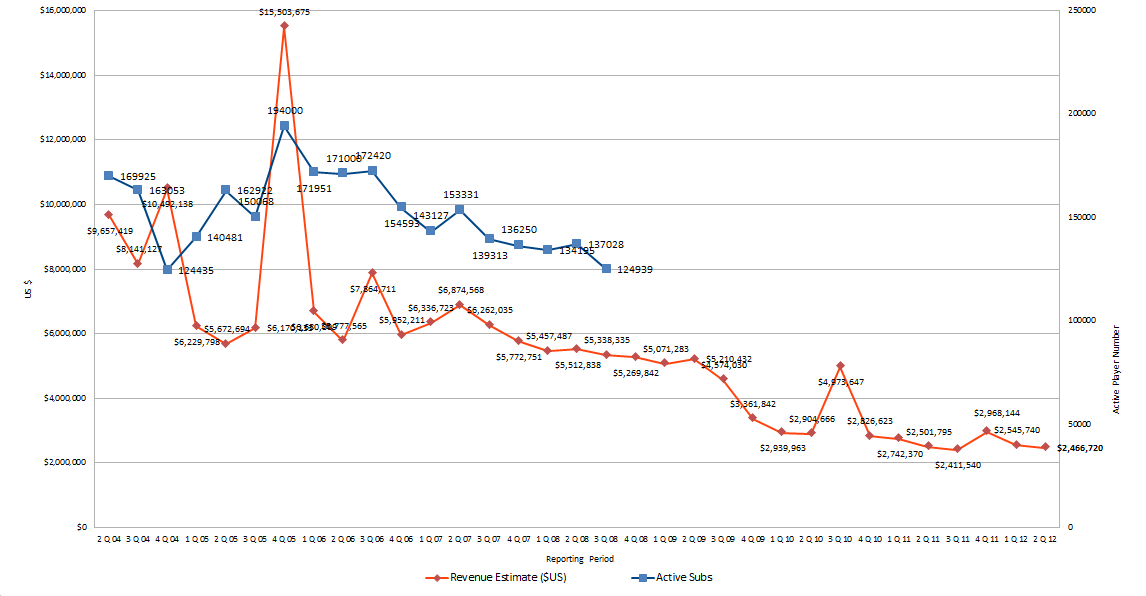
Note that while some Free2Play-haters automatically interpreted this as the death of the Free2Play model, I don't think any conclusion about this is valid. CoH only converted to Free2Play very late in its life, when few people were still interested at all in this game. And there are hundreds of different Free2Play models, some more profitable than others. I could imagine the item shop of Guild Wars 2 doing very well, for example (it already got my money for bag and bank slots).
I don't think of City of Heroes shutting down as a "failure". You shut down after a year, your game is a failure. You shut it down after over 8 years, that might be described as a natural death. The very early games might have profited from a bigger nostalgia factor keeping them alive (UO is celebrating its 15th birthday). But I would be surprised if half of the games released between 2010 and today would still be running in 2020.
- posted by Tobold @ 6:30 AM Permanent Link (5) comments
Monday, September 03, 2012
Guild Wars 2 PvP and monthly achievements
Very early on in Guild Wars 2 I discovered that if you'd just play normally, you'd easily be able to fulfill the requirements for the daily achievement: Kill at least 60 mobs of at least 15 different types, gather 20 times, and do 5 events. As the rewards are nice, I started wondering about the monthly achievements listed below it. It didn't make sense to start that one for August, but now that we are in September, I decided to try and go for it.
It turned out that two of the 4 requirements are "easy" for me: Participate in events, and salvage items for crafting. I do that anyway all the time. The other two requirements weren't all that natural for me: 50 kills in WvWvW, and gaining a lot of xp without dying. So I decided to find out how hard that would be, and started doing some WvWvW PvP. Please keep in mind that this is written from the point of view of somebody who isn't a big PvP fan.
Good news first: I got 50 PvP kills in an afternoon, no problem, once I had found out how WvWvW works. At first I was struggling, because I had chosen the wrong zone. WvWvW is not yet balanced, and my server is up against an overcrowded French server. By being far more, the French are overwhelming the two other sides, holding more than half of the objectives, and constantly overrunning us. I thought that under these circumstances the best place to fight would be in the borderlands zone of my server, home territory so to say. Bad guess, the French had two thirds of that zone, and my side couldn't get anything done. The trick to get my PvP kills was to change to the Eternal Battlegrounds zone, which apparently has caps in place to balance populations. There each server held about a third of the map, and control points were changing hands all the time. Spending some hours there netted me all the kills I needed for the month.
Personally I felt that the WvWvW zones were too big. As you don't see where the enemy players are, but can find the players of your side either on your local radar or via /map chat, players are automatically forming large zerg bands to attack. And because the map is so big, the zerg bands seldom meet each other. So while my side is taking a keep on the left, we are losing a keep on the right to the enemy zerg. And if two large groups ever meet, the fact that everybody who is killed respawns so far away in the home base means that the fight is over by the time you get back to it.
While you do get rewards for holding a keep, that rarely happens. Nobody wants to spend time waiting for the enemy to strike, so when the enemy *does* strike there are 20+ attackers against at max 5 defenders. Standing on the walls and trying to shoot down is surprisingly ineffective, you never get any kills like that, and there is very little advantage from shooting out as compared to shooting into a keep. After some time I realized that the best strategy when seeing an enemy zerg approaching the keep I was in was to teleport away. While they were battering the gate for 15 minutes, my side was taking another keep elsewhere. Only the larger fortresses are defensible. During the day, that is. I expect them to chance hands through guild events at 3 am.
In short, Guild Wars 2 hasn't solved the problems that every other MMORPG had with keep warfare. It all is a bit pointless, with battle raging back and forth around the same positions forever and ever. The numerically stronger side wins locally, but can't hold the whole map. When you come back days later, the map pretty much looks as it did when you last went. Other than for my monthly PvP kills, I don't think I'll do that very often.
And the monthly achievement might turn out to be impossible to fulfill due to the "xp without dying" part. I was watching that score, so I am 100% sure that the counter stopped progressing after I had lost connection and had to relog, although I hadn't died. And at least at my level the number of xp I need to gather without dying is huge, several levels worth. One wrong step in Rata Sum (where some parts of the floors have a glass floor you can walk on, and other similar looking parts of the floor just drop you to your death), and you can start that one all over again. One disconnect or having to log off, and the counter apparently resets to zero as well, so you need to do the achievement in a single session. That doesn't appear to be feasible.
It turned out that two of the 4 requirements are "easy" for me: Participate in events, and salvage items for crafting. I do that anyway all the time. The other two requirements weren't all that natural for me: 50 kills in WvWvW, and gaining a lot of xp without dying. So I decided to find out how hard that would be, and started doing some WvWvW PvP. Please keep in mind that this is written from the point of view of somebody who isn't a big PvP fan.
Good news first: I got 50 PvP kills in an afternoon, no problem, once I had found out how WvWvW works. At first I was struggling, because I had chosen the wrong zone. WvWvW is not yet balanced, and my server is up against an overcrowded French server. By being far more, the French are overwhelming the two other sides, holding more than half of the objectives, and constantly overrunning us. I thought that under these circumstances the best place to fight would be in the borderlands zone of my server, home territory so to say. Bad guess, the French had two thirds of that zone, and my side couldn't get anything done. The trick to get my PvP kills was to change to the Eternal Battlegrounds zone, which apparently has caps in place to balance populations. There each server held about a third of the map, and control points were changing hands all the time. Spending some hours there netted me all the kills I needed for the month.
Personally I felt that the WvWvW zones were too big. As you don't see where the enemy players are, but can find the players of your side either on your local radar or via /map chat, players are automatically forming large zerg bands to attack. And because the map is so big, the zerg bands seldom meet each other. So while my side is taking a keep on the left, we are losing a keep on the right to the enemy zerg. And if two large groups ever meet, the fact that everybody who is killed respawns so far away in the home base means that the fight is over by the time you get back to it.
While you do get rewards for holding a keep, that rarely happens. Nobody wants to spend time waiting for the enemy to strike, so when the enemy *does* strike there are 20+ attackers against at max 5 defenders. Standing on the walls and trying to shoot down is surprisingly ineffective, you never get any kills like that, and there is very little advantage from shooting out as compared to shooting into a keep. After some time I realized that the best strategy when seeing an enemy zerg approaching the keep I was in was to teleport away. While they were battering the gate for 15 minutes, my side was taking another keep elsewhere. Only the larger fortresses are defensible. During the day, that is. I expect them to chance hands through guild events at 3 am.
In short, Guild Wars 2 hasn't solved the problems that every other MMORPG had with keep warfare. It all is a bit pointless, with battle raging back and forth around the same positions forever and ever. The numerically stronger side wins locally, but can't hold the whole map. When you come back days later, the map pretty much looks as it did when you last went. Other than for my monthly PvP kills, I don't think I'll do that very often.
And the monthly achievement might turn out to be impossible to fulfill due to the "xp without dying" part. I was watching that score, so I am 100% sure that the counter stopped progressing after I had lost connection and had to relog, although I hadn't died. And at least at my level the number of xp I need to gather without dying is huge, several levels worth. One wrong step in Rata Sum (where some parts of the floors have a glass floor you can walk on, and other similar looking parts of the floor just drop you to your death), and you can start that one all over again. One disconnect or having to log off, and the counter apparently resets to zero as well, so you need to do the achievement in a single session. That doesn't appear to be feasible.
- posted by Tobold @ 12:05 PM Permanent Link (12) comments

